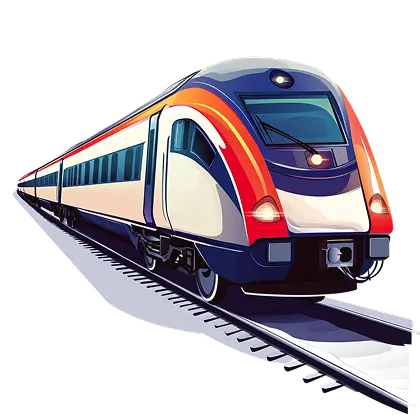
Train (noun) — a track-based transport vehicle used to travel through cities, regions, or countries either with cargo or passengers.
Trains have just the right combination of comfort and speed and are also economical, hence a perfect option when it comes to traveling long distances without involving the drama of traffic.
How to Pronounce “Train”?
 Audio (UK):

 Audio (US):
It’s one syllable, starting with “tr” like in “tree” and rhyming with “rain” — fitting, since trains don’t mind the weather.
Level up your English with Koto!
Examples: How to Use “Train” in a Sentence?
“Train” is a familiar word, often tied to travel, commuting, or even missed connections. From daily rides to cross-country adventures, here’s how it shows up in real life:
What Are Synonyms for the Word “Train”?
Want to level up your language game? Learning a few alternatives to the “train” word adds variety and keeps things interesting when you talk or write.
Related nouns: transport railway
Synonyms (contextual): locomotive
Common collocations: by train train station catch a train train schedule
“Train” Word Formation and Description in Context
Simple but powerful, this word fits like a glove in many phrases. Let’s break down its use across parts of speech:
With adjectives: fast train local train historic train
With verbs: catch a train miss a train board a train
With nouns (noun + noun): train station train ticket freight train
Idioms and Phrases with “Train”
Can a word like “train” carry expressions packed with meaning? Absolutely. Define “train” and it’s more than transport — it’s motion, direction, momentum. Here are some common sayings English speakers use, often linked to travel or life’s journey.
-
Jump on the train — means to get involved in something that’s gaining popularity, like a trend, idea, or movement.
Everyone’s talking about the new app — don’t miss out, jump on thetrain while it’s still hot. -
Train of thought — refers to the flow of ideas or reasoning in someone’s mind.
Sorry, I lost mytrain of thought when the phone rang. -
Bring (something) in its train — used in a more literary or serious tone, it means that something leads to a series of effects or results, just as a train pulls everything connected behind it.
The economic crisis brought inflation and unemployment in itstrain , affecting millions across the country. -
That train has left the station — this idiom means it’s too late to change something or go back; the opportunity is gone, and things are already in motion.
You had months to submit the application, now the deadline’s passed, and thattrain has left the station.
Test Your Knowledge of Train Meaning – Quiz Time!
Time to find out how well you know the word “train” and how it works in everyday language. Ready to stay on track?
Enjoy personalized learning!
“Train” Word in Other Languages
Ready to go global? How do you spell train, not in English? Here’s how this word sounds in some of the most widely spoken languages.
| Language | Word for “Train” |
|---|---|
 Spanish
 |
Tren |
 French
 |
Train |
 German
 |
Zug |
Did You Know It? Interesting Facts About Trains
Trains have a history of hundreds of years behind them, veering through history time and they have come along collecting some really interesting stories with it. It is boarding time on the fun fact express!
-
Steam trains still run — for fun.
Steam trains might be old, but they’re still chugging along in style, offering scenic rides that feel like a trip back in time. -
The trains in Japan are renowned for being punctual.
The average time taken to delay is in seconds, not minutes. In case a train is delayed, you could even receive a written apology. -
The Shanghai Maglev is the fastest standard passenger train.
It runs at the pace of 460 km/h, and it feels like what you are doing in your regular commute to work and back is something your pet turtle would do on a treadmill. -
Certain super-luxury trains are the equivalent of hotels on wheels.
Consider fine dining, individual suites and cars with glass tops. One of the most famous ones is the Venice Simplon-Orient-Express. -
Trains are among the greenest ways to travel.
Compared to planes or cars, modern electric trains produce significantly fewer emissions per passenger, especially when powered by renewable energy.
Famous Quotes Featuring “Train”
Remember the magic of Platform 9¾ or the quiet tension of Brief Encounter’s train station? No spoilers—just cinematic proof that trains carry more than passengers:
— Agatha Christie
Explanation: A train journey lets you slow down and really see the world, not in snapshots, but as a moving picture of real life.
— Haruki Murakami
Explanation: This quote speaks to moments in life that can’t be undone. The “train” is a symbol of chances or chapters that have passed; once gone, you can’t rewind to who or where you were before.
— Elisha Cooper
Explanation: It captures the idea that a train is a compact world on wheels, offering a front-row seat to the bigger world rolling by.