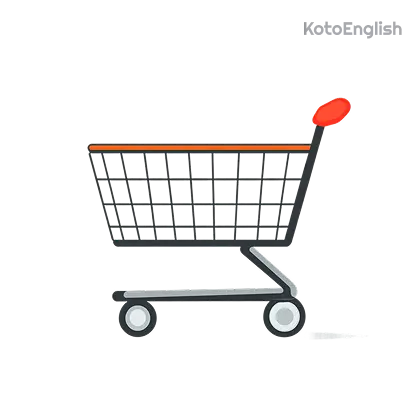
Shopping cart (noun) – is a tool used for adding items before buying them. It’s a wheeled vehicle in offline shops and a cart where you can review your added items on the websites.
How to Pronounce “Shopping Cart”?
 Audio (UK):

 Audio (US):
There are two words. The first word, shopping, sounds like “shop” plus “-ing,” with a stress on the first syllable. The second word, cart, sounds like “car” with a clear t at the end.
Level up your English with Koto!
Examples: How to Use “Shopping Cart” in a Sentence?
But simple meaning and pronunciation knowledge might not be enough for confident use. Let’s define “shopping cart” in context so you can sound like a real pro.
What Are Synonyms for the Word “Shopping Cart”?
For those who want to be fluent, knowing other ways to say the same word is a must. That’s why we have collected the “shopping cart” synonyms you can use.
Related nouns: online cart carriage grocery cart
Synonyms (contextual): trolley basket buggy
Common collocations: to fill a shopping cart an empty shopping cart to check out from the shopping cart
“Shopping Cart” Word Formation and Description in Context
Knowing how the “shopping cart” goes with other parts of speech will help you to sound and write more fluently. Let’s have a look at some of the examples:
With adjectives: a metal shopping cart a large shopping cart a full shopping cart
With verbs: to use a shopping cart to empty a shopping cart to push a shopping cart
With nouns (noun + noun): a shopping cart icon a shopping cart wheel a shopping cart handle
Idioms and Phrases with “Shopping Cart”
After we’ve already covered the shopping cart description, it’s a perfect moment to move on to the everyday phrases built around it.
-
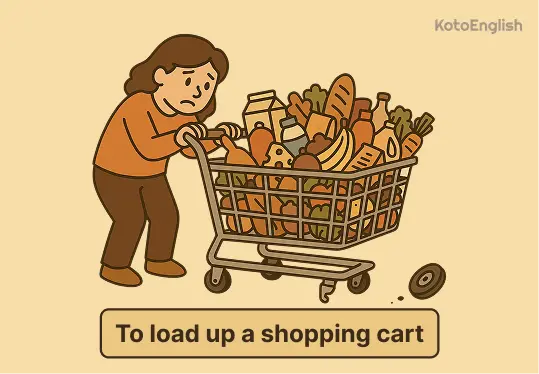
To load up a shopping cart – to fill it with many items.
Joanna loaded up ashopping cart so much that one of the wheels gave out.

-
To put something in a shopping cart – to add an item to it.
I put the last coat in theshopping cart and rushed to checkout.
Let’s See How You’ve Memorized a “Shopping Cart” Meaning – It’s a Quiz Time!
We guess you are ready to check how well you have learned this new word. Complete the following tasks and show who’s the true expert here.
Enjoy personalized learning!
“Shopping Cart” Word in Other Languages
What about learning how to say “shopping cart” in the other top-3 most used languages in Europe? We think it’s never too much. Take a look at our table to excel not only in English.
| Language | Word for “Shopping Cart” |
|---|---|
 Spanish
 |
Carrito de compras |
 French
 |
Panier |
 German
 |
Einkaufswagen |
Fun Facts You Didn’t Know About “Shopping Cart”
Here are the handpicked facts about the shopping cart to make your studying process not only informative but entertaining as well.
-
In 1937, the first shopping cart changed shopping.
Sylvan N. Goldman invented the first shopping cart in 1937, according to Shopify. He modeled it after a folding chair with the addition of baskets and wheels to assist customers in carrying loads. -
Nesting carts that save space.
In 1946, Orla E. Watson invented the so-called nesting shopping cart (one that could be fitted into another and stored easily) that made the stores save space and organize the carts more efficiently. -
How Caroline Cart created a cart for everyone.
A single model of the shopping cart, known as Caroline Cart, is purposefully designed to accommodate non-ambulatory adults or larger children and includes a harnessed seat with extended handles. -
The shopping cart went digital in 1995.
The shopping cart icon was developed by the Real Cart’s CEO Mark Mumma in the mid-90s, and started its way in Internet shopping. Now, you can find it when ordering things on most online stores to see the collected items and check out.
Famous Quotes Featuring “Shopping Cart”
The “shopping cart” meaning is clear to you now, so let’s improve your vocabulary with some famous quotes featuring this phrase.
– Richie Aprile, “The Sopranos”
This phase depicts someone who can carry things and do the “grunt” work, but is pretty useless at the core and unable to control at least something.
– Faith Hill, “Love Is a Sweet Thing”
This part depicts a simple man who tries to feel joy even during his difficult times. The main idea is to encourage listeners to find happiness in the little things, regardless of any circumstances.
– Jarod Kintz
This line shows the use of a shopping cart as a protective cage for those who often can’t stop excessive buying but want to avoid spending too much.