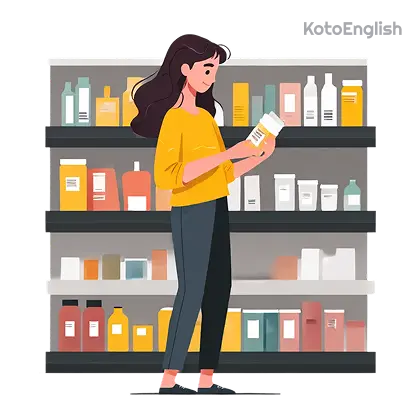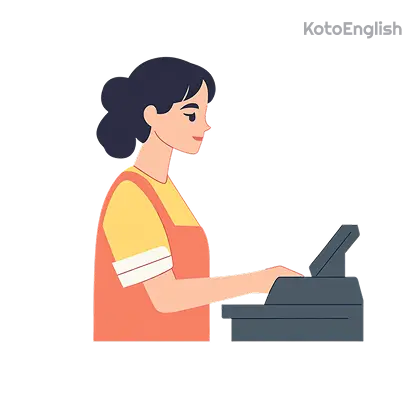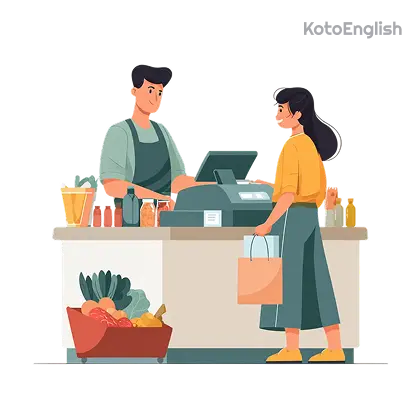
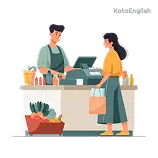
Checkout (noun) — a spot in a store or supermarket where you get to pay for the items before walking out. It may also refer to the act of making online or in-store payments for goods.
How to Pronounce “Checkout”?
 Audio (UK):

 Audio (US):
divide it into two distinct categories, namely check and out. The initial one is similar to the word check, and out is similar to shout.
Level up your English with Koto!
Examples: How to Use “Checkout” in a Sentence?
You will encounter the term “checkout” in most shopping events. The following are some instances of how it is used.
What Are Synonyms for the Word “Checkout”?
“Checkout” can be repeated multiple times, but it can be boring when overused. These are some words and associated terms to make your language fresh.
Related nouns: counter register till
Synonyms (contextual): payment point cash desk
Common collocations: online checkout go to the checkout checkout line fast checkout
“Checkout” Word Formation and Description in Context
“Checkout” is also easy to use in combination with adjectives and verbs to describe your actions regarding shopping more accurately.
With adjectives: online checkout closed checkout busy checkout
With verbs: go through checkout wait at checkout open a checkout
With nouns (noun + noun): checkout counter checkout line checkout area
Idioms and Phrases with “Checkout”
You may define “checkout” as the moment you pay for your items, though in the shopping world, it has several related meanings.
-
Checkout line can be used to refer to an occurrence of waiting to be attended to or waiting to be served.
The project is moving slowly, and we’re all stuck in a kind ofcheckout line . -
Express checkout is a lane or option for customers with a few items.
Use theexpress checkout if you have fewer than ten products. -
One-click checkout is used in e-commerce to describe instant payment with saved details.
The store’s newone-click checkout saves so much time. -
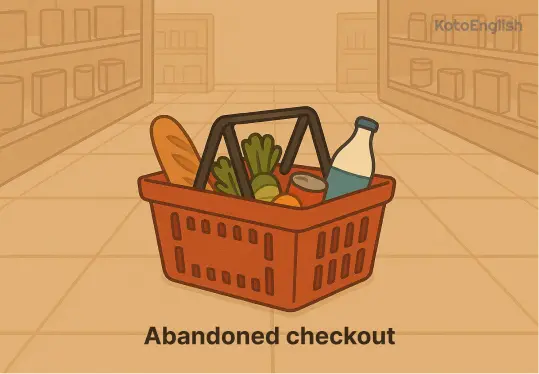
Abandoned checkout / abandoned cart is the situation when the user puts something into a cart but does not pay.
Many online stores send reminders forabandoned checkouts .

Test Your Knowledge of Checkout’s Meaning — Quiz Time!
We will find out how well you recall the definition of “checkout” and its general uses in shopping. Ready?
Enjoy personalized learning!
“Checkout” Word in Other Languages
You already know how to spell “checkout” in English, but here are three common equivalents in other languages to expand your shopping vocabulary.
| Language | Word for “Checkout” |
|---|---|
 Spanish
 |
Caja / Pago |
 French
 |
Caisse / Paiement |
 German
 |
Kasse / Bezahlvorgang |
Did You Know It? Curious Facts About “Checkout”
You may define “checkout” as the moment you pay for your items, though in the shopping world, it has several related meanings.
-
Checkout line can be used to refer to an occurrence of waiting to be attended to or waiting to be served.
The project is moving slowly, and we’re all stuck in a kind of checkout line. -
Express checkout is a lane or option for customers with a few items.
Use the express checkout if you have fewer than ten products. -
One-click checkout is used in e-commerce to describe instant payment with saved details.
The store’s new one-click checkout saves so much time. -
Abandoned checkout / abandoned cart is the situation when the user puts something into a cart but does not pay.
Many online stores send reminders for abandoned checkouts.
Famous Quotes Featuring “Checkout”
It’s one thing to describe a checkout, and another to see it in action. Here are some creative ways people have used it in quotes.
— Richard Turner
The absurdity of self-checkout is delightfully highlighted by Richard Turner’s quote: customers wind up performing the cashier’s duties themselves. It draws attention to how, in the name of convenience, technology transferred some of the store’s effort onto customers.
— Mignon McLaughlin
Mignon McLaughlin humorously reflects on the quiet envy that sparks in the checkout line, where someone else’s cart suddenly seems more delicious than your own.
— Robert Kiyosaki
The quote illustrates how the real estate boom became so mainstream that people from all walks of life tried to profit from it. Kiyosaki uses irony to show how quickly enthusiasm can outpace knowledge.