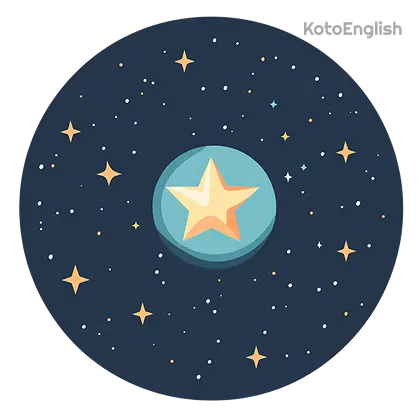
Star (noun) — a bright, burning ball of gas in space that gives off light and heat. Stars look small from Earth because they are very far away, but each one is huge. At night, stars appear as tiny shining points in the sky.
How to Pronounce “Star”?
 Audio (UK):

 Audio (US):
Say st like in “stop,” then add ar as in “car.”
Level up your English with Koto!
Examples: How to Use “Star” in a Sentence
Learn from these real-life examples showing the definition of “star” in contexts where this word appears in everyday English.
What Are Synonyms for the Word “Star”?
While “star” is unique, learning related astronomical terms will help you discuss the night sky more precisely.
Related nouns: sun constellation space
Synonyms (contextual): none it is a specific noun
Common collocations: bright star distant star big star
“Star” Word Formation and Description in Context
Build your vocabulary by mastering a “star” in English and its combinations with other words that native speakers regularly use.
With adjectives: twinkling star giant star fading star beautiful star
With verbs: see stars observe stars study stars count stars
With nouns (noun + noun): star system star light star formation star cluster
Idioms and Phrases with “Star”
Look at what “star” means and learn these nature-inspired expressions that connect “stars” to human experiences, dreams, and observations of the natural world.
-
Reach for the stars — to set ambitious goals; to aim for something challenging to achieve.
My parents always told me toreach for the stars and never give up on my dreams. -
Thank your lucky stars — to be very grateful for good fortune; to feel lucky about something.
You shouldthank your lucky stars you found your wallet, since most people never get them back. -
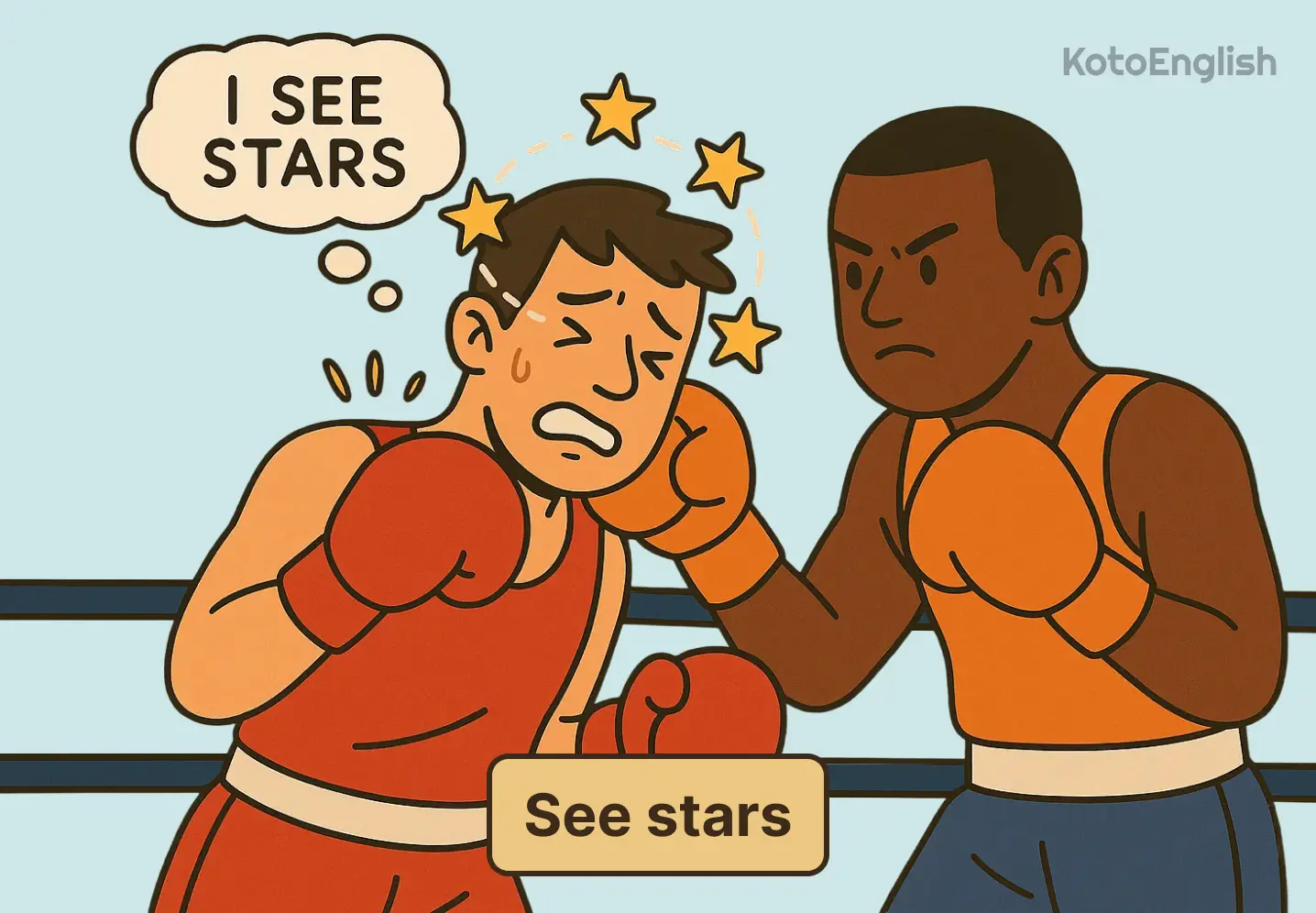
See stars — to see flashes of light, usually after being hit on the head or feeling dizzy.
I hit my head so hard on the cabinet that Isaw stars for a minute.
-
Written in the stars — destined to happen; meant to be; predetermined by fate.
I believe our friendship waswritten in the stars — we were meant to meet. -
Under the stars — outdoors at night; sleeping or spending time outside beneath the night sky.
We went camping and sleptunder the stars with no tent.
Test Your Knowledge of “Star” Meaning
Challenge yourself with these questions to see how well you understand this topic, define “star,” and check how well you remembered idioms.
Enjoy personalized learning!
“Star” Word in Other Languages
Explore how people across the world name these brilliant points of light that have fascinated humanity for thousands of years.
| Language | Word for “Star” |
|---|---|
 Spanish
 |
Estrella |
 French
 |
Étoile |
 German
 |
Stern |
Did You Know It? Fun Facts About “Star”
Prepare to be amazed by these mind-blowing details about “stars” that reveal just how extraordinary our universe really is.
-
Stars are not really twinkling.
The light from the star goes through the layers of air which are in motion and have different temperatures and densities. It gets refracted and moved and that makes it look like the star is twinkling. In space, astronauts view stars continuously and brightly. -
Stardust is what we are made of.
Every single atom of your body, except hydrogen, was once made in stars and scattered across the universe during the supernova explosion. The iron in your blood, the calcium in your bones, and the oxygen you breathe all were produced in the cores of ancient stars billions of years ago. -
Stars vary in color because of temperature.
Blue and white stars are the hottest (over 10,000°C), yellow stars like the Sun are of medium temperature (about 5,500°C), and red stars are the coolest (under 3,500°C). The color of the star gives astronomers very useful clues about its age and chemical composition. -
Stars were the ancient mariner’s GPS devices.
For more than a thousand years, sailors and other people depended on the stars to find their way across oceans and deserts. The North Star (Polaris) has been of utmost importance because it almost never moves, helping people even calculate their coordinates on Earth.
Famous Quotes About “Star”
Discover how famous thinkers and poets have used stars to express wonder about nature and our place in the cosmos.
— Oscar Wilde
At the time of difficulty, Oscar Wilde, the Irish writer, suggests that many people look up to the barest beauty of nature — the stars, for hope or inspiration or both. This view guides us to see the beauty and greatness of nature as opposed to petty problems.
Explanation: The ex-president of the United States suggests that people should pair ambitious dreams with practical actions. Even if it is the universe that inspires you to have big goals, you should always keep in touch with reality and treat it as a step-by-step process.
— Og Mandino
Explanation: He points out to us that only in darkness can we see the stars. This quotation underscores that challenging times are those that will make us feel the beauty of nature and reveal the wonders we would never perceive during the smooth and brighter moments.