

Sky (noun) — the space above the earth that you can see when you look up, appearing blue during the day and dark at night. It is where the sun, moon, stars and clouds are visible and it can change color depending on the weather and time of day.
How to Pronounce “Sky”?
 Audio (UK):

 Audio (US):
Say sk as in “skate,” then add “eye” — it rhymes with “fly,” “high,” and “my.” Very straightforward!
Level up your English with Koto!
Examples: How to Use “Sky” in a Sentence?
Define “sky” by looking at how native speakers typically use this word daily. Read and listen to every sentence carefully and try to come up with something own.
What Are Synonyms for the Word “Sky”?
“Sky” is simple, but knowing related terms will help you describe different conditions and beautiful views more accurately.
Related nouns: atmosphere air space
Synonyms (contextual): none, it is a specific noun
Common collocations: blue sky cloudy sky night sky
“Sky” Word Formation and Description in Context
These word combinations will answer your question of how to say “sky” to talk about weather and nature in your conversations.
With adjectives: clear sky dark sky overcast sky starry sky
With verbs: look at the sky scan the sky photo a sky point at the sky
With nouns (noun + noun): sky color sky view sky diving sky blue
Idioms and Phrases with “Sky”
These expressions will add depth and color to your English, helping you express ideas about limits, moods and possibilities using the idiomatic “sky” meaning.
-
The sky’s the limit — there are no limits to what you can achieve; anything is possible.
With your talent and hard work,the sky’s the limit for your career. -
Out of a clear blue sky — something that happens suddenly and unexpectedly, without warning.
Out of a clear blue sky , my best friend announced she was moving to another country. -
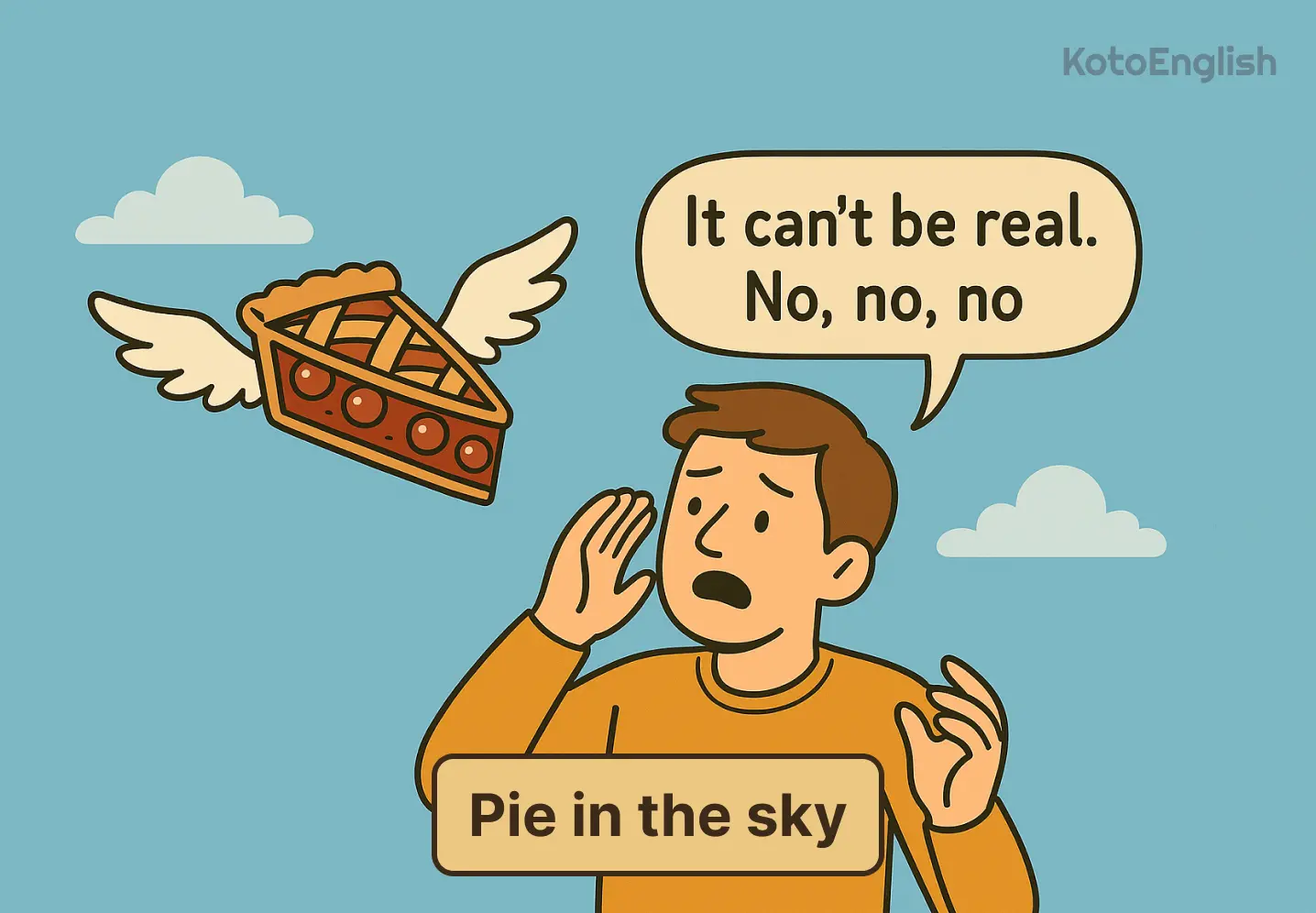
Pie in the sky — something pleasant to think about but very unlikely to happen; an unrealistic plan or idea.
His plan to become a millionaire in one year is justpie in the sky .
-
Reach for the sky — to aim very high; to be ambitious (also used as a command to raise your hands up).
Don’t be afraid toreach for the sky , you’re capable of amazing things. -
The sky is falling — to panic unnecessarily about something; to believe disaster is coming when it’s not.
Don’t act likethe sky is falling just because you got one bad grade.
Test Your Knowledge of “Sky” Meaning: Quiz Time!
See how much you’ve learned about the “sky” and check whether you can use these expressions and the word itself correctly in context.
Enjoy personalized learning!
“Sky” Word in Other Languages
See how to spell “sky” in different languages such as Spanish, French and German.
| Language | Word for “Sky” |
|---|---|
 Spanish
 |
Cielo |
 French
 |
Ciel |
 German
 |
Himmel |
Discover Fun Facts About “Sky”
The “sky” above us holds more mysteries and surprises than you might think — here are some details that will change how you look up.
-
The sky is not blue in the true sense.
The blue sky effect is the result of Rayleigh scattering, a physical phenomenon. Gas molecules in the Earth’s atmosphere scatter sunlight and spread blue light, which has a shorter wavelength than other colors. -
You might be able to see farther than you think.
The Andromeda galaxy, located about 2.5 million light-years away, is the farthest object visible to the naked eye on a clear night. When you see it, you are looking at light that began its journey millions of years ago. -
The sky of the past was different.
Around 4 billion years ago, Earth’s sky was not blue. Due to lower oxygen levels and a different atmospheric composition, the sky may have appeared orange or even pinkish. -
The sky changes color depending on your position.
At sunrise and sunset, the sky often appears red or orange because sunlight travels through more atmosphere. This causes shorter blue wavelengths to scatter away, leaving warmer colors visible.
Quotes Featuring the Word “Sky”
Famous writers and thinkers have used phrases with “sky” as inspiration for profound ideas about freedom, dreams and the human spirit.
— Ralph Waldo Emerson
Explanation: Emerson, the American philosopher, proposes that looking at the sky is a way to greatly energize our spirit, just as bread nourishes our body. The sky provides essential beauty and wonder that feeds our souls and connects us to something larger than ourselves.
Explanation: The people who can enjoy the small wonders of nature daily are actually living life to the fullest and are also keeping their ties to life.
— Pamela Hansford Johnson
Explanation: This citation illustrates the point that the sky can be the origin of such heavenly, poetic and creative descriptions of natural daily transformations.