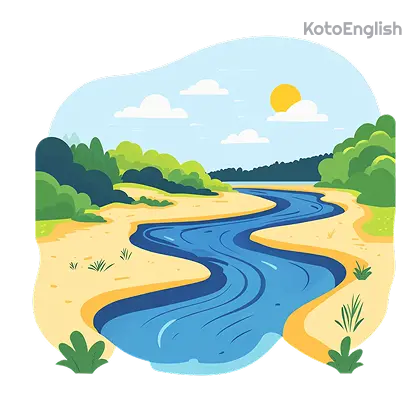
River (noun) — a large natural stream of water that flows across land and usually ends in a sea or lake. Rivers can be wide or narrow, fast or slow, and they provide water for people, animals, and plants.
How to Pronounce “River”?
 Audio (UK):

 Audio (US):
Say ri as in “rich,” then ver like the ending of “river” itself (/vər).
Level up your English with Koto!
Examples: How to Use “River” in a Sentence
Here you can observe how “river” naturally gets included in some places in everyday English. Through these examples, you will understand the syntax of its use.
What Are Synonyms for the Word “River”?
“River” is one type of water body, and adding related words allows you to speak about landscapes more effectively.
Related nouns: stream creek water lake
Synonyms (contextual): brook stream watercourse
Common collocations: fast river long river small river
“River” Word Formation and Description in Context
Build your vocabulary by learning how “river” combines with other words commonly used by native speakers.
With adjectives: wide river deep river calm river flowing river
With verbs: cross a river swim in a river follow a river fish in a river
With nouns (noun + noun): river bank river water river mouth river delta
Idioms and Phrases with “River”
Investigate what “river” signifies in idioms and notice how water that flows is used to characterize life, movement, and feelings.
-
Cross that river when you come to it — tackle an issue only at its occurrence, and do not fret beforehand.
Do not be anxious about the presentation right now; we willcross that river when we come to it . -
Up the river — in trouble or in a difficult situation.
He forgot to hand in the report on time, and now he isup the river with the boss. -
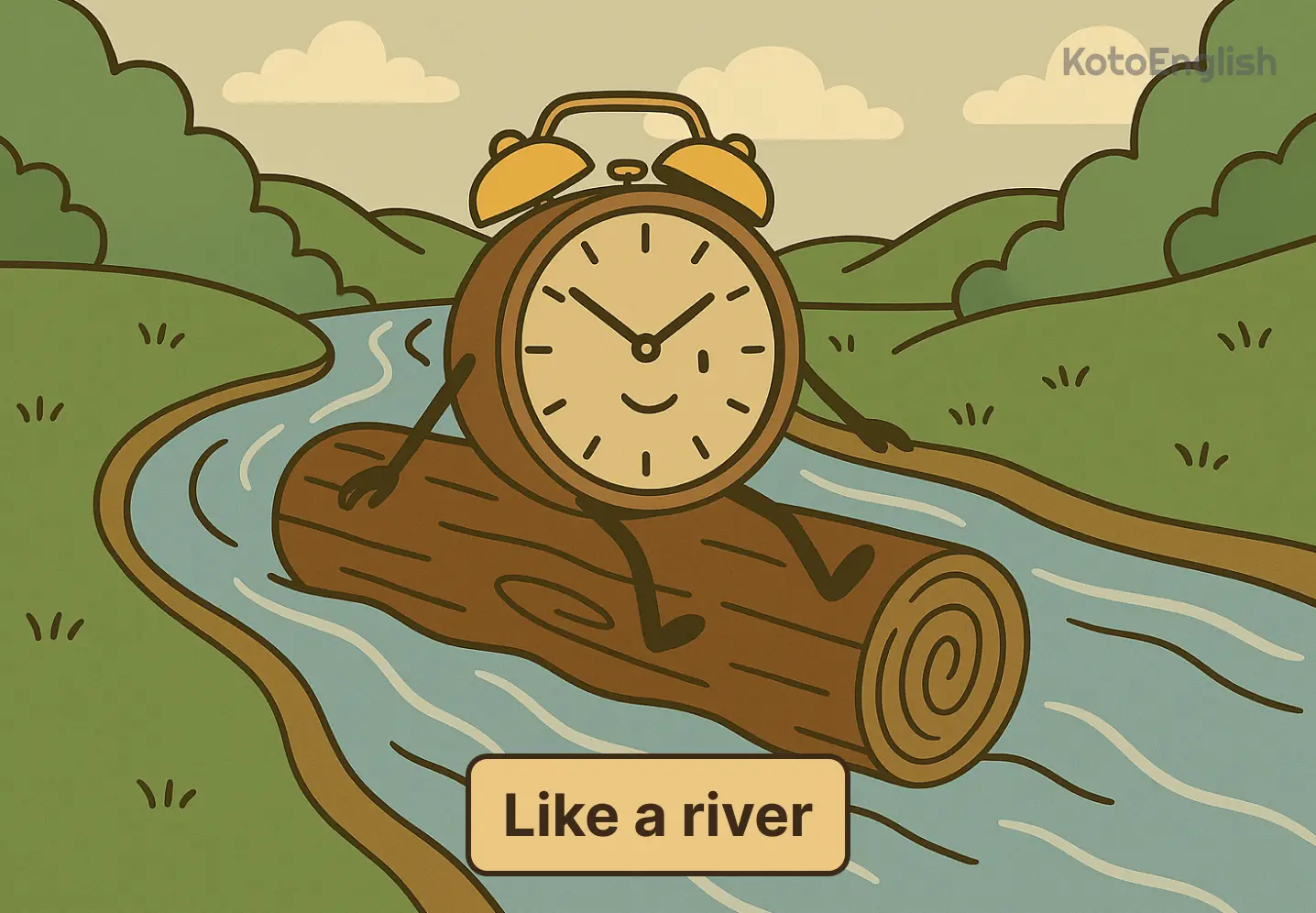
Like a river — always flowing or very gradually running, often used in connection with time, feelings, or happenings.
Time flowslike a river , and we must make the most of it.
-
River of tears — meaning shedding a great deal of tears.
She was so sad after the movie that it felt as if ariver of tears had been shed.
Test Your Knowledge of “River” Meaning
Challenge yourself with these questions to see how well you understand “river” and its common phrases.
Enjoy personalized learning!
“River” Word in Other Languages
Learn how people from European countries refer to rivers, an essential part of nature and daily life.
| Language | Word for “River” |
|---|---|
 Spanish
 |
Río |
 French
 |
Rivière |
 German
 |
Fluss |
Did You Know It? Interesting Facts About “River”
Rivers are indeed some of the most wonderful natural features on Earth. They are fascinating in nature and hide a whole world of traits waiting to be uncovered.
-
Some rivers can flow underground.
The so-called Lost River in Idaho disappears into caves and flows beneath the ground before resurfacing. This underground flow occurs through porous rock or limestone formations, creating hidden channels. -
Rivers change the shape of the Earth over millions of years.
Through erosion and sediment transport, rivers carve valleys, canyons, and deltas. The Grand Canyon is one of the most spectacular landforms created by this slow yet continuous process. -
The Amazon River is the largest in terms of water volume.
The Amazon releases more than 209,000 cubic meters of water per second into the Atlantic Ocean. This enormous discharge affects local ecosystems, rainfall patterns, and even the salinity of nearby coastal waters. -
There is an ongoing discussion about the world’s longest river.
Traditionally, the Nile has been considered the longest river in the world. However, some measurements suggest the Amazon may be longer when its tributaries are included. Seasonal changes and differing measurement methods keep this debate open.
Famous Quotes About “River”
Discover how famous thinkers and writers have used rivers to convey ideas about life, change, and the flow of experiences.
— Heraclitus
Explanation: The river is a symbol of unending change according to the ancient Greek philosopher. Life has an everlasting flow like the river and thus the world and even the people are never alike from one instant to the next.
— A.A. Milne
Explanation: Milne, the creator of Winnie-the-Pooh, makes it clear that patience is a vital trait. As a river that flows slowly but surely to its end, life eventually brings us all the way and hurrying mostly leads to nothing.
— Timi Nadela
Explanation: The saying gives an analogy of a river’s current and the flow of time. It points out that the moments are transitory and their reliving is impossible, hence, it is wise to consider the now and to let go with elegance.