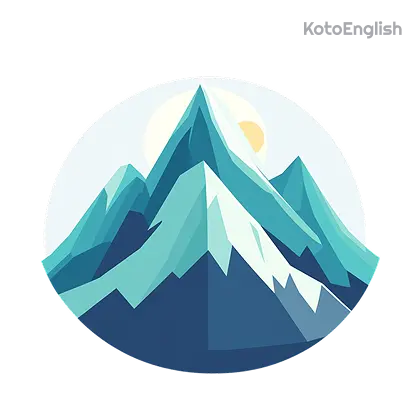
Mountain (noun) — a very high area of land that rises far above the ground around it, often with steep sides and a pointed or rounded top. Mountains are formed by natural forces and can be covered with forests, rocks, or snow.
How to Pronounce “Mountain”?
 Audio (UK):

 Audio (US):
Say MOWN-tin; the t is often soft or silent in casual speech.
Level up your English with Koto!
Examples: How to Use “Mountain” in a Sentence?
To define “mountain,” discover how native speakers incorporate it into their descriptions of nature, travel experiences and geographical features.
What Are Synonyms for the Word “Mountain”?
Understanding how to say “mountain” using alternative terms will help you describe different types of elevated landforms and geographical features more precisely.
Related nouns: hill peak summit range
Synonyms (contextual): mount
Common collocations: mountain range mountain top snow-capped mountain
“Mountain” Word Formation and Description in Context
Learn how to combine “mountain” with different descriptive words to create vivid images of these beautiful natural formations.
With adjectives: high mountain steep mountain rocky mountain towering mountain
With verbs: climb a mountain hike up a mountain see mountains cross mountains
With nouns (noun + noun): mountain air mountain pass mountain slope mountain stream
Idioms and Phrases with “Mountain”
These expressions use “mountain” meaning to convey powerful ideas about challenges, perspective and making big impacts in life.
-
Make a mountain out of a molehill — to treat a small problem as if it were a very big problem.
You’remaking a mountain out of a molehill . It’s just a tiny scratch on your phone. -
Move mountains — to do something extremely difficult or achieve the seemingly impossible.
With determination and teamwork, we canmove mountains and finish this project on time. -
A mountain to climb — a very difficult task or challenge that requires significant effort.
Learning a new language is amountain to climb , but it’s definitely worth the effort. -
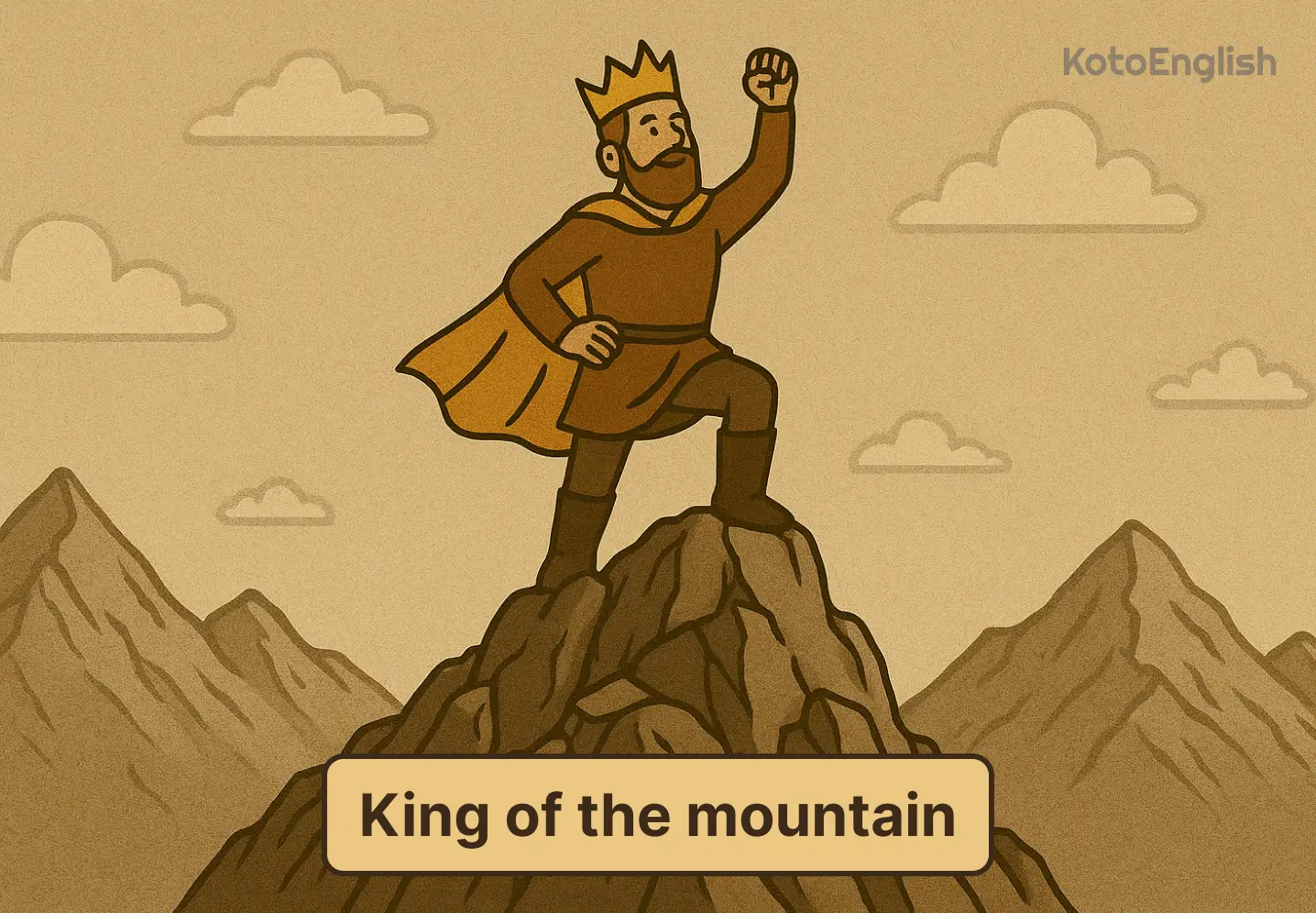
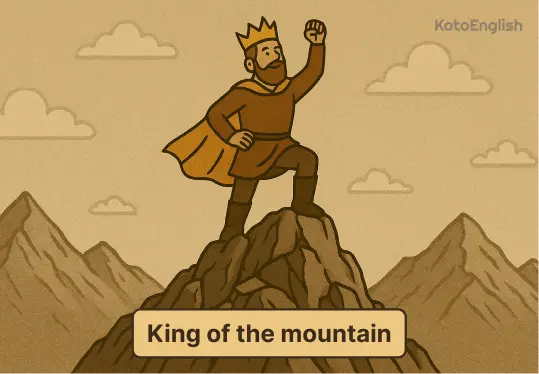
King of the mountain — the most powerful or successful person in a group or field.
After winning the championship three times, he’s nowking of the mountain in professional tennis.
-
Go over the mountain — to go to the other side or start fresh somewhere new.
Some pioneers decided togo over the mountain to find better farmland in the west.
Test Your Knowledge of “Mountain” Meaning: Quiz Time!
Measure your comprehension of “mountains” and the usage of this word with these carefully designed practice questions.
Enjoy personalized learning!
“Mountain” Word in Other Languages
Broaden your geographical vocabulary by learning how to spell “mountain” in Spanish, French and German.
| Language | Word for “Mountain” |
|---|---|
 Spanish
 |
Montaña |
 French
 |
Montagne |
 German
 |
Berg |
Discover Fun Facts About “Mountain”
“Mountains” are one of the most striking landscapes on the planet, and these fascinating facts reveal their hidden secrets and extreme characteristics.
-
Mount Everest grows taller every year.
Mount Everest continues to grow by about 4 millimeters each year due to tectonic activity. The Indian and Eurasian plates are still colliding, causing the Himalayas to rise. In one million years, Everest could be hundreds of meters taller than it is today. -
Mountains create their own weather.
Mountains strongly influence local weather patterns by forcing air to rise, cool and release moisture. As a result, one side of a mountain can be lush and rainy, while the other side may have a dry, desert-like climate. -
Most of Earth’s fresh water comes from mountains.
More than half of the world’s fresh water originates in mountainous regions and flows into rivers that billions of people depend on for drinking, agriculture and energy. Snowfields and glaciers act as natural reservoirs, slowly releasing water over time. -
The longest mountain range is underwater.
Although the Himalayas are impressive, they are not the longest mountain range on Earth. That title belongs to the mid-ocean ridge system, which stretches over 65,000 kilometers beneath the ocean’s surface.
Quotes Featuring the Word “Mountain”
See how philosophers, adventurers and thinkers have used phrases with “mountain” as metaphors for life’s greatest lessons and challenges.
Explanation: The very first individual to reach the peak of Mount Everest teaches us that the essence of mountain climbing is to confront and vanquish our own demons, such as fears, doubts and limitations.
— John Ruskin
Explanation: English art critic Ruskin sees mountains as the greatest among the natural elements always present in the picture of a landscape. He affirms that not only rivers that flow from them but also valleys that lie between owe their beauty to the mountains.
— Barry Finlay
Explanation: Mountain climbing metaphorically stands for endurance and victory. No matter how impossible the goal appears at the base, gradual striving and resolution are sure to take you to the top, step by step, sooner or later.