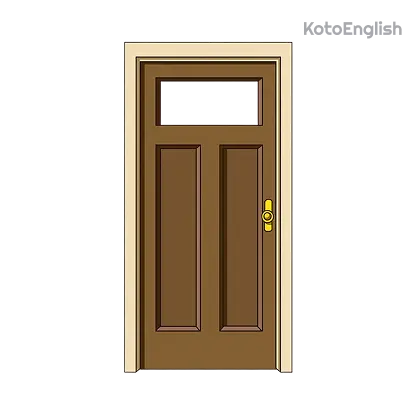
Door (noun) — a movable barrier, typically made of wood, metal or glass, that opens and closes to allow entry or exit from a building, room or vehicle, often with a handle or knob for operation.
How to Pronounce “Door”?
 Audio (UK):

 Audio (US):
Say it like dor — one long sound, with rounded lips, no clear oo or extra vowel. It rhymes with “more,” “floor” and “store.”
Level up your English with Koto!
How to Use “Door” in a Sentence?
Discover how this everyday word is used in different contexts to highlight certain details or provide specific information.
What Are Synonyms for the Word “Door”?
Learn more about the “door” synonyms to expand your vocabulary and talk about this item using different terms.
Related nouns: entrance doorway gate exit
Synonyms (contextual): entry access point
Common collocations: front door back door sliding door
“Door” Word Formation and Description in Context
You know how to spell “door” and what synonymous expressions are connected to it. Now take a look at how to combine “door” with other parts of speech to create simple and meaningful collocations.
With adjectives: locked door open door heavy door wooden door
With verbs: open a door close a door knock on the door lock the door
With nouns (noun + noun): door handle door frame doorbell door lock
Idioms and Interesting Phrases with “Door”
This term is quite straightforward in terms of meaning, but we can find it in a broad selection of English phrases and idioms. Take a look at them and remember their explanation to use these sayings in appropriate situations.
-
Close the door on something — to end an opportunity permanently; to make something impossible.
By dropping out of school, heclosed the door on a college education. -
Open doors — the meaning here is to create opportunities and make new possibilities available.
Learning English willopen doors to international career opportunities. -
Show someone the door — this phrase refers to asking someone to leave or to fire someone.
After his rude behavior, the managershowed him the door . -
When one door closes, another opens — this saying means to stay hopeful after setbacks.
I didn’t get that job, butwhen one door closes, another opens — I will find something better! -
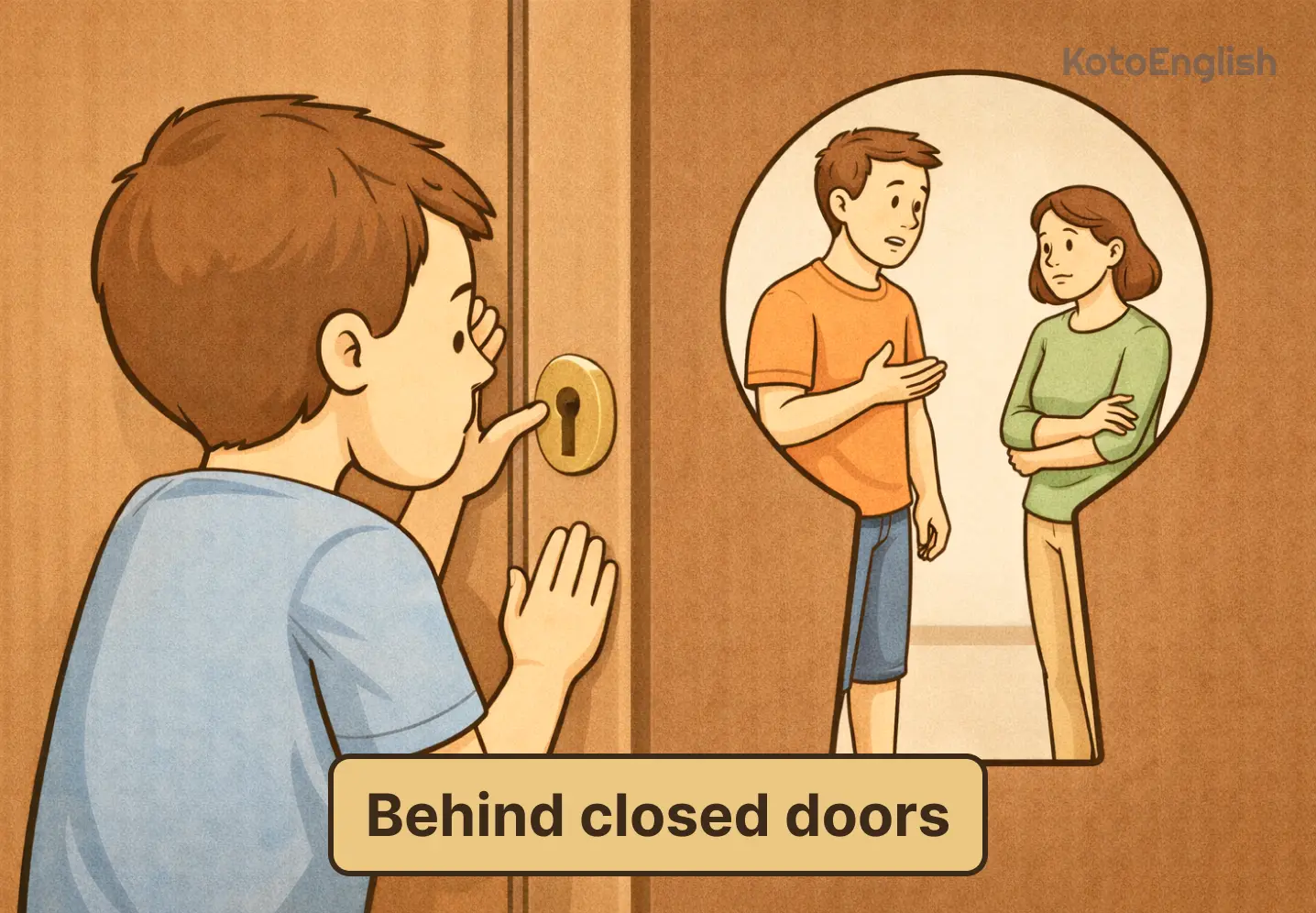
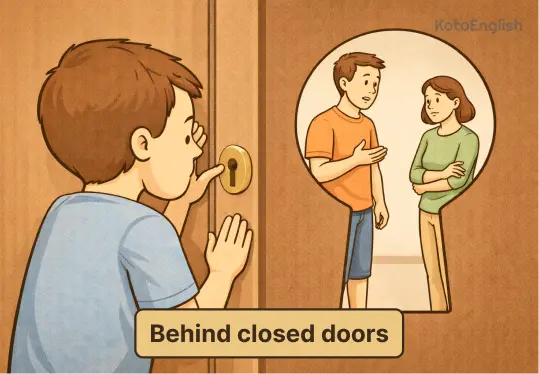
Behind closed doors — it is all about doing something secretly, without others knowing.
The negotiations happenedbehind closed doors , so nobody knows what was discussed.
Test Your Knowledge of “Door” Meaning
Check how well you understand the “door” definition with this quick intellectual game! Read every task carefully and choose options that are right in your opinion.
Enjoy personalized learning!
“Door” Word in Other Languages
Learn how to say “door” and pronounce it correctly in French, Spanish and German.
| Language | Word for “Door” |
|---|---|
 Spanish
 |
Puerta |
 French
 |
Porte |
 German
 |
Tür |
Did You Know It? Fun Facts About “Door”
“Door” is something that everyone uses every day a lot. Discover its history through these interesting details that will shed more light on this simple object.
-
The revolving door was invented to save energy.
In 1888, a man named Theophilus Van Kannel invented the first revolving door, primarily aiming to stop the cold drafts that used to invade the buildings. A revolving door is more effective than a swing door since it creates an airlock and saves ~36 watt hours of your energy when used. -
Doors used to be status symbols.
Fancy doors have always been in the past symbols of great wealth and high social standing. Luxurious doors, for instance, were one of the main features of royal tombs in ancient Egypt. “Keeping up with the Joneses” was originally meant to have fancy front doors like others do. -
“Holding the door” customs vary globally.
In North America and Europe, it is common to hold the door open for strangers. In Asia this practice is stronger because people there are very polite. In Nordic countries, people open doors for one another but expect a quick, indirect and short thanking ritual.
Famous Quotes Featuring “Door”
Walk through these insightful quotations to understand how the word “door” symbolizes opportunity, change and life’s transitions in human wisdom!
Explanation: Helen Keller, among those who posed tremendous resistance against her disabilities, imparted that people usually pay attention obsessively to lost chances (closed doors) instead of recognizing the new ones (open doors) that are there for them.
— Flora Whittemore
Explanation: Every decision we make, which chances to take, which to pass, determines our life’s path. The saying stresses individual accountability for the results of our choices, whether we accept them or not.
— Ogden Nash
Explanation: They want to be outside when they are inside and they wish to be inside when they are outside. This amusing quote reflects the all-embracing truth that people often have the same characteristic of always wanting what is on the other side no matter what.