

Student (noun) — a person who is learning at school, college, or university; someone who studies a particular subject or skill under the guidance of a teacher or through self-directed learning
How to Pronounce “Student”?
 Audio (UK):

 Audio (US):
Two syllables: STOO-dnt. Americans say STOO-dnt while British speakers often add a y sound: STYOO-dnt. The second syllable is very short and quick.
Level up your English with Koto!
Examples: How to Use “Student” in a Sentence?
To define “student” take a closer look at the typical examples of usage in different contexts.
What Are Synonyms for the Word “Student”?
Learn more “student” synonyms to be more fluent and be able to substitute this word with other variants when the context fits.
Related nouns: school university teacher practice
Synonyms (contextual): learner pupil scholar apprentice trainee
Common collocations: college student university student exchange student
“Student” Word Formation and Description in Context
To be able to provide a “student” description, you need to understand everything about this word in terms of combinations with other parts of speech.
With adjectives: bright student struggling student international student
With verbs: become a student enroll as a student teach a student
With nouns (noun + noun): student loan student housing student visa student union
Idioms and Phrases with “Student”
Discover about “student” in English as a part of idiomatic collocations, so you can easily distinguish them and comprehend their meaning.
-
Student of life — someone who continuously learns from everyday experiences rather than just formal education.
My grandfather never went to college, but he was a truestudent of life who learned something new every day. -
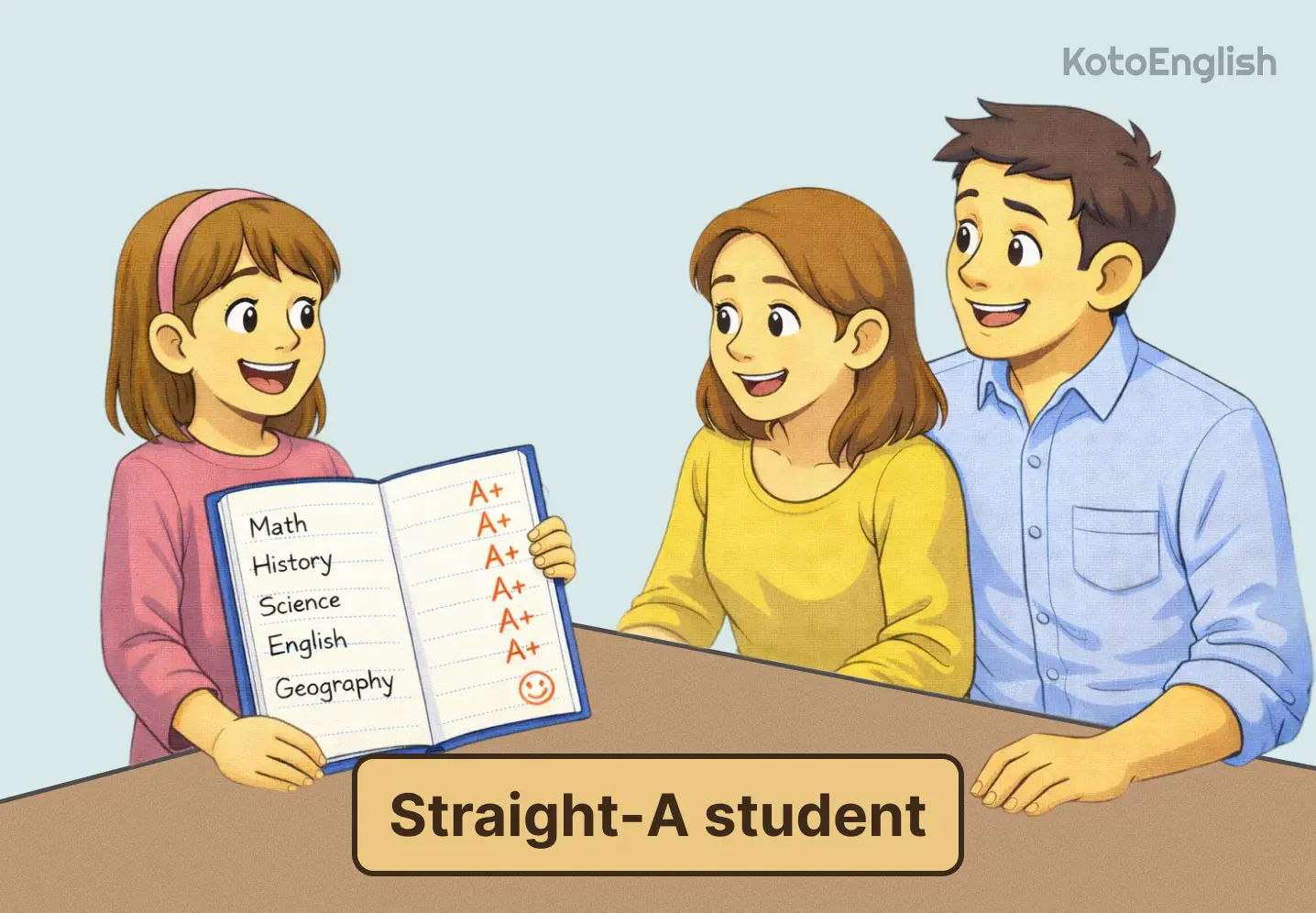
Straight-A student — a student who earns the highest grades in all subjects; an academic overachiever.
Sarah was astraight-A student in high school but struggled when she reached university.
-
Student driver — someone who is learning to drive and doesn’t have a full license yet.
Be patient with that car — there’s astudent driver behind the wheel. -
Eternal student — someone who keeps studying and collecting degrees instead of starting a career; can be positive or negative.
He’s aneternal student with three master’s degrees but has never held a real job. -
Mature student — an adult who returns to education after spending years in the workforce or raising a family.
At 45, she became amature student and finally earned her nursing degree.
Test Your Knowledge of “Student” Meaning
Evaluate how well you understand the description of “student” with this quick quiz. Practice makes perfect!
Enjoy personalized learning!
“Student” Word in Other Languages
Learn how to spell “student” in French, German and Spanish and properly pronounce this word.
| Language | Word for “Student” |
|---|---|
 Spanish
 |
Estudiante |
 French
 |
Étudiant |
 German
 |
Student |
Did You Know It? Fun Facts About “Student”
The statistics and historical landmarks presented here talk about the countless souls across the globe who dedicate their lives to education.
-
The word “student” comes from Latin.
In the Latin word “studere” which means “to be eager” or “to strive after.” The original meaning of the term required both desire and effort from the person, who needed to attend classes. A true student is someone who actively wants to learn, not just someone sitting in a classroom. -
China has the most students in the world.
China holds the record for the highest number of enrolled students, with its 280 million students who study across different educational levels. India comes in second place. The two countries combined produce more than one-third of the total global student population. -
Student debt has exploded in recent decades.
American students now owe over $1.7 trillion in student loans collectively. The average graduate carries around $30,000 in debt. The financial burden has turned into a significant political and social problem that impacts both professional paths and personal decisions. -
Medieval students started university at age 14.
In medieval Europe, boys entered university as young as 13 or 14 years old. They studied Latin, logic and rhetoric before specializing. The concept of “teenager” didn’t exist — these young students were treated as small adults.
Famous Quotes About “Student”
Advice on the true meaning of being a lifelong learner has been proffered by educators, philosophers and students themselves. Read and try to understand what they mean!
— Irving Layton
Explanation: He believed that the best students bring their own perspectives. The educational process functions through mutual interaction between students who possess curiosity and their teachers who need to adapt their thinking methods.
Explanation: This quote stresses lifelong learning, reminding us that growth comes from constant curiosity and progress rather than claiming final mastery.
— H. L. Mencken
Explanation: Mencken uses irony to suggest that authority often involves self-judgment, hinting at the subjectivity and human bias behind positions of power.