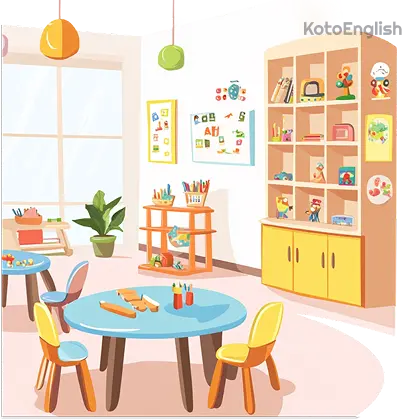

Preschool (noun) — an educational program for young children, typically ages 3-5, before they start elementary school, where kids learn through play, develop social skills and prepare for kindergarten in a structured but fun environment.
How to Pronounce “preschool”?
 Audio (UK):

 Audio (US):
Say PREE-skool with two syllables. Stress the first syllable PREE, then add skool (rhymes with “cool”).
Level up your English with Koto!
Examples: How to Use “Preschool” in a Sentence?
To define “preschool” take a closer look at how native speakers naturally use this word in context related to children and education.
What Are Synonyms for the Word “Preschool”?
Discover related words and “preschool” synonyms to expand your vocabulary and sound more natural while talking or writing.
Related nouns: kindergarten school teacher child
Synonyms (contextual): nursery
Common collocations: preschool teacher preschool age attend preschool
“Preschool” Word Formation and Description in Context
You know the “preschool” description, so learn how to combine this word with other parts of speech to create meaningful collocations.
With adjectives: private preschool Montessori preschool cooperative preschool
With verbs: start preschool enroll in preschool finish preschool
With nouns (noun + noun): preschool curriculum preschool classroom preschool activities
Idioms and Phrases with “Preschool”
“Preschool” in English is not a very popular part of idiomatic expressions but still there are some useful phrases that you can use daily to boost your fluency.
-
Preschool-level — extremely basic or simple.
The instructions were so clear they feltpreschool-level . -
Preschool logic — oversimplified or naive reasoning.
When Michael reduced the conflict to one cause, it came across as purepreschool logic . -
Like a preschooler — acting in a very innocent or immature way.
He was jumping aroundlike a preschooler on the first day of summer. -
Preschool behavior — immature or childish actions.
During the meeting, Amanda slipped into obviouspreschool behavior .


Test Your Knowledge of “Preschool” Meaning
Check how well you understand the description of “preschool” by taking this quick test!
Enjoy personalized learning!
“Preschool” Word in Other Languages
Discover how to spell “preschool” and pronounce it properly in other popular European languages like German, French and Spanish.
| Language | Word for “Preschool” |
|---|---|
 Spanish
 |
Preescolar |
 French
 |
École maternelle |
 German
 |
Vorschule |
Did You Know It? Fun Facts About “Preschool”
Take a break from learning and check out these interesting details about “preschool” and its importance.
-
Preschool is a relatively modern invention.
The first official preschool programs were established in the early 19th century. German educator Friedrich Fröbel opened the first “kindergarten” (children’s garden) in 1837. Before that, young children typically stayed at home with their families or helped with daily work. -
Preschool attendance predicts future success.
Research shows that children who attend high-quality preschool programs often demonstrate stronger academic performance, higher graduation rates and improved career outcomes later in life. -
Not all countries have preschool systems.
Many countries still lack accessible early childhood education. In the United States, private preschool can cost between $4,000 and $17,000 per year. Meanwhile, countries like France offer free preschool education starting at age 3. -
Preschool teachers need specialized training.
Preschool teachers usually hold bachelor’s degrees in early childhood education and study child development, age-appropriate teaching strategies and learning theories to support young children effectively.
Famous Quotes About “Preschool”
Read these quotations and take a look at the explanations to see different opinions and thoughts about this layer of the educational system.
Explanation: Children exhibit “magical” powers every day because they create castles from cardboard and use their imaginary friends to communicate through silence. Spock recognized that we don’t teach children creativity, they have it in them.
— John Hickenlooper
Explanation: It’s rare for politicians, researchers and parents to agree on much, but early childhood education is that strange common ground where the data and the instincts actually shake hands.
— James Sallis
Explanation: Outdoor playtime increases preschoolers’ movement because they spend more time outdoors than in indoor areas. Outdoor spaces create a natural environment that promotes both play activities, exploratory behavior and physical exercise.