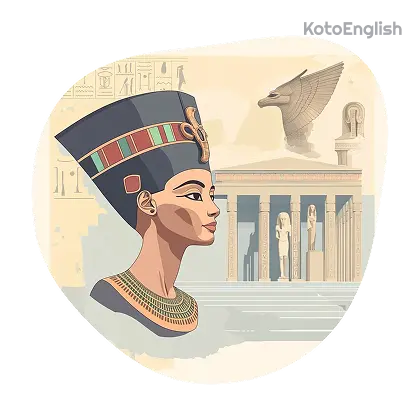

History (noun) — a subject showing the study of past events, particularly human activities, societies and civilizations, examining what happened before the present time through documents, artefacts and records to understand how the world developed.
How to Pronounce “History”?
 Audio (UK):

 Audio (US):
Say HIS-tuh-ree with three syllables. Stress the first syllable HIS, then quickly add tuh-ree. Don’t say his-STORY — keep it as three distinct syllables.
Level up your English with Koto!
Examples: How to Use “History” in a Sentence?
To define “history” as a subject, we recommend that you take a look at these examples of typical usage of this word in certain contexts to see how native speakers apply this word every day.
What Are Synonyms for the Word “History”?
Discover what the “history” synonyms are to expand the capacity of your vocabulary and be able to refer to this word in different terms.
Related nouns: past chronicle school subject teacher
Synonyms (contextual): record story
Common collocations: world history history class
“History” Word Formation and Description in Context
It is not only about a “history” description, but it is also crucial to understand how to use this word in combination with other parts of speech properly. Look at the examples below to get the idea of word-building and the lexical acquisition processes.
With adjectives: modern history local history interesting history
With verbs: study history teach history understand history
With nouns (noun + noun): history book history museum history teacher
Idioms and Phrases with “History”
The “history” in English is present in a wide variety of different forms of phrases and idiomatic expressions, describing feelings, emotions, certain events and human activities.
-
Make history — to do something so important that it will be remembered and recorded in history books.
When she became the first woman president, shemade history . -
History repeats itself — similar events and patterns occur again over time; in everyday English it means that people donʼt learn from past mistakes.
Every financial crisis proves thathistory repeats itself .


-
Ancient history — something from the distant past; also used to mean something no longer relevant or important.
That argument isancient history now. We’ve been friends again for years! -
Go down in history — to be remembered by future generations and become part of the historical record.
The moon landingwent down in history as one of humanity’s greatest achievements at this point. -
History in the making — witnessing or participating in events that will be historically significant.
When the Berlin Wall fell, we knew we were watchinghistory in the making .
Test Your Knowledge of “History” Meaning
Check how well you understand the description of “history” with this quick interactive quiz.
Enjoy personalized learning!
“History” Word in Other Languages
Discover how to spell “history” and pronounce it properly in French, Spanish and German to reinforce your linguistic abilities.
| Language | Word for “History” |
|---|---|
 Spanish
 |
Historia |
 French
 |
Histoire |
 German
 |
Geschichte |
Did You Know It? Fun Facts About “History”
It is an interesting paradox and tautology at the same time but “history” itself has a fascinating history and these revelations will transform how you understand humanity’s relationship with its past!
-
History comes from Greek storytelling.
The word “history” derives from the ancient Greek “historia.” Greek historian Herodotus (484-425 BCE), called the “Father of History,” became one of the first scholars who studied actual events through systematic research instead of using fictional stories. -
Most history was unrecorded until recently.
Humans existed for approximately 300,000 years, but written history only covers the last 5,000 years (since writing was invented). This means 98% of human history is known only through archaeological evidence like tools, bones and cave paintings rather than written records. -
Winners write history.
The famous saying “history is written by the victors” reflects how historical accounts often favor powerful groups. The official history avoided many details, so modern historians now search for different sources that can show the suppressed voices and unknown events that occurred. -
History was once considered a branch of literature.
Until the 19th century, history was classified with literature and rhetoric, with a focus on dramatic storytelling rather than the social sciences. Modern history emerged when scholars adopted scientific methods, emphasizing evidence, objectivity and systematic research.
Famous Quotes About “History”
Learn from these profound reflections on “history’s” importance in understanding present circumstances and shaping future possibilities!
Explanation: Winston Churchill used humor to show how historical figures create their legacies through their written accounts of their lives. The quote demonstrates that history exists as a collection of subjective narratives created through the ability to write and publish viewpoints.
— James Baldwin
Explanation: The social problems and individual identities of today are shaped by historical events, which include slavery, colonialism, revolutions and inventions. Understanding history requires people to recognize how past choices led to present situations and future options.
— Aldous Huxley
Explanation: The historical evidence shows that people will continue to disregard lessons from the past, so Huxley observes how humanity maintains its pattern of stumbling through the same errors that happened in previous centuries over and over again.