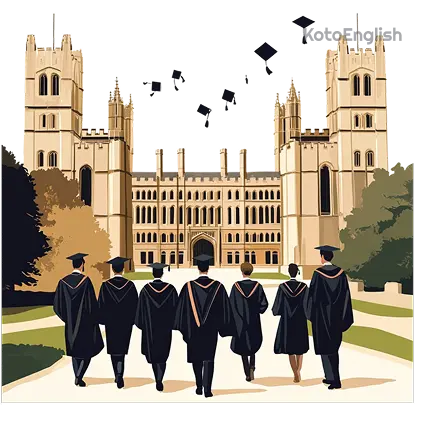

College (noun) — an educational institution providing higher education after high school, offering undergraduate degrees and sometimes specialized training. It is often smaller than universities, where students pursue academic studies and prepare for professional careers.
How to Pronounce “College”?
 Audio (UK):

 Audio (US):
Say KAH-lij (US) or KOL-ij (UK) with two syllables. Stress the first syllable COL. The ending sounds like “ledge” on a mountain.
Level up your English with Koto!
Examples: How to Use “College” in a Sentence?
To define a “college” on a full scale, take a look at how native speakers typically use this word in various contexts while talking about education and studying.
What Are Synonyms for the Word “College”?
There are not many “college” synonyms in English, but still, there are some word equivalents that refer to education in general and “colleges” in particular.
Related nouns: university school institution academy
Synonyms (contextual): undergraduate institution
Common collocations: community college liberal arts college attend college
“College” Word Formation and Description in Context
Learn how to combine this word with other parts of speech like nouns, verbs and adjectives.
With adjectives: technical college expensive college selective college
With verbs: finish college pay for college apply to college
With nouns (noun + noun): college student college degree college campus
Idioms and Phrases with “College”
“College” in English has generated distinctive expressions, so take a look at them and remember how they reflect the unique experiences, challenges, and culture of higher education!
-
Give it the old college try — giving something your best effort, even if success isn’t guaranteed.
I’m not athletic, but I’llgive it the old college try and join the soccer team.


-
College curriculum — the structured set of courses offered by a college.
Thecollege curriculum mixes theory with practical training. -
College buddies — friends you met during college.
Mycollege buddies and I still meet every summer. -
College dropout — someone who leaves college before graduating, often used jokingly or self-deprecatingly.
I’m acollege dropout … from my diet plan, not classes.
Test Your Knowledge of “College” Meaning
Check your comprehension of the description of “college” by completing this interesting quiz. Take your time and try to answer all the questions correctly!
Enjoy personalized learning!
“College” Word in Other Languages
Discover how to spell “college” in other popular European languages like German, French and Spanish.
| Language | Word for “College” |
|---|---|
 Spanish
 |
Colegio |
 French
 |
Collège |
 German
 |
College |
Did You Know It? Fun Facts About “College”
Take a break from learning and read these interesting insights about colleges, revealing their secrets, history and importance for the development of modern society.
-
The college/university distinction varies by country.
In the United States, “college” and “university” are often used interchangeably. In the UK, “college” can mean a secondary education institution for students aged 16 to 18, or a part of a university, such as Cambridge colleges. -
College graduates earn significantly more.
On average, college graduates earn about $1 million more over their lifetimes than high school graduates. However, the earning potential of different majors creates debate about which degrees bring the best financial returns. -
Community colleges serve half of US undergraduates.
Nearly 50% of American undergraduates attend community colleges, which are affordable two-year institutions. They often provide pathways to four-year universities and career growth for students who cannot immediately access traditional four-year colleges.
Famous Quotes About “College”
Every “college” description in these quotations is unique since it is based on personal experience, life path and philosophy. Check out these quotes and their explanations to see if there are some common points with what you have in mind.
Explanation: Modern interpretations show that colleges create inclusive environments which enable students from different backgrounds to learn together. This approach helps students develop skills needed to succeed in diverse workplace and community settings.
— William James
Explanation: He argues that the authentic requirement for graduation involves developing the ability to identify integrity and wisdom together with the character traits of others. Your complete academic training served to develop your moral discernment ability.
— Bernie Sanders
Explanation: The system creates ridiculousness because its primary barrier to learning depends on a student’s ability to pay for their education. Society has established more difficult entry requirements for education than the actual requirements needed for student progress.