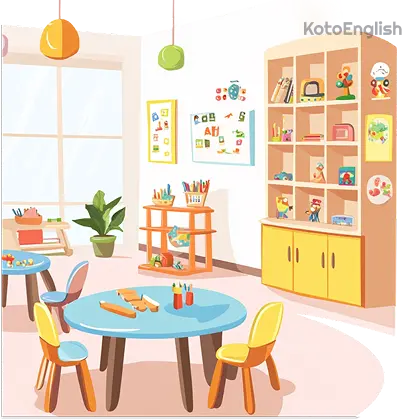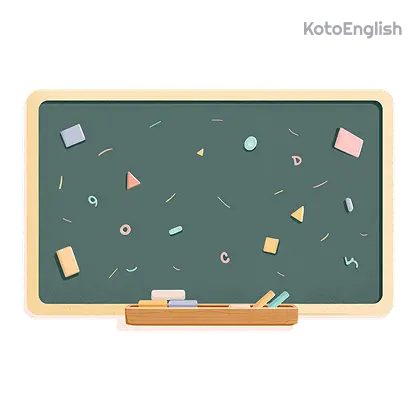

Board (noun) — a flat rectangular surface, typically mounted on a wall in classrooms, used by teachers to write or display information for students. Can be made of different materials and adapted for use with chalk, markers, etc.
How to Pronounce “Board”?
 Audio (UK):

 Audio (US):
One syllable that rhymes with “sword” and “ford.” The oa makes an or sound. Don’t confuse it with “bored” — they sound identical but have different meanings.
Level up your English with Koto!
Examples: How to Use “Board” in a Sentence?
To define “board” as an essential part of a learning process, take a closer look at how native speakers use this word in such contexts below. Read them and remember this scheme.
What Are Synonyms for the Word “Board”?
“Board” synonyms are of high importance if you want to boost your English vocabulary and be able to refer to this item in different terms, so that your written and spoken text remains informative, fluent and original.
Related nouns: school teacher university answer
Synonyms (contextual): blackboard whiteboard smart board
Common collocations: write on the board erase the board clean the board
“Board” Word Formation and Description in Context
Learn more about meaningful collocations by discovering how to combine this word with nouns, verbs and adjectives.
With adjectives: clean board dirty board digital board big board square board
With verbs: write on the board copy from the board look at the board draw on the board
With nouns (noun + noun): board marker board eraser board pen whiteboard cleaner
Idioms and Phrases with “Board”
Discover more details about the meaning of “board”, but in this case, we are talking about indirect, idiomatic contexts. See what these expressions mean and how to properly apply them daily.
-
Go back to the drawing board — to start planning something again because the first attempt failed.
Our experiment didn’t work, so we need togo back to the drawing board and try a new approach.


-
Across the board — affecting everyone or everything equally.
The school announced salary increasesacross the board for all teachers. -
Above board — honest and legal, done openly without hiding anything.
The principal assured parents that all exam procedures were completelyabove board . -
Take something on board — to accept and consider new information or suggestions seriously.
The teachertook our feedbackon board and changed how she assigns homework.
Test Your Knowledge of “Board” Meaning: Quiz Time!
Check how well you comprehend what “board” means with our interactive quiz. Take your time and answer the questions to put theoretical knowledge into practice and, as a result, reinforce your mastery of English.
Enjoy personalized learning!
“Board” Word in Other Languages
Discover the specifics of how you spell “board” and pronounce it properly in German, French and Spanish.
| Language | Word for “Board” |
|---|---|
 Spanish
 |
Pizarra |
 French
 |
Tableau |
 German
 |
Tafel |
Did You Know It? Fun Facts About “Board”
Dive deeper into the “board” description with these fascinating details that shed more light on its history and importance, giving you additional context and background about this term.
-
Blackboards revolutionized education in the 1800s.
Before blackboards, teachers often taught students individually or in very small groups. Scottish educator James Pillans is credited with creating one of the first large classroom blackboards around 1801 by joining several smaller slates together. -
Chalk dust was a real health problem.
Teachers who spent decades writing on chalkboards sometimes developed respiratory issues from inhaling chalk dust daily. Because of these concerns, many schools began switching to whiteboards in the 1990s. -
Whiteboards were invented by accident.
In the 1950s, a photographer noticed he could write on enameled negative surfaces and easily erase the marks. This accidental discovery led to the development of early whiteboards. They became widely used only in the 1990s, when dry-erase marker technology improved. -
Smart boards can cost over $5,000.
Interactive whiteboards with touch functionality and internet connectivity began transforming classrooms in the 2000s. A single smart board can cost between $1,500 and $7,000, making it a significant investment for schools.
Famous Quotes About “Board”
The “board” functions as a classroom instrument that represents both student selection, their desire to learn and their right to think freely. The authors demonstrate through their works which methods people use to acquire knowledge while developing their unique paths through life.
— Elizabeth Edwards
Explanation: The quote describes life as an open space that people can shape through their personal decisions because their choices will create permanent impressions that determine their future paths.
— Richard Feynman
Explanation: Feynman values curiosity and critical thinking because he believes learning requires people to challenge their existing beliefs instead of accepting unchangeable facts.
Explanation: Einstein states that genuine education occurs through personal exploration while teaching resources exist to help students achieve self-directed comprehension.