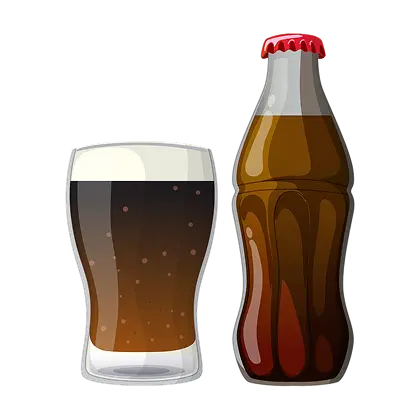
Coke (noun) — a sweet, carbonated, brown-colored soft drink that does not contain alcohol. It is believed that the word comes from the name of the carbonated drink of “The Coca-Cola Company”.
How to Pronounce “Coke”?
 Audio (UK):

 Audio (US):
focus on the “o” sound, making it long and gliding slightly, like in “poke” or “joke.” You can also pronounce it similarly to “kohk.”
Level up your English with Koto!
Examples: How to Use “Coke” in a Sentence?
You can adore Coke, or you can not love it at all, but to draw conclusions, in any case, it is better to know how to use this word correctly in various phrases.
What Are Synonyms for the Word “Coke”?
Some people can’t imagine an evening without a can of Coke and chips, but many other words connect with “Coke” no worse, and sometimes even better, than chips.
Related nouns: drink soda can bottle cola soft drink straw
Synonyms (contextual): cola
Common collocations: cold Coke can of Coke drink Coke sip Coke Coke and fries
“Coke” Word Formation and Description in Context
What to combine a can of Coke with while watching an evening movie is up to you, of course, but “Coke” in English combines with other words very boldly, just take a look!
With adjectives: fizzy Coke sweet Coke ice-cold Coke diet Coke refreshing Coke
With verbs: open a Coke pour a Coke serve a Coke order a Coke
With nouns (noun + noun): Coke drink Coke can Coke brand Coke flavor Coke machine
Idioms and Phrases with “Coke”
Folk wisdom and established expressions always convey the most value in short, capacious phrases. See how the Coke description becomes more multifaceted with the following popular expressions:
-
Jinx, buy me a Coke! — This seemingly absurd phrase is said when two people suddenly say the same thing at the same time.
A and B: “Where’s Mom?” A: “Jinx, buy me aCoke !” -
Coke and a smile — is an informal expression used to suggest taking a break, or lifting the mood and relaxing. It was popularized by one of Coca-Cola’s advertising slogans.
Hey, it’s not that bad! You need to sit down, have aCoke and smile. -
A Coca-Cola smile — an artificial, overly broad, or advertising smile.
He walked into the room with aCoca-Cola smile that didn’t quite reach his eyes.
Test Your Knowledge of Coke Meaning – Quiz Time!
To avoid trouble and always be on the crest of a wave, like the Coca-Cola brand, let’s test your knowledge so that you no longer have to ask yourself the question: How do you spell “Coke?“
Enjoy personalized learning!
“Coke” Word in Other Languages
If there is a drink that is popular and famous all over the world, it would definitely be Coke. Such international popularity has led to the word sounding almost identical in different languages:
| Language | Word for “Coke” |
|---|---|
 Spanish
 |
Coca |
 French
 |
Coca |
 German
 |
Cola |
Did You Know It? Fun Facts About “Coke”
Probably no other drink in the world is surrounded by so many rumors, speculations, and assumptions as Coke. But we operate only with facts and invite you to learn some of the most interesting to better understand what Coke means:
-
Early Coke contained little cocaine.
Invented by pharmacist John Pemberton in 1886, Coca-Cola was initially advertised as a brain tonic to relieve headaches and fatigue. The drink did contain cocaine, but not as much as is commonly believed — only 9 milligrams, and it was removed from the range in 1903. -
Coke was first canned for service members in the Pacific and Japan.
Previously, the drink was bottled in glass and marketed as a tonic, and plastic packaging emerged only later in the 1970s. -
The name Coca-Cola comes from the coca plant and the kola nut.
The name Coca-Cola comes from the two components of the drink: cocaine, which comes from the coca plant, and caffeine, which comes from the kola nut. The modern combination has been slightly modified to sound more appealing to the market. -
A contour bottle (also called the “hobbleskirt”) is sometimes named as a “Christmas bottle”.
The publication of the patent for the contour bottle in the official publication of the US Patent Office is dated December 25, 1923, and this is a simple coincidence related to the periodicity of the newspaper. However, from then until 1937, all contour bottles had a Christmas patent stamp, for which they were given the name “Christmas bottle”.
Famous Quotes Featuring “Coke”
Cola, as a drink, may not have a very ancient history, but it has already managed to win the love of many, and some famous people have even mentioned it in their statements.
— Caroline B. Cooney
Explanation: This quote describes how familiar and unfamiliar things can sometimes calm you down. A familiar taste in a problematic situation creates a sense of stability, reducing the frightening uncertainty of the world around you.
Explanation: The historian and educator’s words can be seen as a warning that the global influence of big brands is as significant and serious as the social problems of hunger and poverty, and it may be time to shift the focus to more critical aspects of life.
— Anthony T. Hincks
Explanation: The quote highlights how popular and commonplace the drink has become, widely consumed and almost like a daily dietary staple.