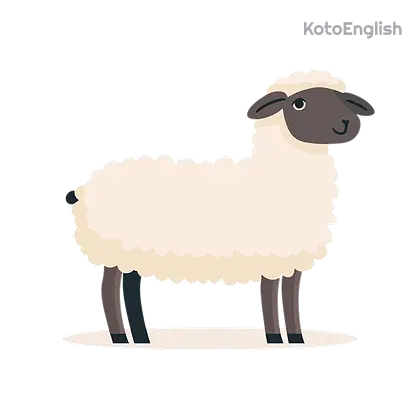
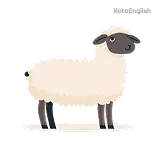
Sheep (noun) — a domesticated animal with a woolly coat, hooves, and a short tail, often raised for wool, meat, and milk. Sheep are generally gentle, social, and kept in flocks.
How to Pronounce “Sheep”?
 Audio (UK):

 Audio (US):
Begin with the sh sound, hold the long ee vowel, and end softly with a p sound, releasing gently at the lips.
Level up your English with Koto!
How to Use “Sheep” in a Sentence
To understand the word “sheep,” it helps to see how people use it in everyday speech. Read the examples below, listen, and repeat to build confidence.
What Are Synonyms for the Word “Sheep”?
Learning related words for “sheep” helps you describe animals more clearly and sound more confident in simple conversations.
Related nouns: lamb goat
Synonyms (contextual): none it is a specific noun
Common collocations: farm sheep sheep wool grazing sheep
“Sheep” Word Formation and Description in Context
After learning similar words, it’s useful to see how “sheep” works with other parts of a sentence in everyday English.
With adjectives: white sheep young sheep woolly sheep
With verbs: feed sheep watch sheep shear sheep
With nouns (noun + noun): sheep farm sheep wool sheep flock
Idioms and Interesting Phrases with “Sheep”
When learning the word “sheep,” it may seem very basic at first. However, English includes several expressions with “sheep” that add meaning and color to everyday speech.
-
A black sheep — a person who is different from the rest of a group, often in a negative way.
He is theblack sheep of the family because he never follows the rules. -
Like sheep — acting without thinking, simply following others.
People followed the new trendlike sheep . -
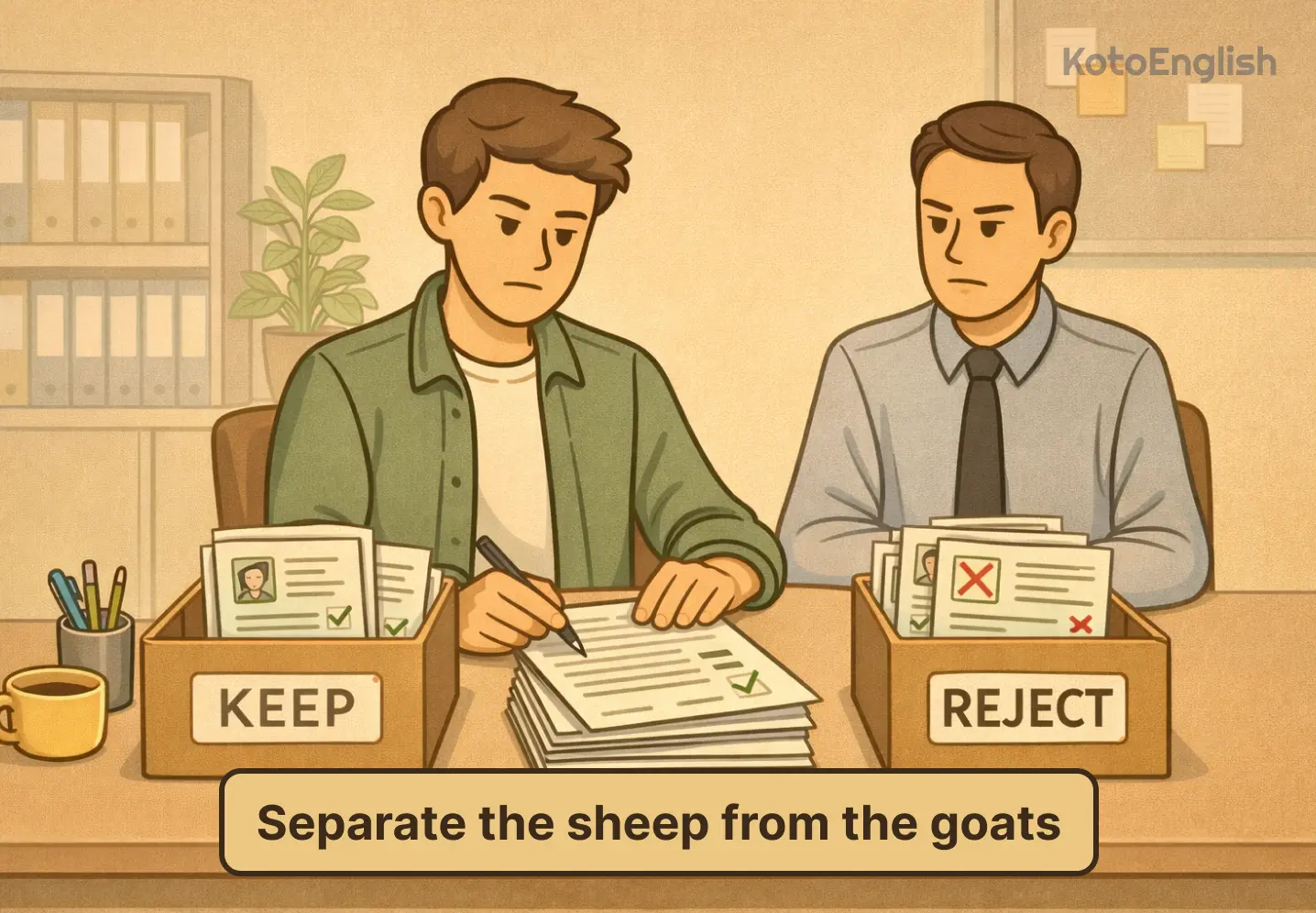
Separate the sheep from the goats — to clearly see who is good or useful and who is not.
The test helped the teacherseparate the sheep from the goats .
Test Your Knowledge of “Sheep” Meaning
Here’s a fun activity for you to do! How well do you think you know the definition of “sheep?”
Enjoy personalized learning!
“Sheep” Word in Other Languages
You can learn how to say “sheep” in several languages so that you can add some species to your basic animal vocabulary.
| Language | Word for “Sheep” |
|---|---|
 Spanish
 |
Oveja |
 French
 |
Mouton |
 German
 |
Schaf |
Did You Know It? Fun Facts About “Sheep”
Sheep have several surprising abilities and habits that many people do not expect. Now that you know how to use the word “sheep,” take a look at these curious facts!
-
Sheep have the ability to remember faces for a long time.
Researchers from Cambridge University have come to the conclusion that sheep can recognize and remember human and sheep faces for over a period of two years and up to fifty of each! -
Some sheep are crowned with many horns.
The Jacob sheep, a rare variety from the UK, can grow up to four or even six horns, while most of the sheep only have two or none. -
The wool of sheep keeps growing as long as they live.
Every year, a sheep provides around 2–5 kg (4–11 lb) of wool, hence the necessity of regular shearing for the wellness of the animal. -
Lamborghini the Sheep set a record for most races won.
The sheep Lamborghini at Odds Farm Park in the United Kingdom won an astonishing 165 out of 179 races over a 250-metre track in 2011, thus earning him the title of the sheep that had won the most races ever. -
The sheep population on the planet is very large.
According to FAO (Food and Agriculture Organization of the United Nations), the total number of sheep globally is more than 1.2 billion, and the largest populations are found in China, Australia, and India.
Famous Quotes Featuring “Sheep” in English
Sheep are very often quoted in well-known sayings and they are mostly symbols of behavior, safety, and conformity.
— George Orwell, Animal Farm
Explanation: Orwell employs sheep to represent blind repetition and unthinking obedience. The quote is a picture of how people can receive ideas without any doubt, just by being with the majority.
— Isaiah, The Bible
Explanation: The saying compares humans to sheep to indicate how fast and easy it is for people to lose their way and follow their own paths instead of the ones common to all or that of the guides.