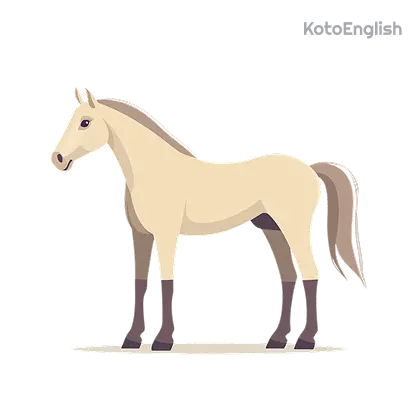

Mouse (noun) — a small rodent with a pointed nose, rounded ears, a long, thin tail and soft fur, often gray or brown in color, living in houses, fields, or forests, known for eating grains and cheese and making squeaking sounds. The plural form for this word is “mice.”
How to Pronounce “Mouse”?
 Audio (UK):

 Audio (US):
Start with m, then say ah and glide into oo (ma-oo) and finish with a clear s sound.
Level up your English with Koto!
Examples: How to Use “Mouse” in a Sentence?
Begin with authentic samples that demonstrate just how the little animals appear in everyday conversations or wildlife experiences to define “mouse.”
What Are Synonyms for the Word “Mouse”?
The term “mouse” refers to a very specific animal, but the use of these terms will allow you to express your ideas more accurately about this small creature and related topics.
Related nouns: rodent vermin rat
Synonyms (contextual): none, it is a specific noun
Common collocations: pet mouse wild mouse field mouse
“Mouse” Word Formation and Description in Context
Learn how to say “mouse” in combinations with verbs, adjectives and nouns. This will help you understand how collocations in English function and enhance your overall knowledge.
With adjectives: tiny mouse gray mouse wild mouse pet mouse
With verbs: catch a mouse see a mouse trap mice feed a mouse
With nouns (noun + noun): mouse hole mouse trap mouse nest mouse tail
Idioms and Phrases with “Mouse”
The meaning of “mouse” in these idiomatic expressions reveals how this small animal symbolizes quietness, timidity and vulnerability in everyday English language.
-
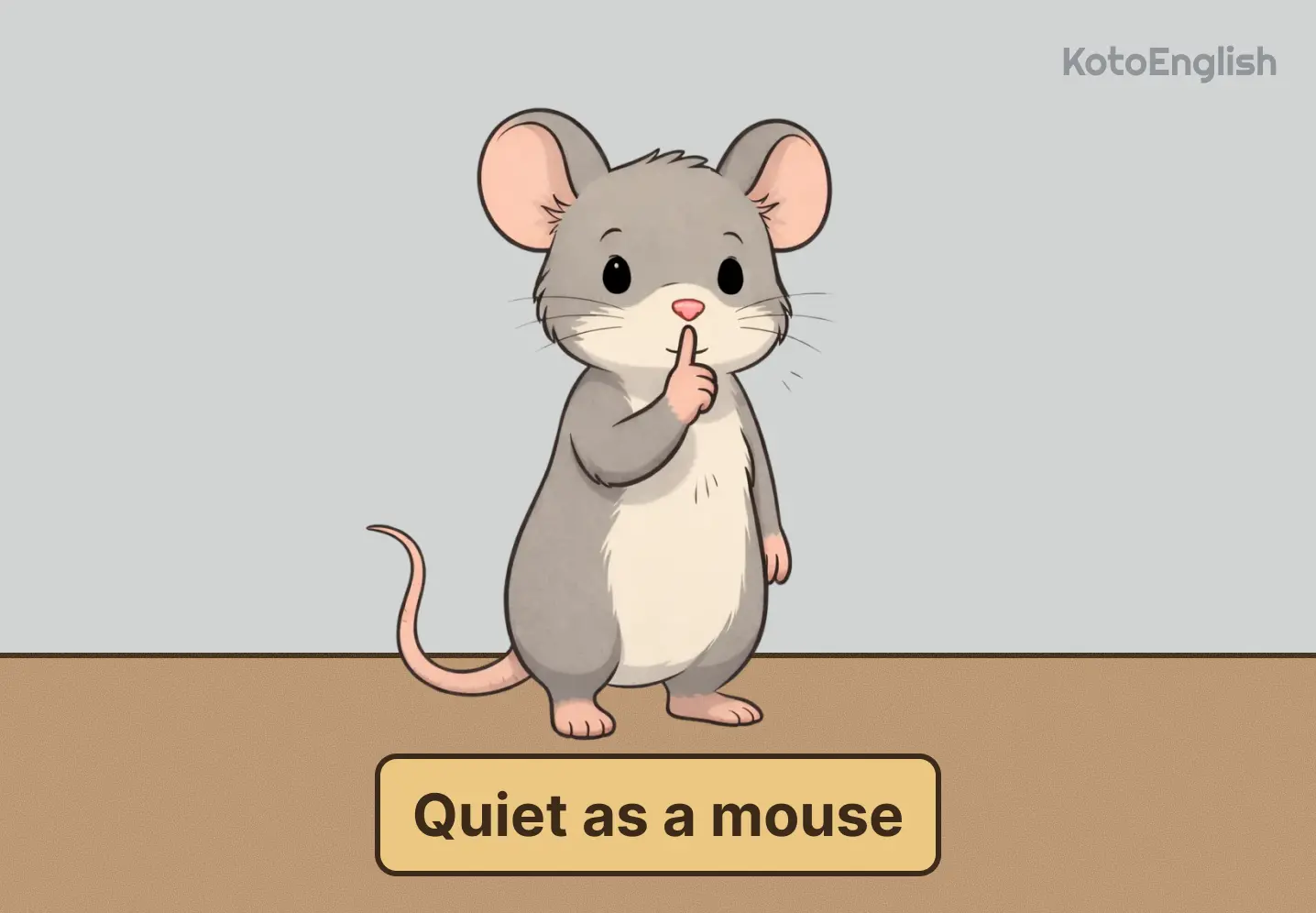
Quiet as a mouse — making no noise at all.
The children were asquiet as mice during the scary movie.
-
Play cat and mouse — to engage in a pursuit where one party repeatedly chases or outsmarts the other.
The detective and the thiefplayed cat and mouse for months before the arrest. -
Poor as a church mouse — extremely poor.
After losing his job, he was aspoor as a church mouse . -
When the cat’s away, the mice will play — people misbehave or relax when the person in authority is absent.
The students got very loud when the teacher left —when the cat’s away, the mice will play .
Test Your Knowledge of “Mouse” Meaning: Quiz Time!
Assess your comprehension of vocabulary terms and expressions by answering these questions, which challenge your understanding in both the literal and figurative aspects.
Enjoy personalized learning!
“Mouse” Word in Other Languages
Discover how to spell “mouse” and properly pronounce it in other European languages such as French, German and Spanish.
| Language | Word for “Mouse” |
|---|---|
 Spanish
 |
Ratón |
 French
 |
Souris |
 German
 |
Maus |
Discover Interesting Facts About “Mouse”
Mice are far more complex and fascinating than most people realize and these surprising facts challenge common assumptions about these creatures!
-
Mice can squeeze through impossibly small spaces.
A mouse can fit into a hole that is as big as a dime, which is 0.6 to 0.7 cm in diameter, because of their flexible, flat skeleton, which they press and to fit through. The only limitation is their skull, so if it goes through, the entire body follows. -
A female mouse can have 5-10 litters per year.
Mouse reproduction is outstandingly rapid. A female may produce 5-10 litters a year, each litter consisting of 3-14 babies. One pair of mice can theoretically produce 5,000 descendants in a single year if all offspring survive and reproduce. Nonetheless, predators usually prevent this. -
Mice sing love songs at ultrasonic frequencies.
Male mice produce complex ultrasonic sounds beyond the range of human perception. These “songs” make up verse-chorus-like patterns similar to those found in bird songs. Scientists study mouse songs to understand vocal learning and communication among mammals. -
Mice have been sent to space.
Since the 1950s, mice have been flown to space for a variety of scientific studies of the impact of microgravity on living organisms. These brave space mice have been invaluable in helping scientists study the loss of bone density, muscle atrophy and other biological changes. -
Mice are excellent jumpers and climbers.
This tiny creature has been known to jump amazingly high for its size. Mice can leap up to a foot above the ground and can climb vertical surfaces with their grip and agility. They are also gifted swimmers and can stay in water for as long as three days in a sudden emergency.
Quotes Featuring the Word “Mouse”
See what famous writers, thinkers and storytellers have expressed about mice in literature and their symbolic meanings throughout culture.
— Robert Burns
Explanation: These famous lines go on to compare men to their smallest counterpart, the mouse and suggest that no one can fully control their fate. The quote also teaches us to keep aside our ego and accept that life may run through any way other than as we have thought of.
— Plautus
Explanation: If you want to fare well, prepare multiple plans of action instead of tying your destiny to just one. Like a mouse that has many holes to escape safely, human beings protect themselves by showing flexibility, being cautious and staying on top of change.
— Jeremy Paxman
Explanation: This quote challenges the idea that being first is always best. While acting early can bring rewards, waiting and observing can be smarter when there is danger involved. The “second mouse” succeeds because it learns from the first mouse’s mistake.