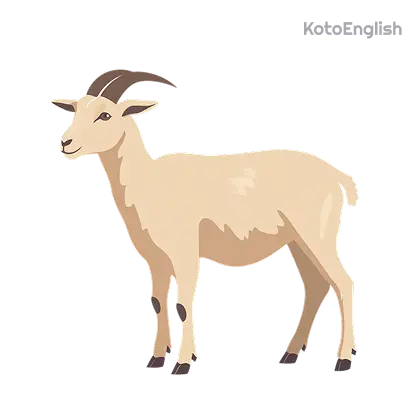
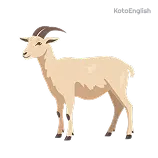
Goat (noun) — a domestic animal characterized by horns and a beard, whose diet consists primarily of grass and plants. These animals are raised for their milk, meat, and wool.
How to Pronounce “Goat”?
 Audio (UK):

 Audio (US):
Begin with a hard g sound like in “go,” then blend into the oh sound as in “boat,” and finish with a soft t at the end.
Level up your English with Koto!
Examples: How to Use “Goat” in a Sentence?
You can really understand a “goat” in English when we see the word within real-life contexts.
What Are Synonyms for the Word “Goat”?
When you define “goat” or explore its description, understanding related vocabulary helps you grasp it better.
Related nouns: animal cow milk
Synonyms (contextual): none, it’s a specific noun
Common collocations: goat milk baby goat goat cheese mountain goat
“Goat” Word Formation and Description in Context
When the word is used in conjunction with other words, the “goat” description extends beyond that of just an animal of the same species.
With adjectives: young goat hungry goat stubborn goat wild goat
With verbs: feed a goat keep a goat raise a goat milk a goat
With nouns (noun + noun): goat farm goat milk goat meat
Idioms and Phrases with “Goat”
What does “goat” mean beyond the animal itself? The world is filled with goat-related sayings with its sleekest set to reflect everything under the sun.
-
Get someone’s goat — to irritate someone.
Maths alwaysgets him goat . He doesn’t understand formulas and rules. -
Scapegoat — a person blamed by others for doing something.
They didn’t send work on time and made me thescapegoat . I wasn’t guilty! -
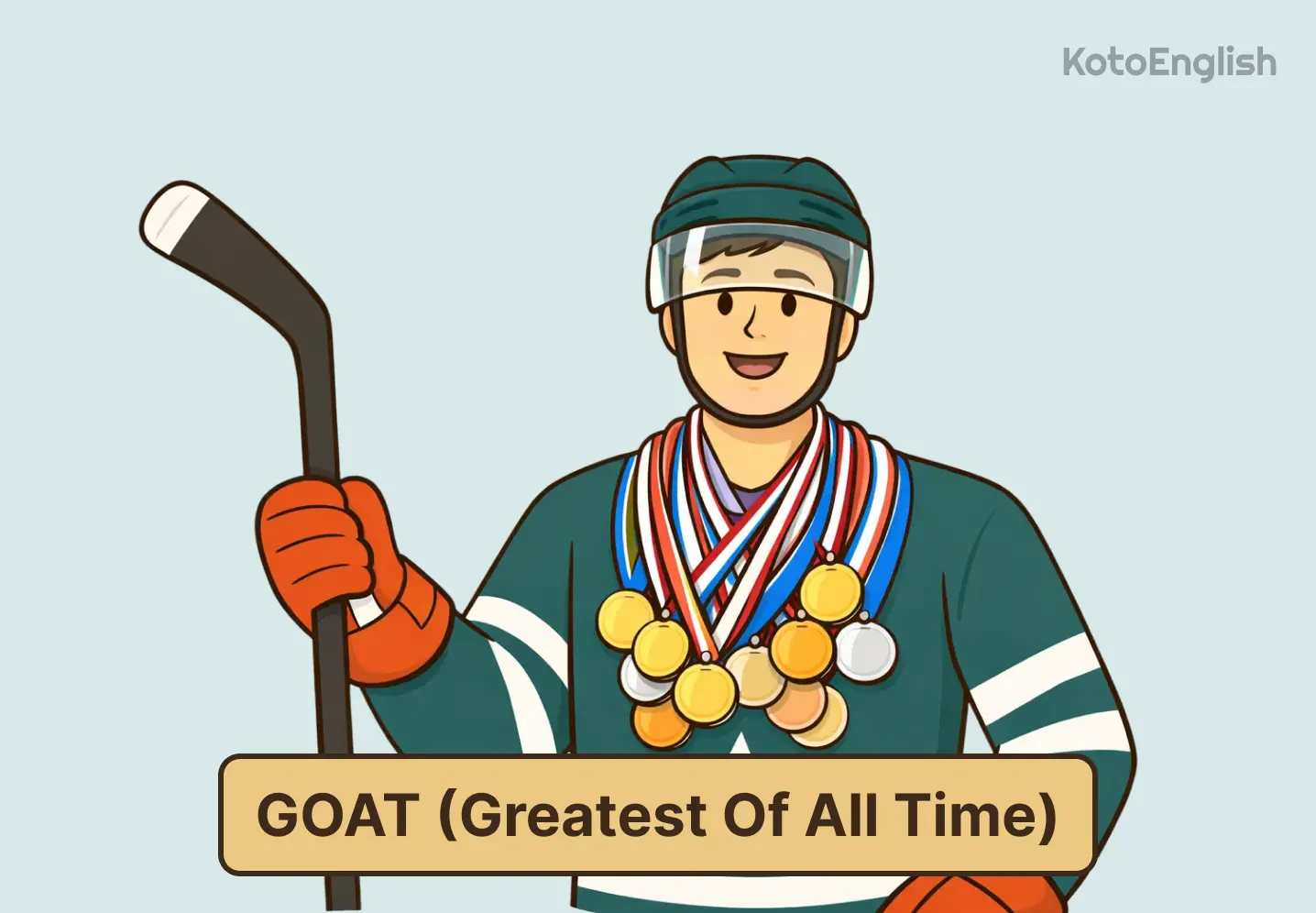
GOAT (Greatest Of All Time) — an acronym used to call someone the best in something.
Serbia’s water polo team isGOAT . They won the Olympics in Rio, Tokyo and Paris.
Test Your Knowledge of “Goat” Meaning
Now that you understand the meaning of “goat” and various uses of this word, let’s practice with these exercises to reinforce your learning.
Enjoy personalized learning!
“Goat” Word in Other Languages
The “goat” in English may sound different across different European languages, but the animal remains equally important in every corner of the world.
| Language | Word for “Goat” |
|---|---|
 Spanish
 |
Cabra |
 French
 |
Chèvre |
 German
 |
Ziege |
Did You Know It? Fun Facts About “Goat”
Understanding the description of “goat” tends to go deep when one stumbles upon some intriguing facts, which cherish this amazing animal and its association with people through time.
-
Goats have rectangular pupils in their eyes.
This sort of vision ensures that they will think of predators in nearly all directions so that they can swim there without twisting their heads, which also goes a long way to help them survive in their environment. -
Goats were domesticated among the first.
Around 10,000 years ago in the Iranian mountains, goats were kept by humans as the first form of domesticated livestock. As such, they are among the oldest domestic animals in human history, even pre-dating cattle and pigs in some regions. -
They are good climbers and jumpers.
They have an impressive sense of balance, which is likely to make modern rock climbers feel very envious. -
The way a goat “speaks” depends on the herd in which it was born.
Researchers have recently discovered that goats have “accents,” which refer to certain vocal patterns influenced by the goat’s social group. Young ones modify their “words” depending on the company, just as human beings acquire regional accents from their communities.
Famous Quotes About “Goat”
Do you think many authors and philosophers were inspired by goats to write some catchy sayings? Let’s check these quotes and see:
Explanation: Humor can be an effective tool for addressing the fragility of recorded knowledge and the imperative to conserve books.
— James Patterson
Explanation: Instead of saying a typical romantic “I love you so much,” the character would say she loves him even more than the passion of goats.