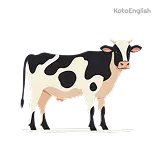
Sheep (noun) — a domesticated animal with a woolly coat, hooves, and a short tail, often raised for wool, meat, and milk. Sheep are generally gentle, social, and kept in flocks.
How to Pronounce “Cow”?
 Audio (UK):

 Audio (US):
Start with the strong c sound like “k,” then prolong the vowel sound to a long ow as in “how.” Finally, gently drop your jaw for the diphthong to finish smoothly.
Level up your English with Koto!
How to Use “Cow” in a Sentence
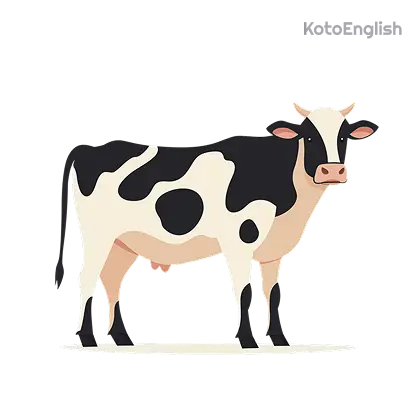
Cows are mentioned a lot in conversations that deal with farming, food, and nature. Take a look at these examples, listen, and repeat to make it a habit to use “cow” in a conversational way.
What Are Synonyms for the Word “Cow”?
The use of synonyms will not only increase the interest and liveliness of your speech or writing but also tremendously widen your vocabulary.
Related nouns: bull calf goat
Synonyms (contextual): none it is a specific noun
Common collocations: dairy cow grazing cow farm cow
“Cow” Word Formation and Description in Context
Keep an eye on how the “cow” cooperates with descriptive words, actions, and other nouns in everyday language use.
With adjectives: brown cow dairy cow grazing cow healthy cow
With verbs: milk a cow feed a cow herd a cow watch a cow
With nouns (noun + noun): cow pasture cow farm cow bell cow feed
Idioms and Phrases with “Cow”
There are lots of expressions with “cow” in English, and when you learn them, you will not only be able to speak but also easily understand the conversations.
-
Till the cows come home — this expression means for a very long time, often longer than expected.
We can argue about ittill the cows come home , but it won’t change his mind. -
Cash cow — a product, business, or asset that consistently generates a lot of profit.
That app turned out to be a realcash cow for the company. -
Holy cow! — an expression of surprise or astonishment.
Holy cow! I didn’t expect to see you here. -
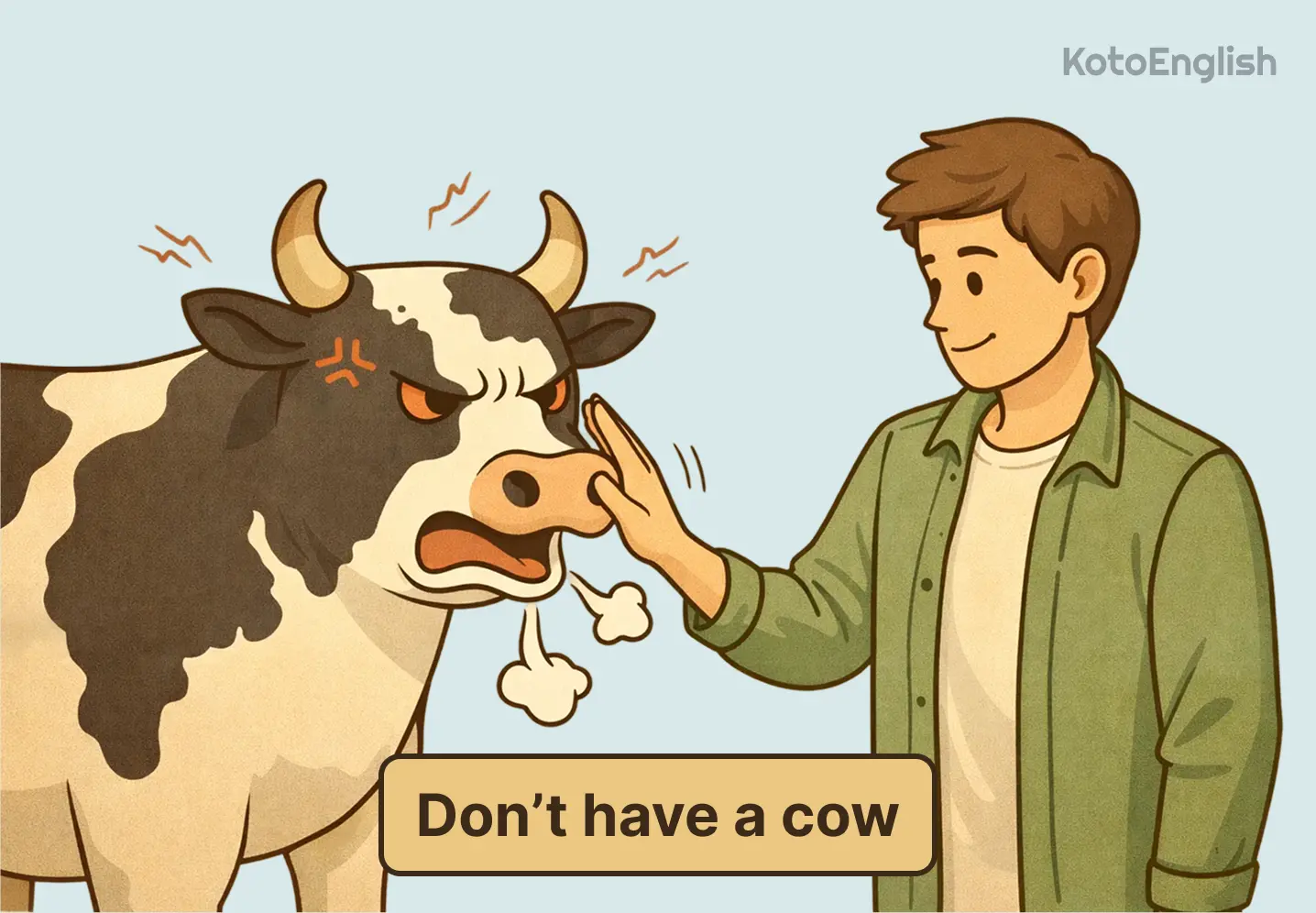
Don’t have a cow — don’t get upset or overreact.
Don’t have a cow — it’s just a small mistake, nothing serious.
Test Your Knowledge of “Cow” Meaning
Check how well you know the word “cow,” its usage, and idioms with this quick quiz!
Enjoy personalized learning!
“Cow” Word in Other Languages
Learn how to say “cow” in different languages to broaden your vocabulary and understanding of animals worldwide.
| Language | Word for “Cow” |
|---|---|
 Spanish
 |
Vaca |
 French
 |
Vache |
 German
 |
Kuh |
Did You Know It? Fun Facts About “Cow”
Cows are animals with their own peculiarities and histories that sometimes even the closest ones to them might not be aware of. Now that you are familiar with the word “cow” and its usage, get ready to be amazed by these facts!
-
Cows have been domesticated for over 10,000 years.
The evidence based on archaeology points to the fact that the first cattle were domesticated in the region of the Near East around 8,000-10,000 years ago. These herbivores have been giving us various products such as milk, meat, leather and labor. -
Cows have excellent memories and social skills.
The scientists have found out that cows can remember the faces of other cows and humans for as long as five years and that they can form herds of tight friends. Furthermore, they have devised a system of different sounds along with body movements to convey feelings like tension, joy, or inquisitiveness. -
Cows almost have a panoramic vision.
They have nearly 360-degree visibility, with just a tiny blind spot at their nose. This is beneficial for them to be vigilant of the wild predators. -
Cows can produce a lot of milk.
In fact, a single high-yield dairy cow is capable of giving over 25 liters (6.5 gallons) of milk every single day. A cow’s lifetime milk production is close to 11,000 gallons, or more than 200,000 cups. Imagine how much cheese or butter can be produced from such a huge quantity.
Famous Quotes Featuring “Cow”
Cows have inspired artists, writers, and thinkers for centuries, not only for their practical role in human life but also for their gentle and thoughtful nature. These quotes show how people have observed cows, reflected on their behavior, and even drawn life lessons from them.
Explanation: The above quotation implies that something as mindlessly mundane and uninteresting as milking a cow can help people think creatively and generate novel concepts.
— Ogden Nash
Explanation: When the poet said the cow provides milk and says “moo” there was almost a mischievous seriousness.
— Thomas de Quincey
Explanation: The quote celebrates the gentle, caring disposition of cows in the particular relationship between a cow and her calf.