
Jeans (noun) — a type of trousers made from strong, thick cotton fabric called denim. People wear jeans every day because they are comfortable, durable, and look good with many clothes. They can be blue, black, or other colors.
How to Pronounce “Jeans”?
 Audio (UK):

 Audio (US):
Start with the j sound like in “jump,” then say eens like “beans.” Always use the plural form — we say “jeans” not “jean.”
Level up your English with Koto!
Examples: How to Use “Jeans” in a Sentence
The definition of “jeans” is simple but there are different ways of using this word. Learn how to do this like a native speaker with the examples below.
What Are Synonyms for the Word “Jeans”?
Learn about the synonymous expressions that come with this word in order to make your English more fluent and natural as a result.
Related nouns: trousers clothing denim
Synonyms (contextual): pants
Common collocations: skinny jeans baggy jeans bootcut jeans
“Jeans” Word Formation and Description in Context
Discover various combinations with different parts of speech to be able to make a description of “jeans” on your own and create meaningful collocations and sentences.
With adjectives: tight jeans faded jeans distressed jeans high-waisted jeans
With verbs: wear jeans put on jeans wash jeans try on jeans
With nouns (noun + noun): jeans pocket jeans fabric denim jeans jeans button
Idioms and Phrases with “Jeans”
Look at what do “jeans” mean in idiomatic contexts. Remember these phrases and try to apply them daily if the situation fits.
-
Mom jeans — high-waisted, loose-fitting jeans that are comfortable and often look slightly old-fashioned.
She woremom jeans to the café because they were comfortable and stylish in a relaxed, retro way. -
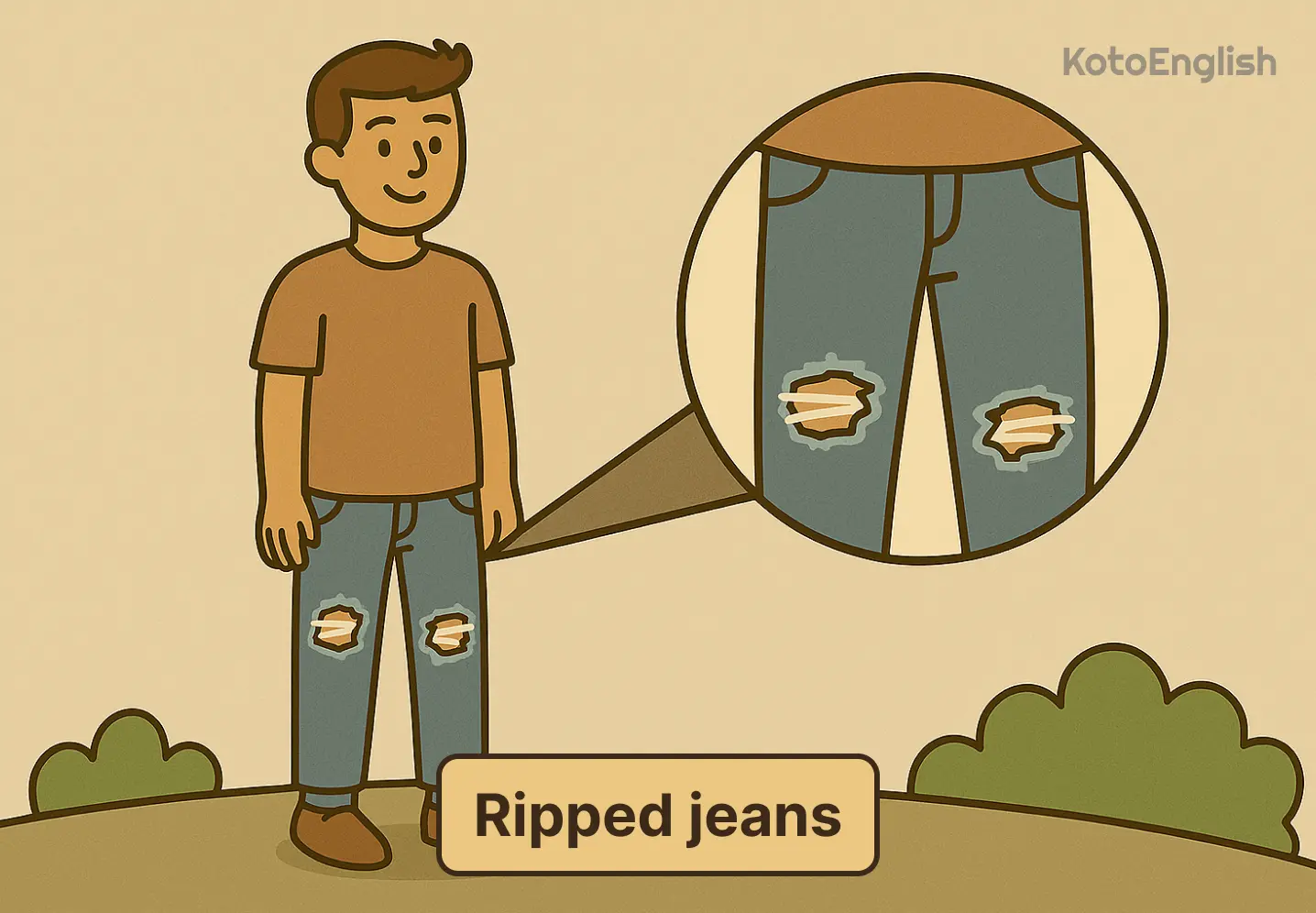
Ripped jeans — jeans that have intentional tears or holes as a fashion style.
He boughtripped jeans to give his outfit a cool, casual, and slightly edgy look.
-
In blue jeans — means to dress casually.
He arrived at the partyin blue jeans , feeling relaxed and ready to have a good time.
Test Your Knowledge of “Jeans” Meaning
Using this intellectual game, check what you remember, define “jeans,” and answer some questions. Practice makes perfect!
Enjoy personalized learning!
“Jeans” Word in Other Languages
Discover how to say this word in other popular European languages and how it sounds.
| Language | Word for “Jeans” |
|---|---|
 Spanish
 |
Vaqueros/Jeans |
 French
 |
Jean |
 German
 |
Jeans |
Did You Know It? Fun Facts About “Jeans”
The definition of “jeans” is straightforward, but the history behind this clothing item is very interesting and surprising. So let’s take a look at these interesting details.
-
Jeans were invented for gold miners.
In 1873, Levi Strauss and Jacob Davis invented the first jeans specifically for gold miners in California who needed sturdy pants for work. They reinforced the pockets with metal rivets to prevent tearing. -
Jeans were once banned in some places.
In the 1950s and 1960s, some schools, theaters and restaurants banned jeans because they were seen as a symbol of rebellion. Today, jeans are accepted almost everywhere, including many offices and restaurants. -
Jeans fade because of the indigo dye’s unique properties.
Indigo dye does not fully penetrate cotton fibers and stays on the surface. Over time, friction and washing wear it away, creating natural fading patterns known as “whiskers” and “honeycombs.” -
The tiny front pocket was made for pocket watches.
In the 1800s, miners and cowboys needed a safe place for fragile pocket watches. This small pocket protected them from damage and remains a classic design feature today.
Famous Quotes About “Jeans”
Explore what celebrities, designers, and actors have said about jeans to understand why this simple clothing item means so much to modern culture.
Explanation: Armani says that jeans can be worn by everyone, regardless of their age, social standing, or even their personal style. They erase social barriers because they are so universal and comfortable that anyone can wear them.
— Yves Saint Laurent
Explanation: With the statement, he is praising the notion of fashion being an expression rather than a restriction. The ability to mix different styles, traditional and new, has been facilitated by the denim’s quality, making it the core around which other fashion items can be arranged.
— Cameron Diaz
Explanation: Jeans have now become the go-to, no-stress solution because they are always fitting, appropriate, and comfortable. They are the reliable choice when everything else feels wrong.