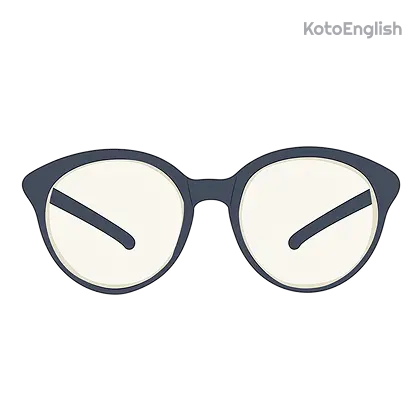
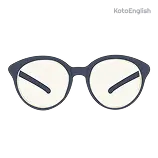
Glasses (noun) — an accessory worn on one’s nose and ears to correct sight. It has two lenses and a frame. The word is plural.
How to Pronounce “Glasses”?
 Audio (UK):

 Audio (US):
Stress the first part, glass, then pronounce the ending -es, with the letter z instead of s, like in the word “roses.”
Level up your English with Koto!
Examples: How to Use “Glasses” in a Sentence?
Read the instances of using the word in real-life situations to grasp the meaning of “glasses.”
What Are Synonyms for the Word “Glasses”?
If you use this word too many times and want another with the same connotation, you have many options to choose from. Collocations will help you improve the “glassess” description.
Related nouns: lens frame
Synonyms (contextual): spectacles eyewear eyeglasses
Common collocations: wear glasses clean glasses cheap glasses
“Glasses” Word Formation and Description in Context
Glasses in English pair with other parts of speech, enabling you to enrich your vocabulary:
With adjectives: expensive glasses old glasses new glasses broken glasses
With verbs: put on glasses take off glasses buy glasses repair glasses lose glasses
With nouns (noun + noun): reading glasses driving glasses protective glasses
Idioms and Popular Phrases Featuring “Glasses”
Even knowing how to define “glasses,” you may need time to understand idioms and phrases with the word (however, the number of them is limited).
-
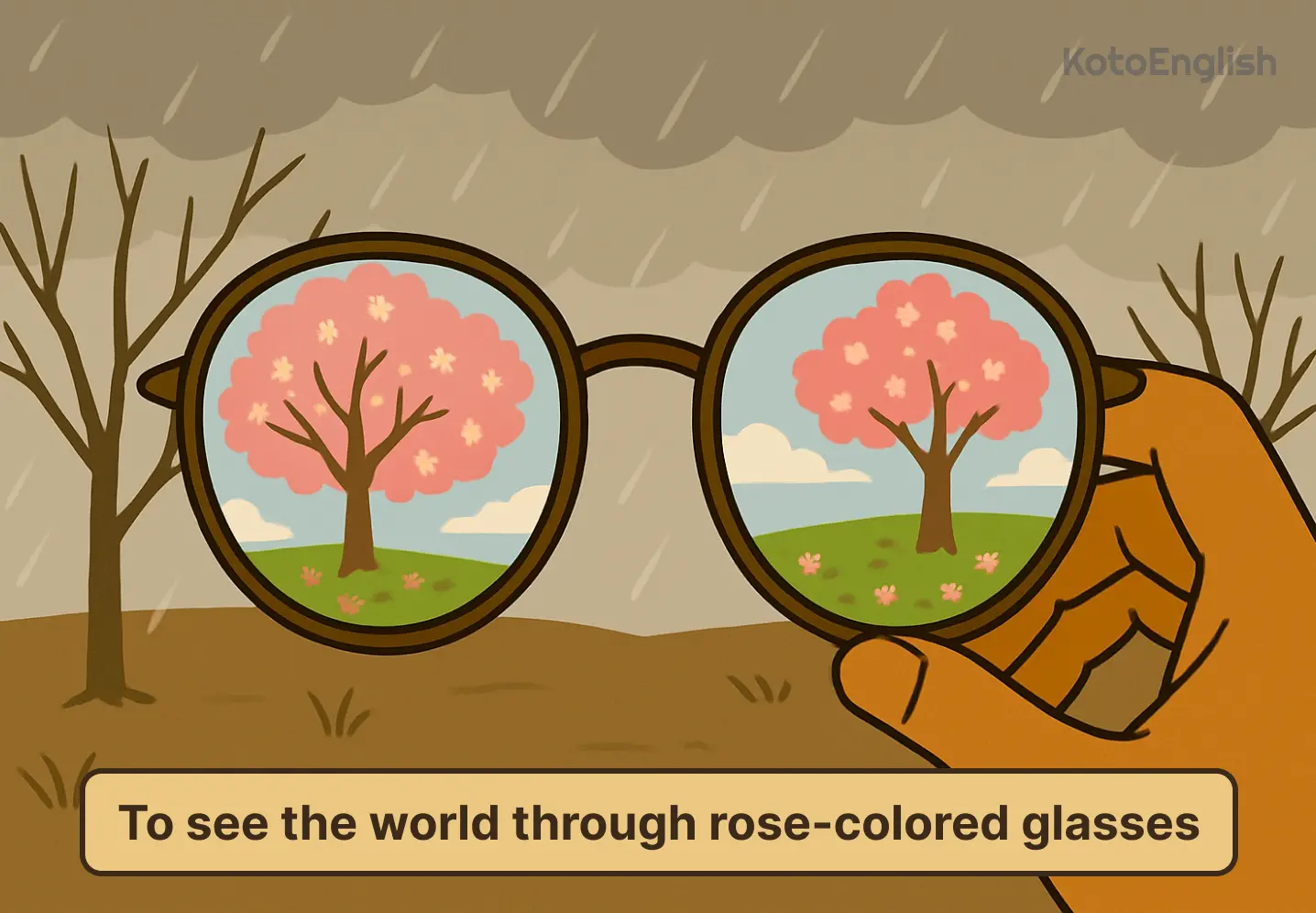
To see the world through rose-colored glasses means to be overly optimistic.
It’s not easy to accept reality when yousee the world through rose-colored glasses .

-
A glasses prescription is a document given by an eye doctor that tells a patient what lenses to wear.
I can’t see well. On Monday, I have an appointment with my eye doctor to get aglasses prescription .
Test Your Knowledge of Glasses’ Meaning
Complete these exercises to find out how well you’ve learnt the description of glasses.
Enjoy personalized learning!
“Glasses” Word in Other Languages
How to say “glasses” in the most spoken European languages? Let’s check now. Check the pronunciation by pressing the button.
| Language | Word for “Glasses” |
|---|---|
 Spanish
 |
Gafas |
 French
 |
Lunettes |
 German
 |
Brille |
Did You Know It? Fun Facts About “Glasses”
From proto-glasses to modern smart accessories, you will find the most interesting details from the history of eyewear.
-
The first glasses appeared in the 13th century.
This significant element was invented in Italy at the end of the 13th century. What did people use before this invention? So, people in the ancient world used reading stones that could magnify texts. -
The biggest glasses were made in the Netherlands.
In 2004, Errold Jessurun crafted a large pair of glasses. Its lenses were 68 cm in diameter and 38 cm in height. The lenses had a strength of +1.25. The achievement was noted by Guinness World Records. -
John Lennon’s glasses cost more than $180,000.
A pair found in Ringo Starr’s car was sold at a high price despite a minor defect. However, the most expensive eyewear costs approximately $400,000, as it is made of gold and brilliants. -
Smart glasses are like small phones.
Listening to music, answering calls, and taking pictures — these are features that modern glasses from Xiaomi, Ray-Ban, and Nreal offer buyers. They are very helpful when your hands are busy.
Famous Quotes Featuring “Glasses”
Knowing what “glasses” mean and collocations and idioms featuring this word, you’ll be able to enjoy some good sayings from designers and writers:
Explanation: That’s the irony of becoming famous. People work hard to be noticed, praised and welcomed, but when they achieve what they want, they lose their privacy, hiding behind dark glasses.
— Vivienne Westwood
Explanation: For this legendary British designer, glasses were not an attribute that improved her vision or an accessory. She treated them as a significant element of her style.
— Charles William Eliot
Explanation: This phrase is the opposite of the idea of wearing rose-colored glasses. People tend to treat reality too positively or too negatively, in shades of gray and brown. The safe option is to find a golden mean.