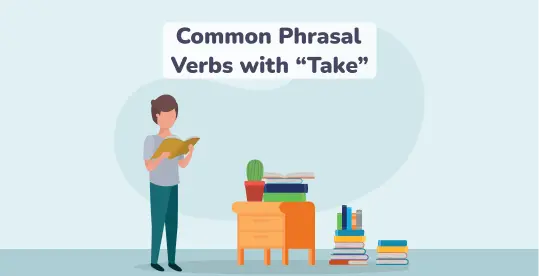
What is a phrasal verb?
Phrasal verbs are combinations of two or more words that construct an entirely different phrase. They consist of a verb with an adverb or a preposition and the meanings of them are usually unrelated to the phrasal verb itself.
Merriam-Webster defines a phrasal verb as:
“a phrase that combines a verb with a preposition or adverb or both and that functions as a verb whose meaning is different from the combined meanings of the individual words”
For instance, the phrasal verb get around means to travel to many different places. With that being said, if you separate get and around, the verb and adverb will mean completely different things.
The most common prepositions that are used to create phrasal verbs are:
- up
- down
- in
- on
- off
- away
- over
Today, we will be discussing only phrasal verbs with the word “take,” so let’s get started!
Why are phrasal verbs with “take” so common?
At its core, “take” carries a sense of seizing, receiving, or transitioning — making it semantically elastic enough to stretch across dozens of contexts.
When you take on a challenge, take over a company, or take offence, you’re always moving something (a task, power, an emotion) into your sphere of influence.
This verb naturally maps onto human experiences of agency: grabbing control, shouldering responsibility, or reacting. Its Germanic roots also favor short, punchy combinations with particles — a pattern English inherited and never abandoned.
Common meanings of “take” in English phrasal verbs
English has dozens of phrases with “take.” It seems impossible to memorize each one. The good news: you don’t have to. These combinations follow predictable patterns based on the core meaning of “take.”
When you grasp the logic, you automatically recognize the meaning, since it is based on how your brain works. Here are six categories that cover most likely every phrasal verb with the word “take.”
- Responsibility: Take on duties or take up a cause. You accept an obligation.
- Movement: Take off, take away, take back. The verb moves something from one point to another.
- Control: Take over, take charge. You seize authority.
- Removal: Take out, take down, take apart. You extract or eliminate something.
- Reaction: Take offense, take something personally. You internalize an external event.
- Emotions: Take heart, take comfort, take pride. You accept and absorb a feeling.
The overriding principle that ties all six together is that “take” involves movement towards the self.
The next time you encounter an unfamiliar phrasal verb with the word “take” while learning English, reading, or listening to something, ask yourself: “What is being pulled towards the subject?”
25 phrasal verbs with “take”: meanings and examples
Learning what “take” in a sentence means and how to use it correctly in a conversation could greatly improve your language skills. As well as create an appearance of a more fluent and confident English speaker.
Here are 25 phrases and even more sentences with “take” that we are going to be focusing on today:
- Take aback
- Take away
- Take after
- Take against
- Take apart
- Take aside
- Take back
- Take over
- Take down
- Take off
- Take for
- Take to
- Take up
- Take on
- Take in
- Take out
- Take through
- Take it out (on)
- Take it upon (oneself)
- Take up (on)
- Take care of
- Take part in
- Take place
- Take advantage of
- Take into account
We will give you a definition for each of these phrasal verbs. Additionally, we put example sentences under each to give you a better understanding of the context.
Be sure to practice these verbs out loud as it helps memorize new words and meanings faster!
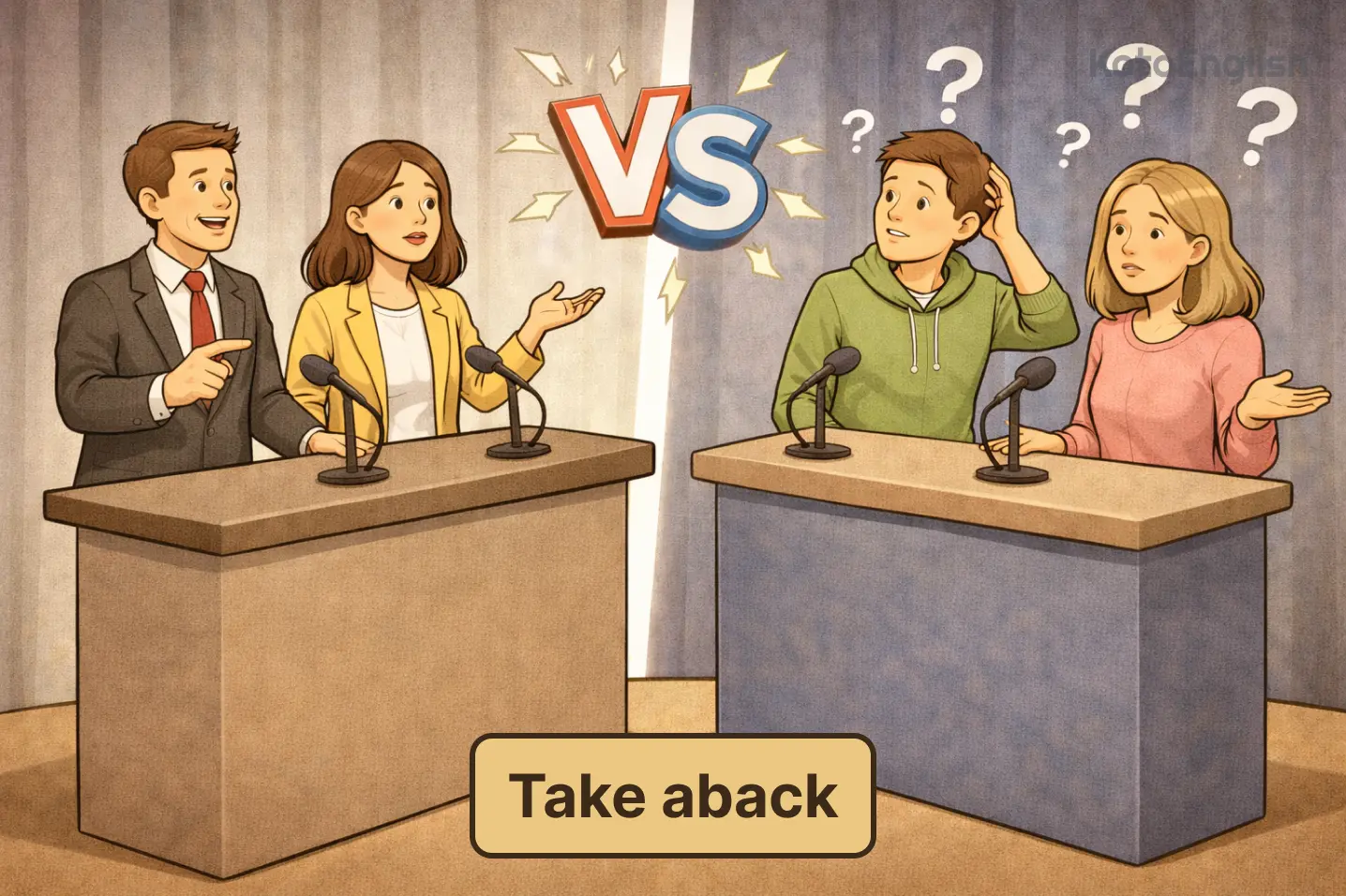
Take aback
To surprise or shock someone when they weren’t expecting it. Usually, this phrasal verb is used as (to be) taken aback.
Take away
To remove something so that someone no longer has it. In some cases, it also means reducing the value of something or someone.
- To take something from a person:
- To reduce the value:
Take after
To resemble someone in your family by characteristics, appearance, mannerisms, etc.
Take against
To begin to dislike someone, sometimes for no good reason.
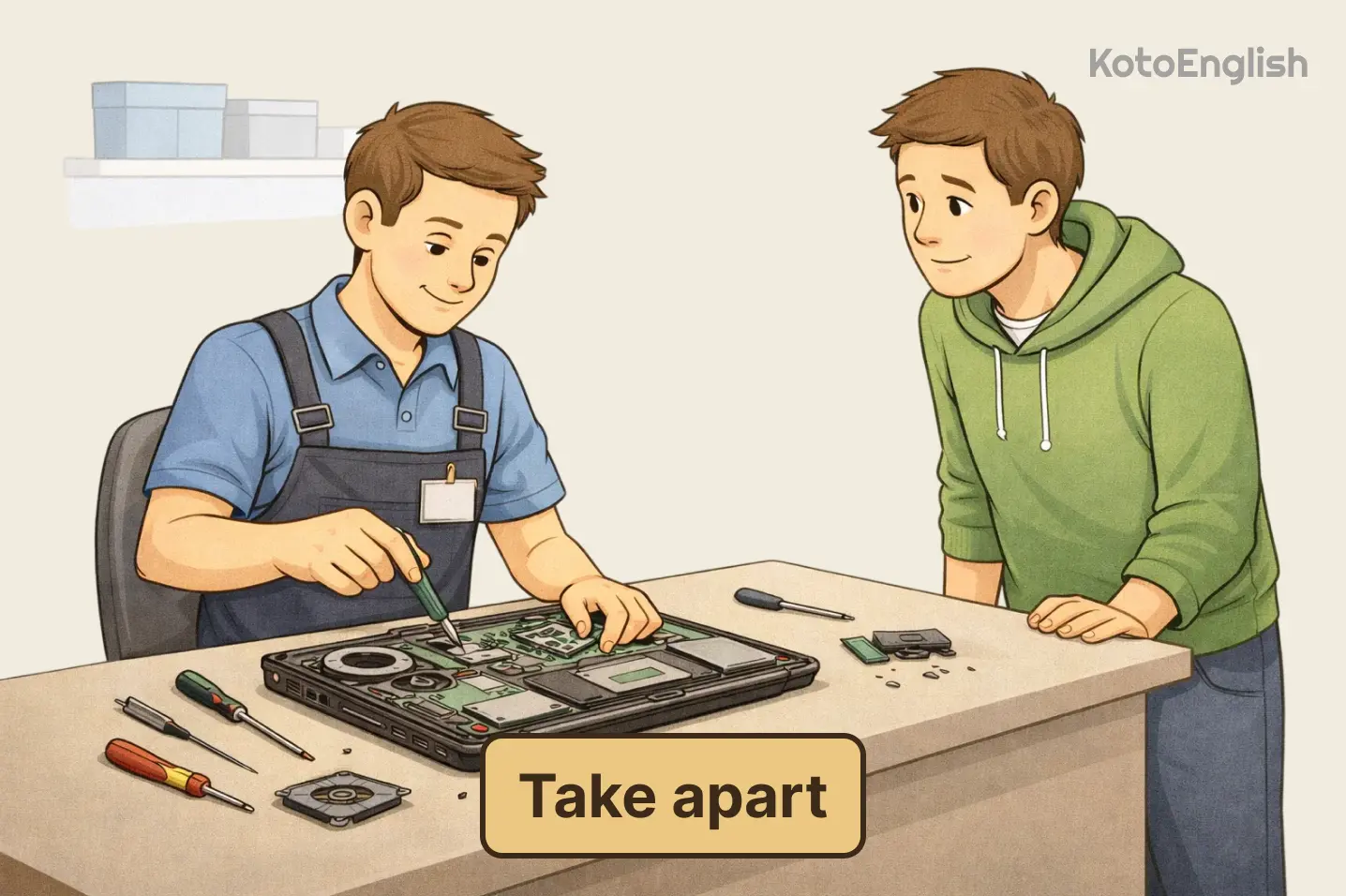
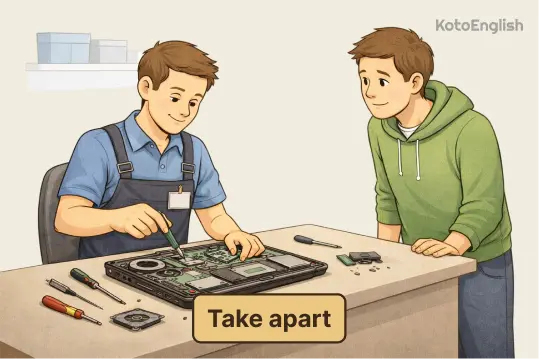
Take apart
To break something down into multiple parts.
Take aside
To take someone away from a person or people they are with in order to speak to them privately.
Take back
To return something after borrowing or buying it. It can also mean to withdraw your statement after realizing it was wrong.
- To bring something back to its owner or the shop after use:
- To retract your statement once you understand it was incorrect:
Take over
To take control of something, or to do something that someone or something did before.
- To gain control of something:
- To carry on the work done before:
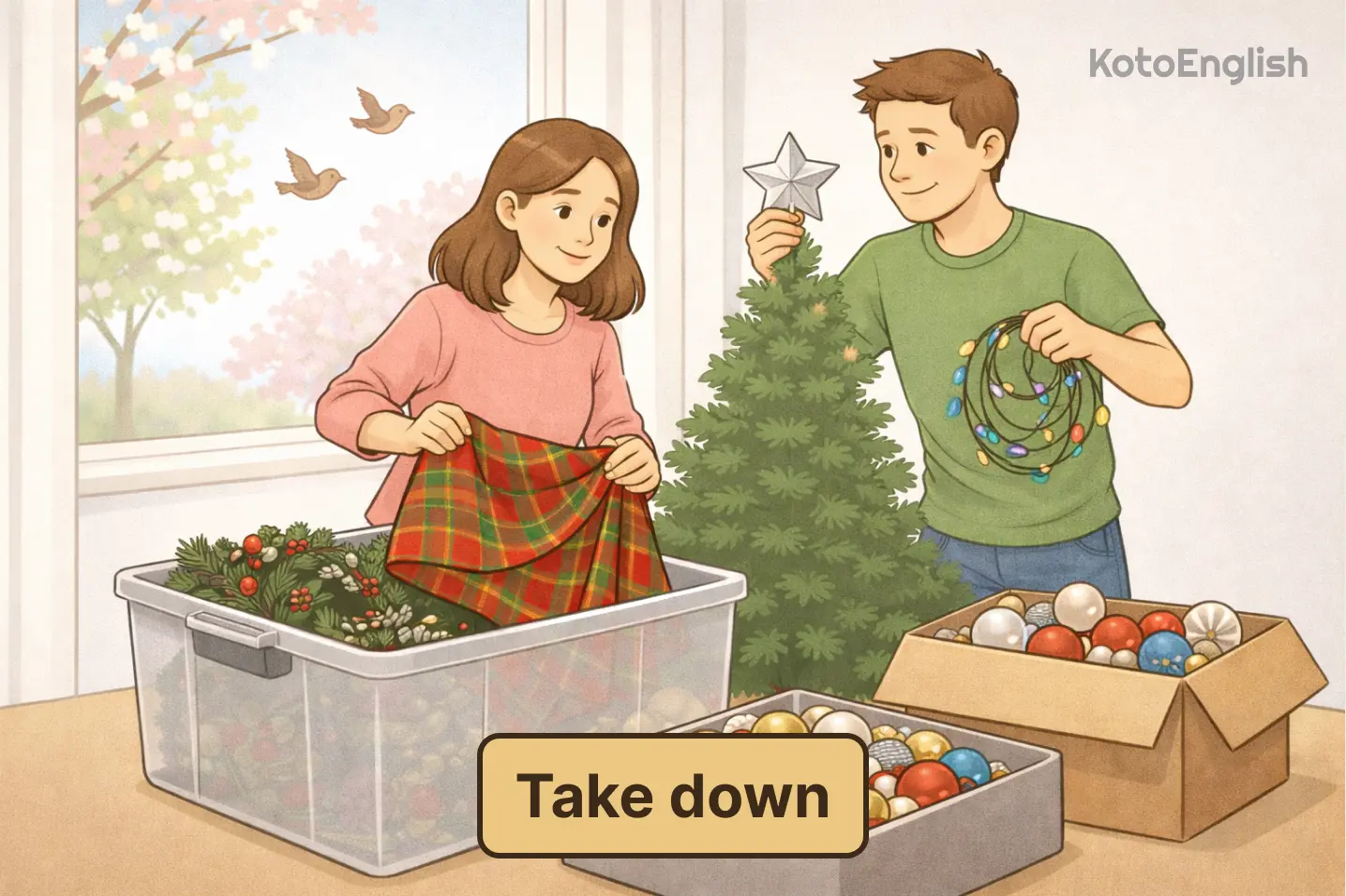
Take down
To remove something from a high place, like a top shelf, or generally put it away. Sometimes, it means to defeat or stop someone from causing harm.
- To put something away:
- To stop someone from doing bad things:
Take off
To remove something, usually in the context of clothes. It can also mean to reduce the price as a discount or to quickly rise from one place and move to another.
- To remove clothes:
- To make a price lower in the form of a discount:
- To go from one place to another:
Take for
To prematurely assume something, usually about someone.
Take to
To start liking someone or something. To start doing something often. Sometimes to go somewhere because of being in a difficult or dangerous situation.
- To begin to like someone or something:
- To start doing something regularly:
- To seek a place due to danger or trouble:
Take up
The meaning here is to start doing something habitually. Also means to occupy space.
- To start doing something regularly:
- Filling a particular amount of space:
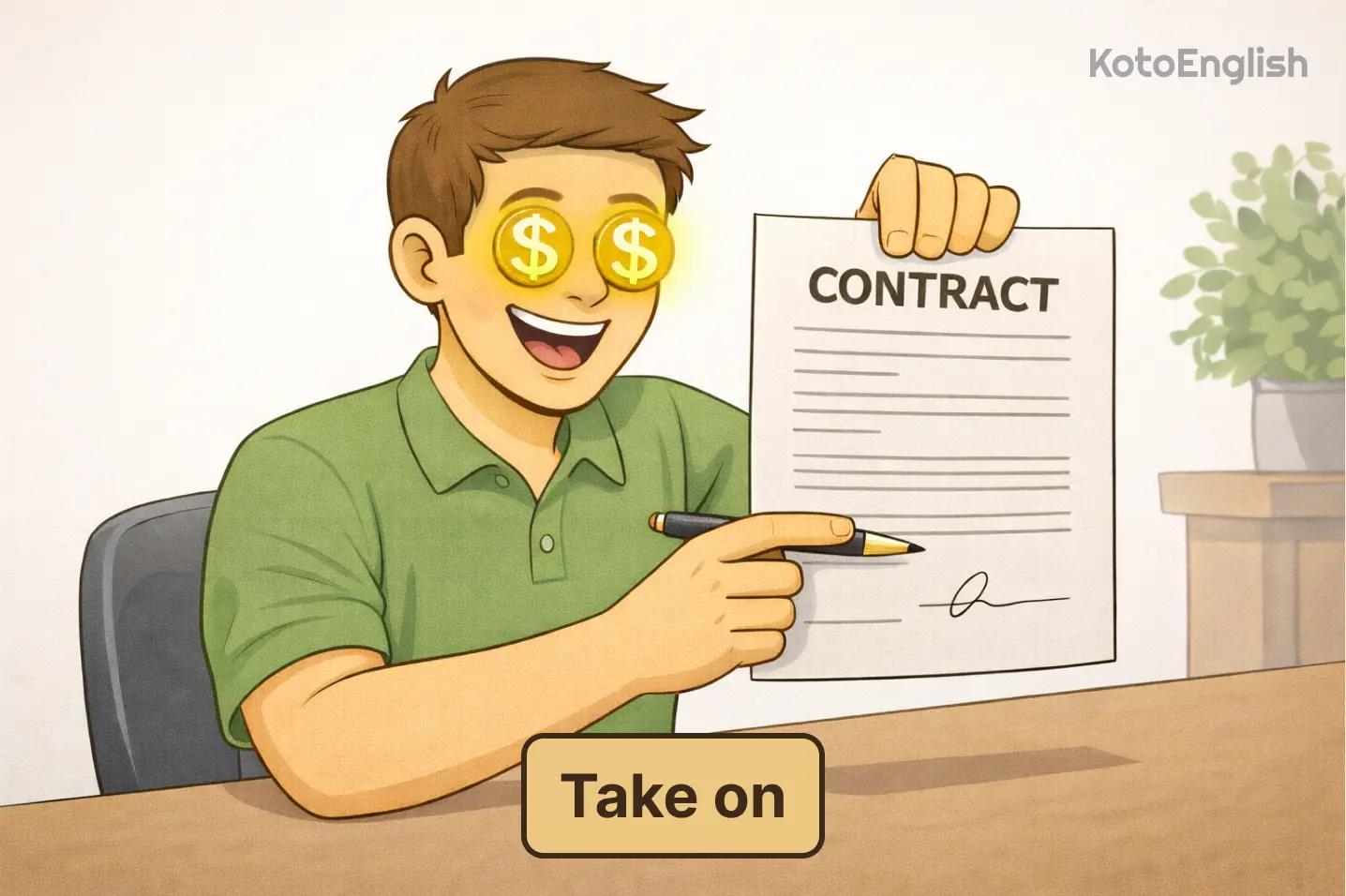
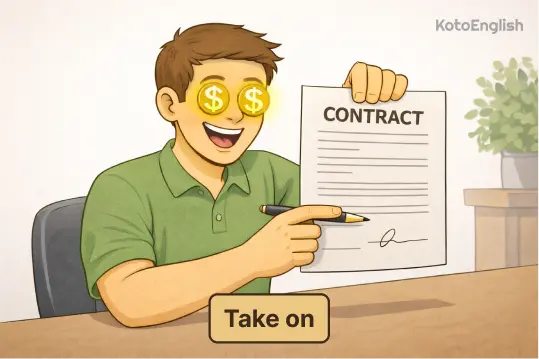
Take on
This phrasal verb is used to talk about accepting a job or assuming some kind of responsibility.
Take in
It means to allow someone to stay in your house.
Take out
To withdraw or remove something. To take someone out means inviting them to a date or to eat at a restaurant.
- To take something away:
- To invite someone:
Interesting detail: the word “takeout” means ordering food from a restaurant to eat at home.
Take through
It is used to explain in detail to someone how a certain thing or job is meant to be done.
Take it out (on)
To cause someone harm or make them feel bad because of your own misfortunes. Usually, people take it out on somebody who isn’t at fault.
Take it upon (oneself)
Taking something upon yourself means to accept responsibility for something even if you weren’t asked to do it.
Take up (on)
To accept an offer or an invitation.
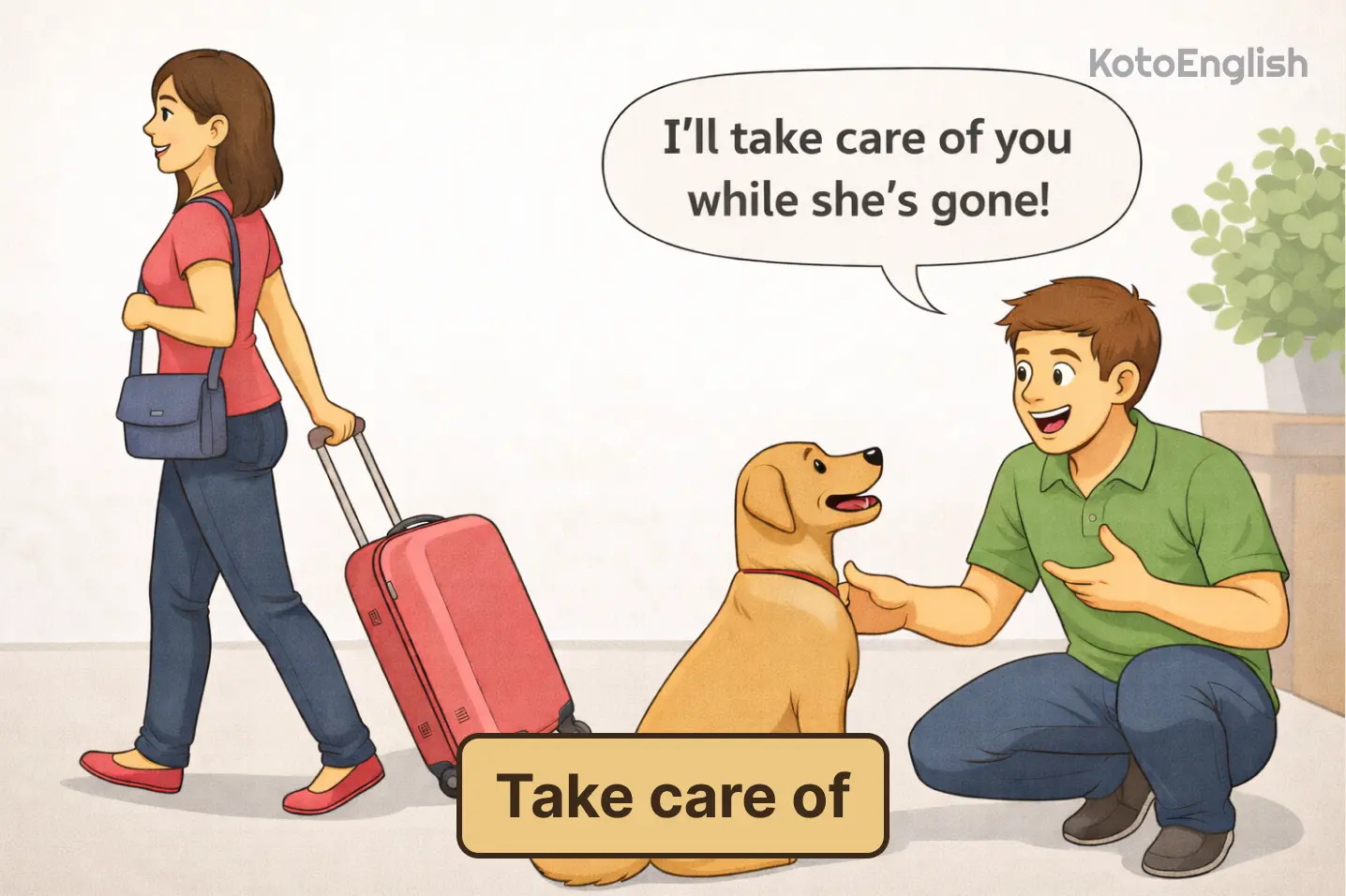
Take care of
To look after or to be responsible for a task.
Take part in
To participate in a certain activity.
Take place
It’s all about when or where an event happens.
Take advantage of
To use an opportunity to do something or succeed; exploit someone or something to reach your goal.
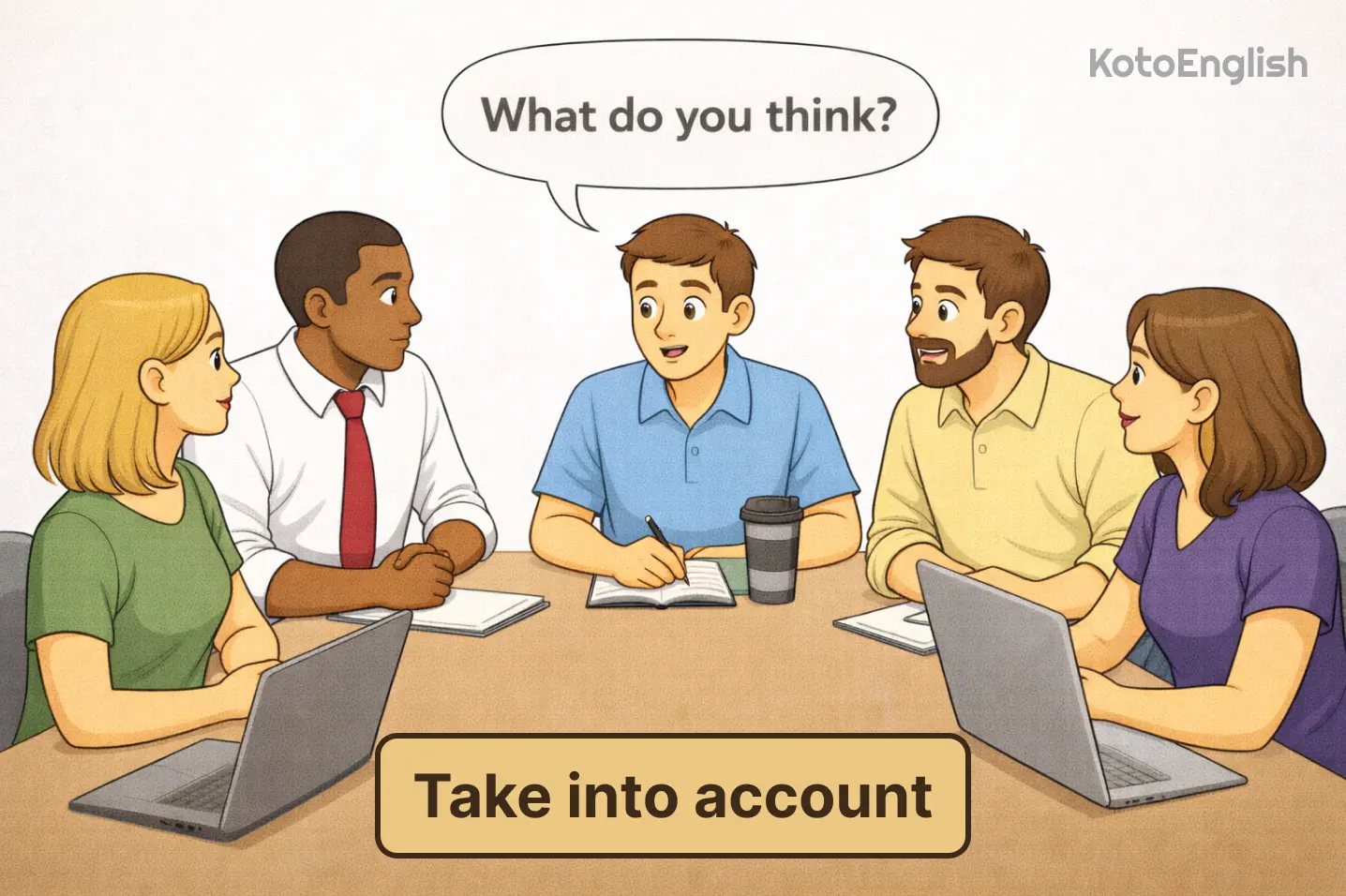
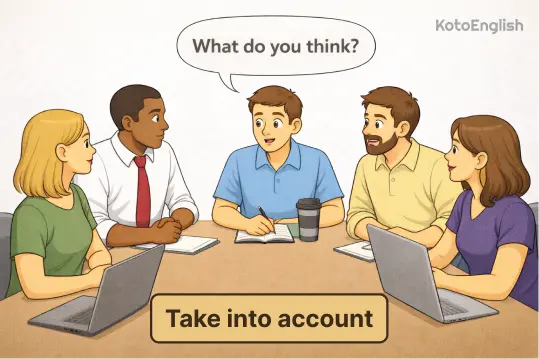
Take into account
The meaning here is straightforward — to consider.
Common mistakes learners make with “take”
English phrasal verbs with “take” cause trouble for learners at every level. The combinations look simple, but small errors change the meaning completely. Most mistakes fall into three categories: confusing similar phrases, placing words in the wrong order and dropping necessary prepositions.
Each error type has a clear fix once you understand the pattern.
- Confusing similar phrases
The confusion between take on and take out happens because the phrases sound alike. The prepositions signal opposite directions. As we know, taking on means accepting responsibility or a challenge.
On the other side, take out focuses on removing something from a place. Remember that on pulls inward, out pushes away.
|
He took out a new challenge.
|
He took on a new challenge.
|
|
Please take on the trash.
|
Please take out the trash.
|
- Wrong word order
Errors with the right word order show up in separable phrasal verbs. For example, when pronouns are involved, they must be placed between the verbs and the particles in a phrasal verb with “take.” Take it out is correct and take out it is not.
Using nouns allows both positions, so take out the trash or take the trash out is okay.
|
Please take out it after dinner.
|
Please take it out after dinner.
|
|
Please take back it if it doesn’t fit.
|
Please take it back if it doesn’t fit.
|
- Avoidance of vital prepositions
When prepositions are absent, it confuses the listener or reader. Compare these different examples: take care of … means take care of something specific that you mention. Take care alone only functions as a saying when you bid farewell to a person.
It is of the utmost importance to use the correct preposition with “take” in a phrasal verb, since even the change from on to in can make your message unclear or even insult somebody in certain contexts.
|
Please take care this issue before Friday.
|
Please take care of this issue before Friday.
|
|
Adam, take care my dog before I return.
|
“Take care!” he said as he left the room.
|
Quick practice quiz
To progress in learning English and especially with something as complex as phrasal verbs it is vital to practice consistently with different types of exercises. Go through the following tasks and test how well you understand this topic and can define which phrasal verbs to use according to contexts.
Summarizing phrasal verbs with “take”
There are many ways for non-native English speakers to learn how to make their speech sound more natural. Studying and understanding phrasal verbs is fundamental for the development of your English skills in the long run if you want a visible result.
Learning all English phrasal verbs with “take” is not a one-day exercise, especially considering how many versions of this phrasal verb exist. However, as you learn these phrases by blocks of meaning and practice incorporating them into your speech, you will memorize them faster.
In this article, we looked at 25 “take” phrasal verbs, explaining what each of them means and how to use them in a sentence. Be sure to come back to this article as you learn new phrasal verbs. Good luck with your English journey and remember, practice makes everything perfect!
Frequently asked questions (FAQs)
It is a fixed combination of the verb take and one or more particles (such as up, off, over, in, away) that function as single semantic units, often producing meanings that cannot be understood literally.
It is a high-frequency and basic verb, which is why it has a very good adaptability. Gradually, its original conception of “holding” or “receiving” was broadened through metaphorical interpretation, making it capable of conveying notions such as choice, reaction, time and work.
They come in different forms and are commonly used in daily conversation and also in informal writing, thus making the communication sound natural and fluent. Nevertheless, there are a few that are completely accepted in formal situations.
For example:
- To take into consideration
- To take responsibility
For instance, the verb “take off” might signify removing one’s garment, an airplane leaving the ground, or a sudden success based on the context. It is crucial to get the surrounding words and the situation in order to accurately understand the intended meaning.