Meaning of the verb “set” in English phrases
The English language has an infinite number of phrases with the verb “set,” which may come across as a lot to handle. The silver lining: there is no need to memorize each one separately.
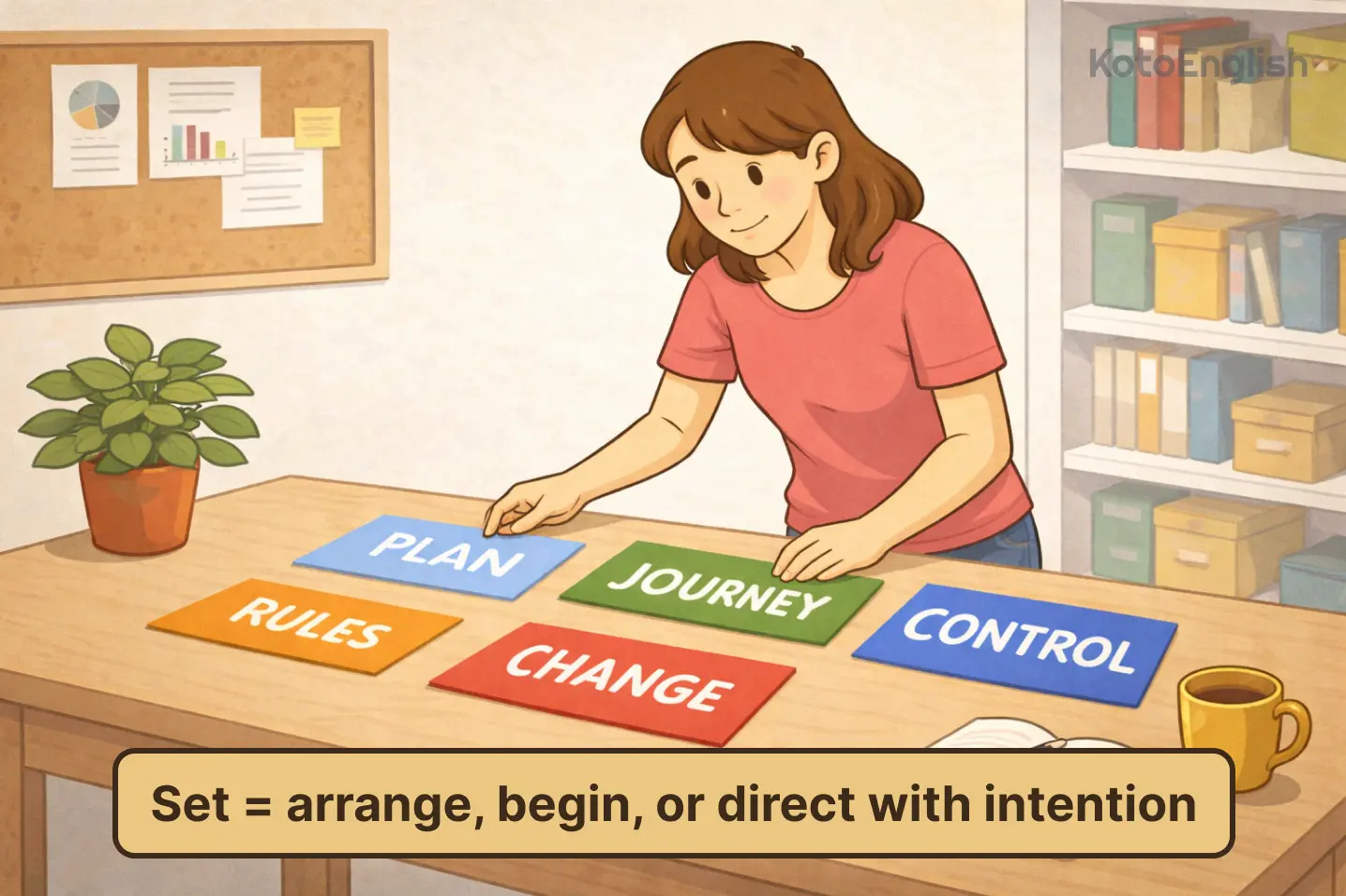
The greater part of “set” phrasal verbs is built around the basic meanings or concepts. Understanding the logic makes it rather common to draw the meaning from the context. The 6 categories below take in most of the idioms.
- Position or placement. Set down, set aside, set up. These expressions are related to putting something in a particular location or arranging it purposefully.
- Beginning or initiating. Set out, set off, set about. The action, journey or process is being undertaken at your behest.
- Timing or progression. Set in, set back, set forward. The times when something starts, develops or gets delayed are their main focus.
- Control or preparation. Set up, set straight, set right. These are about putting things in order, making adjustments or exercising power over a particular situation.
- Limitations or rules. Set limits, set boundaries, set terms. You are stating the rules, the restraining conditions or the terms.
- Reaction or change. Set aside differences, set fire to, set in motion. These involve organizing, adjusting, or gaining authority over a situation.
The common thread among this phrasal verbs with “set” list is that “set” expresses a conscious act, a modification, or a prelude — something that is actively organized or placed.
When next you confront a strange to you “set” phrase in English, put the question: “What is being arranged, initiated, or directed?”This way of thinking will support you in unraveling the meanings effortlessly.
15 Common phrasal verbs with “set”
The way “set” functions in phrasal verbs learning can impact your English fluency and the way you sound to the listeners. To facilitate your learning process, we have classified 15 frequently used phrases with “set” according to their meanings, along with examples. Today’s focus is on the next 15 commonly used English phrasal verbs with “set.”
- Set up
- Set off
- Set out
- Set aside
- Set in
- Set back
- Set free
- Set loose
- Set right
- Set down
- Set apart
- Set back on
- Set about
- Set against
- Set upon
Speak them out loud to recall their use quickly.
The way “set” functions in phrasal verbs learning can impact your English fluency and the way you sound to the listeners. To facilitate your learning process, we have classified 15 frequently used phrases with “set” according to their meanings, along with examples. Speak them out loud to recall their use quickly.
Set up
This phrasal verb has various meanings and it can indicate that something is being started or created, plans are being arranged, or even that someone is being deceived. It all depends on the context to help you out in inferring the correct meaning. Another use of this phrase, written as a setup, is also used as a noun to mean different things.
- To start or create something:
- To arrange plans or organize something:
- To trick or frame someone (set someone up):
Set off
Employ “set off” in the case of the commencement of an event, for instance, a trip, or when a certain circumstance brings about an event. The term has a common connotation of activity beginning at a particular location.
Set out
In my own words, “setting out” is to do an activity or begin a journey with a purpose. It emphasizes the intention and direction behind the action.
- To start a journey or activity with purpose:
- To display or present something:
Set aside
The term “set aside” refers to the act of saving, reserving, or temporarily overlooking something in order to direct attention to a different activity.
Set in
This phrase is quite often used to describe phenomena that are just starting and will probably last for some time like weather, emotions, or a circumstance. Besides, it signifies that the change that has been established is very likely to be accepted.


Set back
When different aspects of a process fall out of step regarding the maintenance, development, or creation of cloud or mobile applications, a “set back” gets in place. The word “setback” can also be used as a noun and refer to the same situation.
Set free
To set someone free means to release them from confinement, imprisonment, or control. It emphasizes giving freedom to someone or something.
Set loose
Inducing freedom or surrendering control is understatedly expressed in this line. This may include humans, animals, ideas, or forces.


Set right
The expression “set right” is applied in contexts where a mistake is being corrected or a problem is being solved. This term indicates not only the act of correcting but also the restoration of order or the re-establishment of proper conditions.
Set down
The term “set down” in a common way refers to the careful placing of an object on a surface or to the formal recording of rules, ideas, or information. It highlights both the aspects of placement and documentation.
Set apart
This phrase highlights what makes someone or something special or different from others. It often emphasizes qualities or characteristics that distinguish them.
Set back on
Used in more formal contexts, a phrasal verb with the word “set” — to “set back on” refers to being affected by something that forces you to reconsider or return to an earlier state.
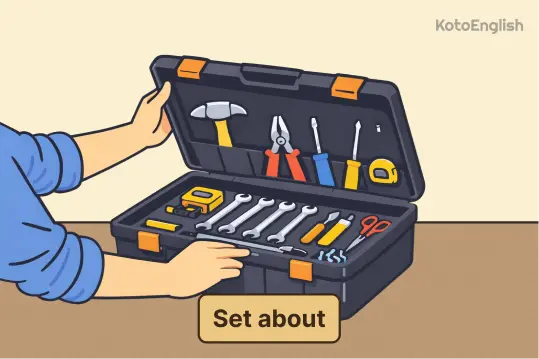
Set about
“Set about” describes the energetic start of an activity by an individual or group of individuals. It conveys the sense of having a goal and being determined to accomplish it.

Set against
A definition includes setting someone against someone, which means making two people dislike each other. In this case, this expression is similar to one of the phrasal verbs with “take.”
Set upon
As one of our last phrasal verbs with the word “set” for today, the expression to “set upon” relates to preparing to physically or verbally attack or harass another person. An alternative meaning of this verb is to make an offensive move in a certain game or sport.
Common mistakes when using “set” phrasal verbs
The compatibility of English phrasal verbs and the word “set” can be a major source of confusion for students at all levels. Even though the mistakes seem to be very minor, the wrong use of these verbs can lead to a drastic shift in meaning.
Most of the mistakes are made because of these three reasons: confusing similar phrases, wrong ordering of words, and leaving out important prepositions. When someone knows the reasons for these errors, then it is not going to be a problem to fix them.
Confusing similar phrases
“Set aside” and “set apart” are terms that learners frequently mix up. Although they sound alike, their meanings are very different. “Set aside” relates to the act of keeping or saving something, whereas “set apart” highlights the process of making a person or thing special or different.
|
She set apart some money for her trip.
|
She set aside some money for her trip.
|
|
This award sets aside her from the others.
|
This award sets her apart from the others.
|
Wrong word order
Separable phrasal verbs require pronouns to be placed between the verb and the particle. Using the wrong order can make your sentence sound unnatural.
|
Please set back on it if needed.
|
Please set it back on if needed.
|
|
Set free the bird carefully.
|
Set the bird free carefully.
|
Avoidance of vital prepositions
Dropping prepositions after the “set” in a sentence may lead to confusion for the listener or even alter the meaning completely. For instance, setting out on a journey needs the preposition on. “Set out” a journey without on gives the impression of being incorrect and unnatural.
|
She set out her journey early in the morning.
|
She set out on her journey early in the morning.
|
|
The alarm set off by mistake.
|
The alarm was set off by mistake.
|
Tips for learning phrasal verbs with “set”
Phrasal verbs with “set” might give you a hard time like a puzzle piece, but spotting the patterns will turn them into a much easier task to handle. Do the opposite of memorizing long lists and focus instead on understanding how the particle changes the meaning.
Group by meaning. Phrasal verbs can be organized into many different categories, such as starting/creating (set up), beginning/journey (set off, set out), fixing/correcting (set right), or freeing/saving (set aside, set free). When you group them by meaning, it even becomes automatic to guess the meanings.
Learn in context. Reading sentences or listening to conversations where “set” phrasal verbs occur will cement their usage in your mind. Context is much more powerful than lists.
Use visual aids. Learning through flashcards, tables, or charts showing the verb, particle, and meaning is much more enjoyable and less like homework. You can even add example sentences so you can see them in action.
Practice actively. You can try writing your own sentences, recording yourself, or even “teaching” the verbs to a friend. When you actively use them, they become locked in your memory.
Review frequently. The best way is to have short, repeated sessions. Revisiting phrasal verbs weekly ensures they are there and not gone.


The key to acquiring English phrasal verbs with “set” is to see patterns and use them with ease rather than memorizing every single phrase. After a little practice, these problematic verbs would quickly become some of your most effective English language tools.
Practice section
One of the best ways to learn the English language is to practice regularly through different kinds of exercises when it comes to sentences with “set.” Do the exercises provided below and see your comprehension of expressions with “set” in real-life situations.
Conclusion
Phrasal verbs have been a source of fascination for people learning English for a long time because they are simple to use, but at the same time, they are able to convey a rich and expressive meaning. In this discussion, we have looked at 15 widely used phrasal verbs with “set” which can make your speaking skills stronger and your daily vocabulary broader.
Grasping the patterns of those verbs and doing regular practice will change the difficult subject into a strong advantage on your road to English communication with confidence.
Frequently asked questions (FAQs)
“Set up” is the most typical and adaptable phrasal verb that has “set” as its base. It is quite often employed in the contexts of business, daily conversation, and writing to denote the beginning, the arrangement, or the creation of something, and in specific cases, the meaning will be that of deceiving someone.
The majority of the phrasal verbs that contain the word “set” are neutral in their tone. They are applicable in various situations such as daily conversation, business talks, academic writing and media, depending on the context. The expressions “set up,” “set out” and “set aside” are often found in formal documents.
Certainly, numerous phrasal verbs with the word “set” possess several meanings. For instance, “set up” might refer to arranging, founding, or tricking someone. The right understanding is always conditioned by the context.
The verb “set” has been considered one of the oldest and most versatile among the verbs of the English language. Gradually, it got fused with various particles and contexts, which enabled it to cover such a wide array of meanings as those related to position, beginning, control, change, and intention.