
What does the verb come mean?
The word “come” helps you convey the idea of moving toward a point of reference.
You can use it to describe:
| Aspect | When to use | Examples |
|---|---|---|
| Movement or arrival | Someone or something moves, returns, or enters. |
|
| Change of state or opinion | These verbs describe a change in a person’s attitude or condition. |
|
| Results or outcomes | You can use them to talk about someone’s actions that lead to a result. |
|
| Occurrence or development | Something happens or progresses |
|
This focus on direction and movement blends this word perfectly with prepositions like up, across, out, and into. But when they couple, many of these phrases transition from physical movement to abstract ideas.
Most common phrasal verbs with “come”
Phrases with “come” will help you sound confident, as they allow you to express your ideas more concisely.
Here are 25 English phrasal verbs with “come” that we are going to explore right now:
- Come after
- Come across
- Come about
- Come along
- Come away
- Come apart
- Come around
- Come at
- Come back
- Come by
- Come between
- Come down
- Come down to
- Come down with
- Come forth
- Come from
- Come for
- Come in
- Come off
- Come out
- Come over
- Come through
- Come together
- Come to
- Come up
Below, you’ll find the contexts in which the verb is used and see examples of “come” in a sentence for each case.
Come after
Starting off our list of “come” phrasal verbs, come after encodes movement toward a specific target.
- To chase someone in order to capture:
- To follow in time or order:
Come across
The meaning of come across depends on whether it’s used with an object or not.
- To behave a certain way that makes an impression about your character:
- To accidentally find something or meet someone:
Come about
When something comes about, it simply means to happen.
Come along
Coming along means arriving at a place of destination, especially when accompanying someone.


Come away
To come away shifts from physical separation to someone’s impression.
- To detach physically:
- To leave a situation with an idea or impression:
Come apart
To come apart means to break into small pieces. This expression can also be used figuratively to describe a situation.
Come around
It’s an inseparable phrasal verb that can refer to time, opinion or movement.
- To visit someone:
- To change your mind about something:
- To happen after some time (typically refers to events and seasons):
Come at
To come at someone means moving in their direction, physically preparing to attack them. The expression can be used to describe a verbal confrontation as well.
Come back
When someone or something comes back, it means they return to their original place. Interestingly, the joint word “comeback” refers to giving a snarky or witty reply to someone’s comment.
Come by
The meaning of this phrasal verb with “come” depends on whether it is followed by an object.


- To obtain something:
- To visit a place:
Come between
When a particular problem or situation arises between people, it means it harms their relationship and causes them to disagree.
Come down
If something comes down, it becomes physically or figuratively lower, i.e., descending in level.
Come down to
When a situation or a choice comes down to something, it refers to the most influential or fundamental factor.
Come down with
Coming down with means to suddenly become ill.


Come forth
To come forth means to step out into view physically or to tell the truth about something figuratively.
Come from
Coming from refers to a stative expression rather than an event or an action.
- To originate in a place:
- The cause of the problem or situation:
Come for
When someone comes for another person or an object, it means they arrive to collect or escort it. This phrasal verb sometimes refers to a potentially dangerous situation.
Come in
Come in is a simple phrasal verb with the word “come” that doesn’t require a destination or a stated object.
- To enter a place:
- To become involved:
Come off
Come off is used to describe a result rather than the action itself.
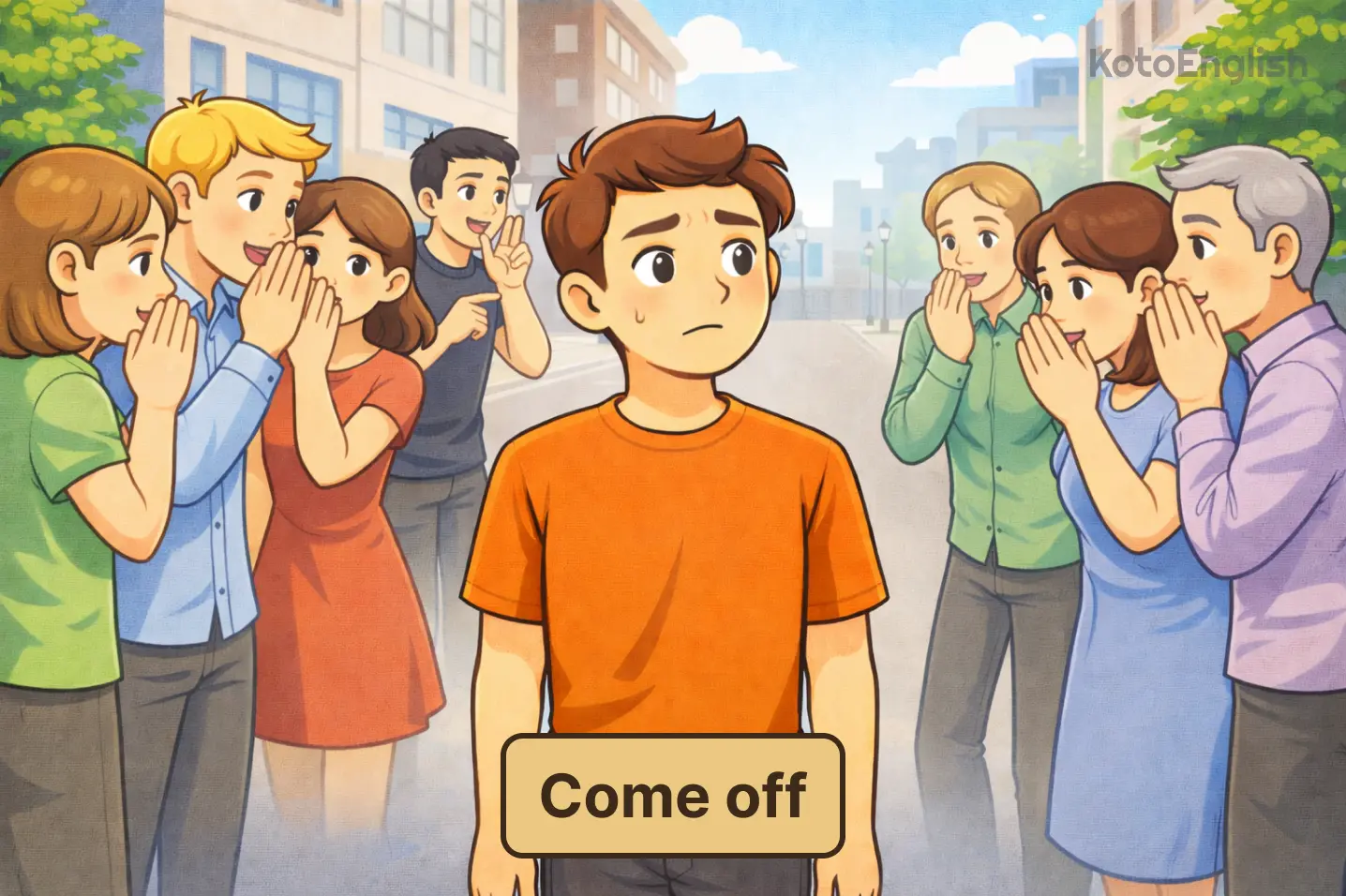
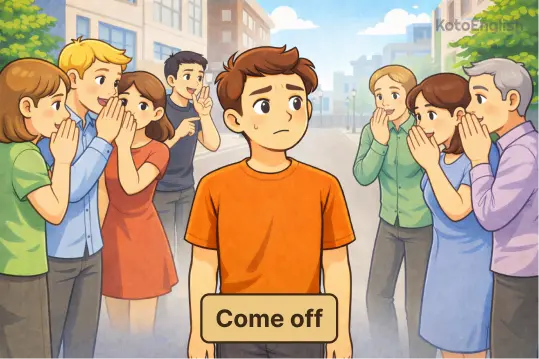
- To give a particular impression:
- To fail:
- To succeed at something:
Come out
You can use come out to talk about something new becoming publicly available.
Come over
Coming over is used in informal English literally and figuratively.
- To visit or move toward someone:
- To be suddenly influenced by a feeling:
Come through
When something comes through, like a message or an emotion, it means it was well-communicated and received by other members of the conversation.
Come together
Come together is used when a group of people, such as friends or family members, meet and gather together for some kind of activity.


Come to
When someone comes to, it means they have regained consciousness after surgery or an accident.
Come up
The last phrasal verb with the word “come” in our list is come up, which means to appear or arise.
Common mistakes learners make
With so many meanings and variables, it’s easy to forget how to create sentences with “come”. Read further to learn about frequent cases to avoid.
- Confusing similar phrasal verbs
One small particle can entirely change the meaning of a phrasal verb. It’s important to memorize them and not to use them interchangeably.
|
An interesting idea came across in the meeting.
|
An interesting idea came up in the meeting.
|
|
He came up to a new solution.
|
He came up with a new solution.
|
- Adding unnecessary prepositions
Some phrases may feel short and unnatural, especially if you try to translate them from your native language. That’s why you need to learn phrasal verbs in context and use them as they are, without any extra words.
|
He came across with an interesting book
|
He came across an interesting book.
|
|
They came back to home very late.
|
They came back home very late.
|
- Following a wrong word order
Most phrasal verbs are inseparable, with their order fixed. When learning them, you need to check them in the dictionary.
|
He came yesterday with down a cold.
|
He came down with a cold yesterday.
|
|
The plan came successfully off.
|
The plan came off successfully.
|
Practice section
You’ve read so many examples and got familiar with frequently occurring hiccups. It’s time to check how well you’ve grasped the topic by completing these exercises.
How to remember “come” phrasal verbs more easily
It doesn’t always work to memorize these words just by repeating them multiple times until they stick in your mind. Upon reading, you’ll learn about some tricks that will help you crack the complexity of the topic.
Tip 1. Group them
It will be easier to memorize these verbs by separating them into different categories, as we’ve done above. By doing this, you’ll be able to use them more freely.
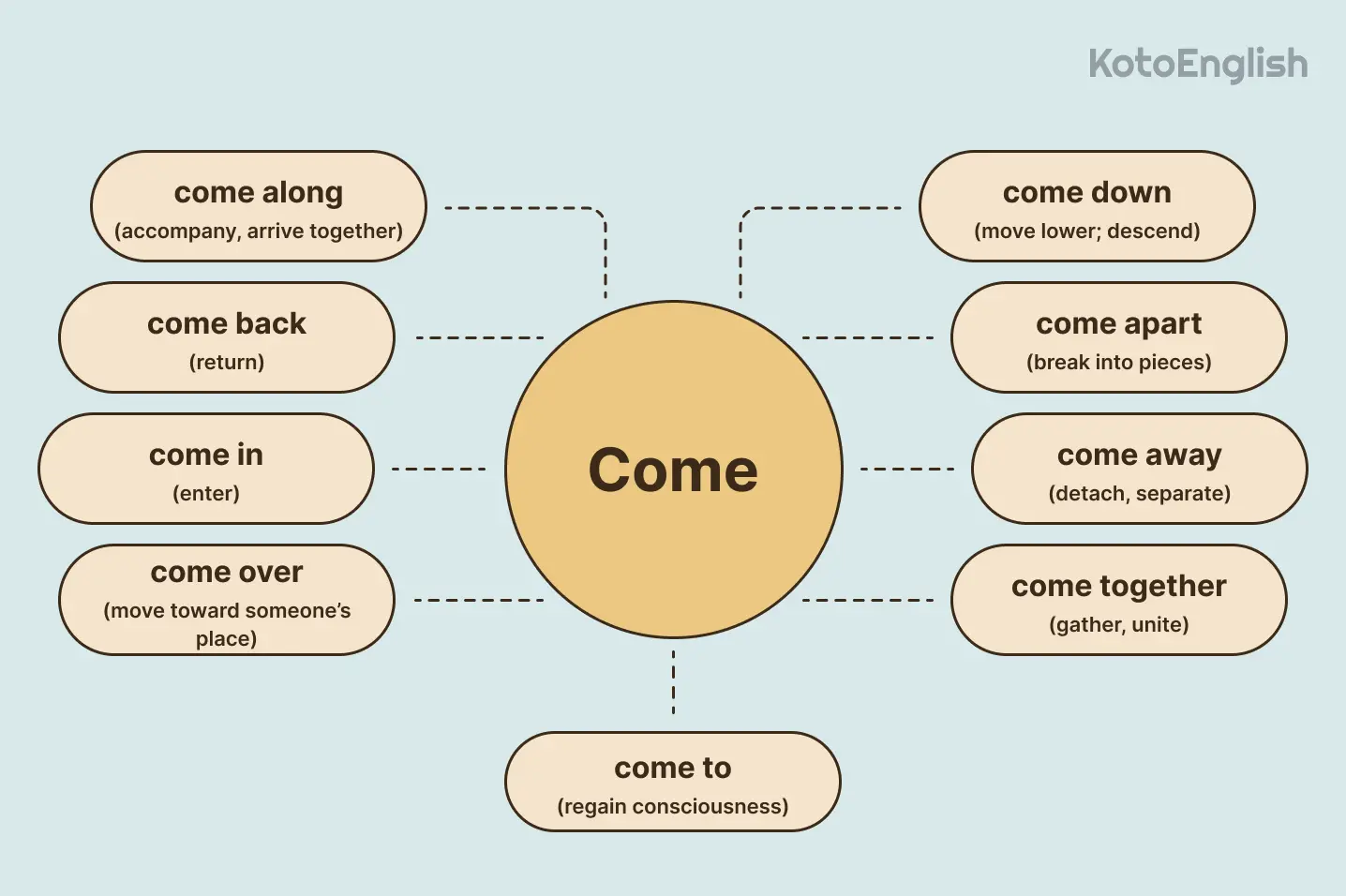
Tip 2. Make them true for you
Write sentences using the target words and apply them to your life. What secret information came out in your favorite book? Do your cousins come together? This will help you recall phrasal verbs fast.
Tip 3. Practice enough
It takes time to learn 25 phrasal verbs. So it’s important to revise them from time to time. You can use this list, your notes, and videos on YouTube just to be sure you remember them. To work on more language aspects, it’s good to write sentences using difficult English tenses, like Past Perfect or Future Perfect Continuous.
Conclusion
Wrapping your head around phrasal verbs with the word “come” is not an easy undertaking for a non-native student who strives to become as fluent in the English language as possible. However, to master casual conversations in English, you must be well-versed in a lot of types of informal speech.
In this article, we took a closer look at the 25 most widely used “come” phrasal verbs and explained how you can apply them in your day-to-day life when learning English. Be sure to practice skills daily to stay on top of your progress.
Frequently asked questions (FAQs)
When reading stories, watching movies, and talking to native speakers, you’ll surely hear phrasal verbs like:
- come in
- come back
- come across
- come out
Most phrasal verbs with the word “come” are either informal or neutral. When writing academic research papers or legal documents, speakers typically use single-word alternatives.
Yes, they can. You can see in the list that many verbs have more than one meaning. For example, the verb “come around” can have three different meanings depending on the context.
At any level of English, these words can be useful. For instance, “come in” and “come back” are frequently used by learners at the beginning of their study. Come up, come over, and come forth are for intermediate and advanced levels.