What is an adverb?
An adverb is a word that provides additional information about the verb, an adjective, another adverb, or an entire sentence. It can give information about the manner, time, place, and sometimes the frequency and degree of an action, and therefore adverbs often answer the questions of how, when, where, how often, and to what extent.
Take the sentence Ophelia runs
Quickly tells us something about the way she runs. Some adverbs modify the whole sentence rather than a word, like in the phrase
When you study English online, you have an opportunity to get the information stored in one place, so let’s consider the modifications in a convenient table before getting deeper into topic:
| Modifies | Example | Question |
|---|---|---|
|
Verb |
He spoke |
How? |
|
Adjective |
It is |
To what extent? |
|
Adverb |
Fred answered |
How much? |
|
Sentence |
|
What comment? |
Now that we know the basic function of adverbs, it is easier to discuss the main kinds of adverbs. Each kind has its own meaning and usage in a sentence which you will learn sequentially.
Types of adverbs in English
Adverbs are classified into groups based on their meanings. Some adverbs describe the manner in which an action is performed, others indicate the time or place at which an action occurs, and still some express the frequency, degree, or certainty of an action, or the relationship of the words in a sentence.
| Type | Function | Example |
|---|---|---|
|
Manner |
How? |
|
|
Time |
When? |
|
|
Place |
Where? |
|
|
Frequency |
How often? |
|
|
Degree |
How much? |
|
Adverbs of manner (How?)
Adverbs of manner tell us how an action is performed. They answer the question how and are often formed by adding -ly to an adjective. These are possibly the most common adverbs of all. Let’s check on the examples:
Adverbs of time (When?)
This kind shows when the action takes place, telling us when something is happening, has happened, or will happen (depending on the tense in English).
They commonly include now, yesterday, soon, later, and recently that you can see in real-world samples below:
Adverbs of place (Where?)
Adverbs of place indicate the location or direction of the action. They are the answer to the question where and help the listener imagine the movement, position, or destination of the action. Here are the examples:
Some adverbs of place indicate a fixed place, while others show movement toward or away from the place.
Adverbs of frequency (How often?)
They are used to describe how often an action is carried out, routine steps, habits, things that are true in general. Commonly, you will see these terms in books, articles, in daily messages:
| Word | Meaning |
|---|---|
|
|
100% of time |
|
|
in most cases |
|
|
many times |
|
|
from time to time |
|
|
0% of time |
Here is how some of them work in sentences:
Adverbs of degree (How much? To what extent?)
These special terms describe the level of intensity indicating the strength, weakness, completeness, or limits of something.
They are often used before adjectives and adverbs, but some are also placed before verbs.
Adverbs of certainty
These adverbs describe the extent to which the speaker is sure about what they are saying. Adverbs of certainty are frequently used in speech and writing because they help us express our certainty without appearing to be absolute.
This group is particularly relevant to tone as it can influence whether a sentence sounds cautious, neutral, or confident.
Interrogative adverbs
Using them, you can ask various questions to extend the conversation, like about hobbies, recent news, or it will be helpful during the speaking test.
Relative adverbs
They join clauses and provide additional information about location, time, or reasons. The most common ones are where, when, why.
Now, as you learned the core types and read sentences where they are used, we move to the section that discloses the way you can form them to use correctly.
How to form adverbs
Many adverbs are created using adjectives, but this is not always a straightforward process, as in the case of adding only one form to the word. English has regular, spelling changes, irregular, and identical adverbs.
Adding -ly to adjectives
Here we have a strict and clear rule that sounds like: many adverbs are formed by placing -ly after adjectives in English. Here are the examples you need to learn this pattern:
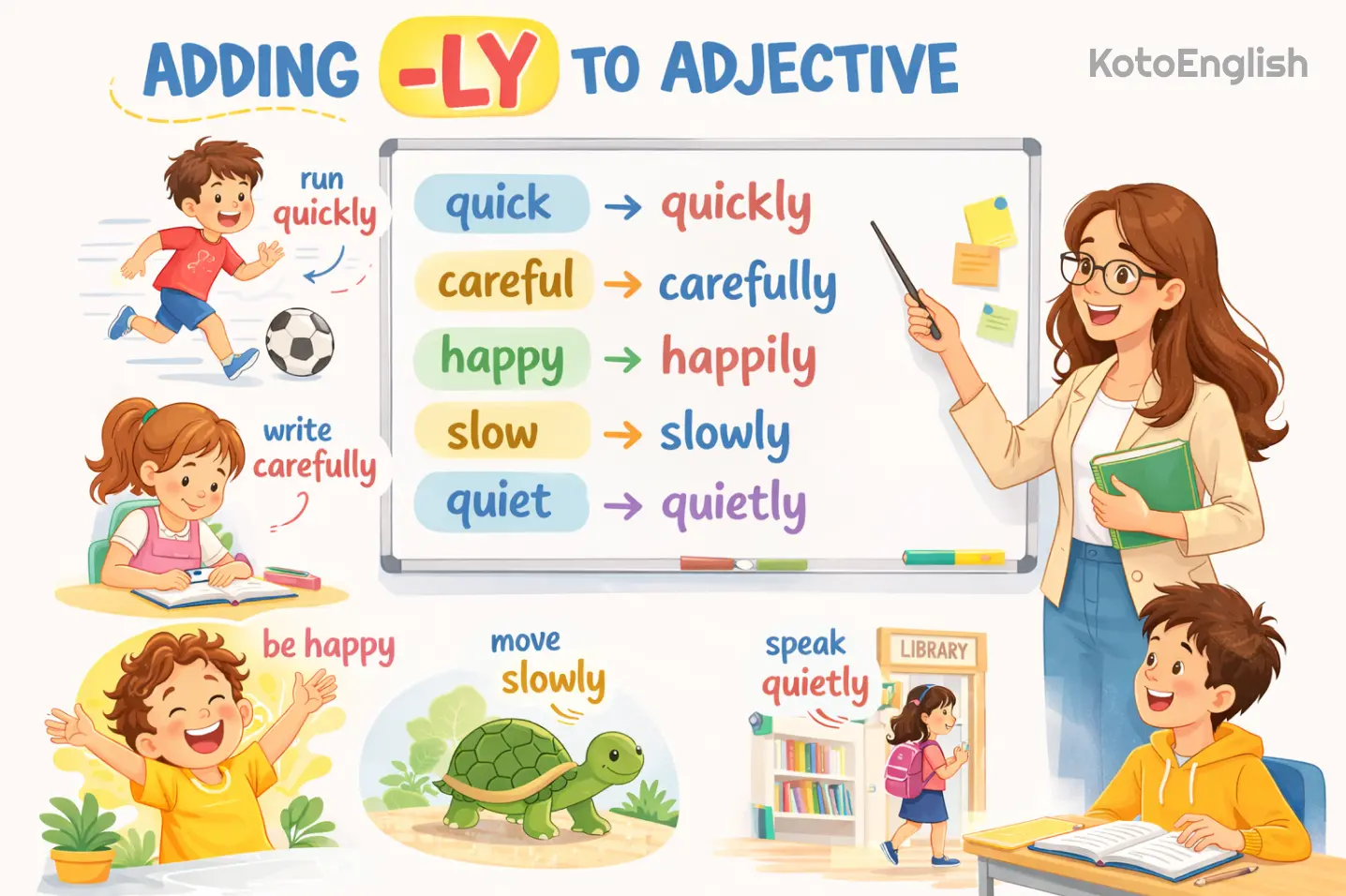
slow →
polite →
Spelling rules when adding -ly
For the correct form of some adjectives, you need to change them before adding -ly, just like in the words below:
- The ending -y turns into -i:
happy → happ
- If the words end with -ic, it becomes -ally:
basic → basic
- -le ending drops the -e:
simple → simpl
The changes are small but when you decide to pass the test, communicate clearly and be fluent in English, you need to study them.
Irregular adverbs
As you have learned the common rules, it is time to move to those that have specific requirements and you need to learn them by heart. Here is the most common of them that describes the difference:
good →


Adjectives that don’t change form
There are also words that are alike in both their adjectival and adverbial forms, and among the typical ones you will see fast, late, early.
Here, you see how context matters the same as spelling, and it can be like this in one sentence, making it more challenging for learners. Further let’s check on where and how you place these terms in sentences.
Position of adverbs in a sentence
The position in which an adverb is placed depends on the type and purpose of the adverb. Some adverbs appear at the beginning of a sentence, while others occur in the middle and at the end.
Beginning position
In this case, the order of adverbs is often used to add emphasis or make comments on the entire sentence. This is the usual placement when the adverb expresses attitude or viewpoint.
Adverbs in the middle position
The middle position for adverbs means you need to put them before the main verb and auxiliary verb. You can apply this grammar pattern to types like frequency, certainty, degree (sometimes).
The placement we drew above sounds natural, although the exact placement depends on the verb phrase.
Adverbs at the end of a sentence
The end placement is common with adverbs of manner, place, time. This order often sounds the most neutral and natural, especially when the sentence is simple.
When you don’t need any special emphasis for your idea/thought, this position is often the safest choice.
Position of adverbs of frequency
They appear before the main verb and after the verb be (and related is/are). The best option to get this concept is to look at examples:
Position with auxiliary and modal verbs
When the sentence contains an auxiliary or modal verb, the adverb is normally placed between them.
The placement maintains the balance in the sentence and sounds natural in standard English.
Order of multiple adverbs in a sentence
In cases where there are several adverbs or adverbial items, it seems that in English we tend to use:


In other words, we tend to specify how something happened, then where it occurred, and finally when it took place. Here are some examples:
Though it is not an unbreakable rule, the guideline above is strong and widely used by native speakers, and can help you build native sentences.
Comparative and superlative forms of adverbs
Just as with adjectives, many adverbs can be used to make comparisons across actions, methods, results, and you need to learn this if your goal is to improve your English.
Short adverbs
Comparative adverbs alongside superlative forms are presented through -er and -est.
Long adverbs
More and most are the common ones in this type, adding to words without modification.
Irregular forms
Without the usual pattern, it can be hard to predict adverbs from base form and may be confused with adjectives, so let’s consider the table that explains this concept:
| Adverb | Comparative | Superlative adverbs |
|---|---|---|
|
|
better |
best |
|
|
worse |
worst |
|
|
less |
least |
Using less and least
These terms show a lower degree of action and help you express that something happens to a smaller extent.
These forms are especially useful when the comparison is about reduction and not increase, which you can get from the context of text/audio/video.
Adverbs vs adjectives
Adjectives and adverbs are similar words, but they are used for different purposes. An adjective is a word used to describe a noun or pronoun, whereas an adverb is a word that describes a verb, adjective, another adverb, or a sentence as a whole.
This difference also influences position. Adjectives are usually found before a noun or after a linking verb, although adverbs are determined by the part of the sentence they are modifying.
Adverbs in different sentence types
Adverbs don’t vanish in different types of sentences; their positions can vary based on whether they are in a question, negative, or emphatic sentence.
Adverbs in questions
Here these interrogative adverbs often come first, like in the examples:
Adverbs in negative sentences
They are still essential in negative sentences because they carry meaning, precision, tone. They usually occur near the verb and work together with negative forms such as not or never.
Emphasizing with adverbs
Some adverbs are used only for emphasis or to strengthen the meaning of a word or sentence, making it sound stronger or more forceful. These are also known as intensifiers.
Adverbs in negative sentences are important in explaining frequency, time, and tone. They make negative sentences more precise and expressive. Emphasizing them makes the meaning more powerful and vivid.
Common adverb mistakes learners make
Adverbs are not hard because they are not complex in form. There are many other reasons for mistakes in adverbs. Here are the most common ones:
- Using an adjective instead of an adverb
It happens because students do not always clearly separate the roles these two parts of speech play in writing and speaking.
| She sings beautiful. | She sings beautifully. |
| He speaks quite. | He speaks quietly. |
- Wrong word order
This error occurs because adverbs do not all occupy the same position in English.
| He drinks coffee always. | He always drinks coffee. |
| She takes out dinner often. | She often takes out dinner. |
- Confusing hard and hardly
Students may confuse these similar words, thinking hardly is the adverb form of hard, but let’s see the correct usage.
| She works hardly on Mondays. | She works hard on Mondays. |
| They clean hardly before Christmas Eve. | They clean hard before Christmas Eve. |
To avoid these mistakes, you need to be aware of them (which is done) and practice regularly. To ensure you memorize this lesson, we propose a little activity you can find in the next section.
Practice section
These exercises will help you ensure that you can identify adverbs, select the correct adverb form, and use them in a sentence.
Summary
Adverbs are used to convey meaning in the form of manner, time, place, frequency, degree, certainty, or viewpoint, and they can be used to modify verbs, adjectives, other adverbs, or even whole sentences.
To use adverbs effectively, it is essential to be aware of their form, type, and position. Once the patterns are familiar, adverbs are no longer just grammatical concepts, but useful tools in sentence construction.
Frequently asked questions (FAQs)
Generally, an adverb will modify a verb and indicate how, when, where, or how often the action is performed. An adverb may modify another adverb or adjective and provide additional information. In summary, it makes the description more precise.
The adverb’s position depends on its function. It can be placed before the main verb, after it, at the beginning of the sentence, or even at the end. This will help the sentence to sound natural.
Good is an adjective; it is usually used to describe a noun. Well is an adverb; it is usually used to describe a verb. For instance, “She is a good writer” is correct, but “She writes well” indicates how she writes.
Yes, but not always. In English, most adjectives need an adverb form, often ending in -ly, to be used to modify a verb. But in some set phrases or colloquial language, an adjective can be used where learners expect an adverb.
No, adverbs are not necessary in every sentence. A sentence can exist without adverbs, but they are good for giving extra information that makes the sentence clearer which is suitable for various purposes, from daily communication to work emails and more.