What is the Past Continuous tense?
The Past Continuous, also called the Past Progressive, is an English tense used to describe actions in progress at a particular time, focusing on duration, simultaneous, and temporary activities.
This tense is widely used in narratives because it helps provide additional details to the story, such as emphasizing the duration or making clear that events happened at the same time.

Let’s look into the specifics to grasp this grammar perfectly.
Past Continuous tense examples:
Level up your English with Koto!
Past Continuous tense formula
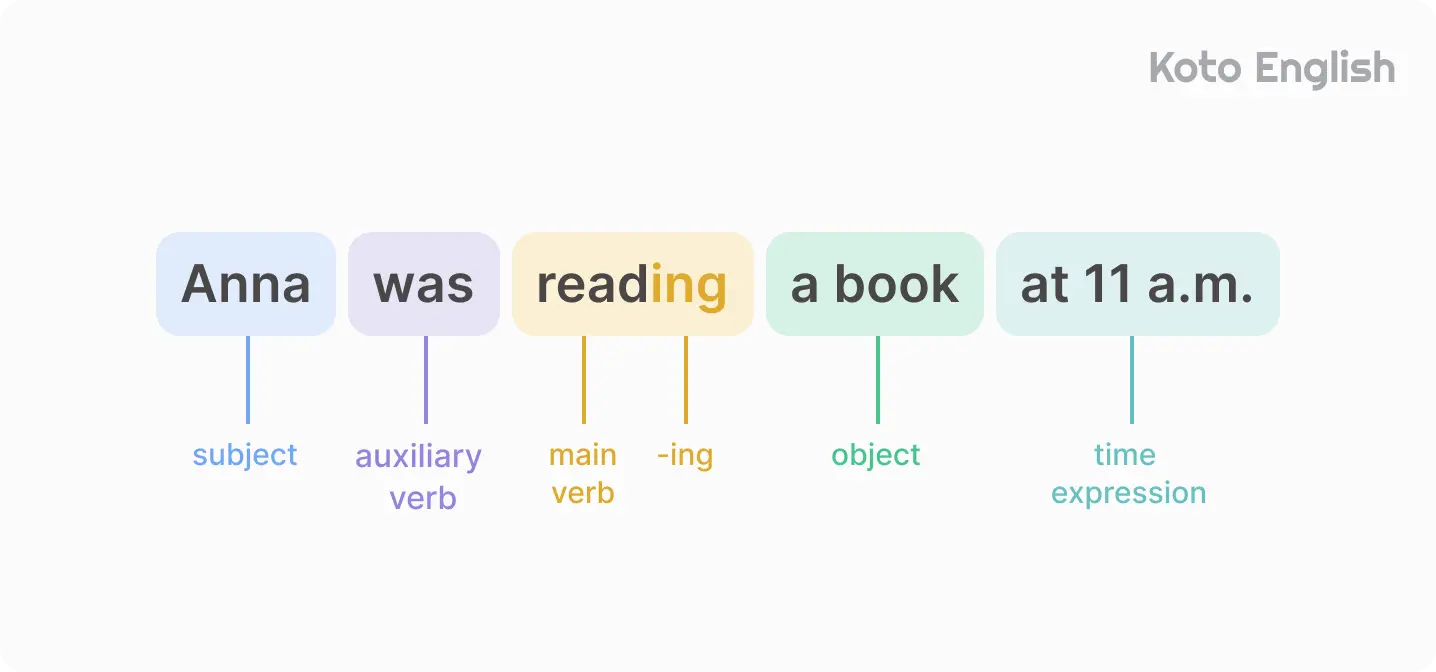
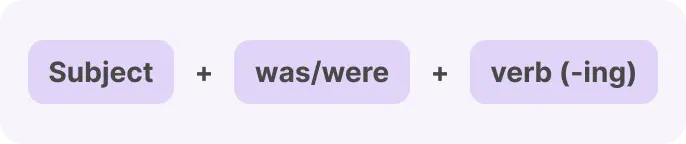
The Past Continuous structure is formed by using was and were , taking the subject into account + the verb with -ing ending.

Glance at some Past Continuous sentences:
| Subject | Examples |
|---|---|
| I |
I
|
| You (singular) |
You
|
| He |
He
|
| She |
She
|
| It |
It
|
| You (plural) |
You
|
| We |
We
|
| They |
They
|
There’s no short form when you use the positive Past Continuous form. The cases We’re listening, and He’s swimming are formed in the Present Continuous tense.
When do we use the Past Continuous?
We choose Past Continuous when we want to talk about actions that were taking place yesterday at 6 a.m., at that moment, or, simply, temporary situations that were ongoing in the past at a specified time. Also, it is used with actions happening at the same time and interrupted events.
Past Continuous usage examples:
| Usage | Examples |
|---|---|
| Actions in progress at a specific time in the past |
My friends
|
| Simultaneous events in the past |
Daniel
|
| Longer activities interrupted by a shorter one |
I
|
| Setting description |
The sun
|
Past Continuous tense markers:
| Time indicators | Examples |
|---|---|
| at 8 a.m., at 10 p.m. |
I
|
| at that moment |
Mark
|
| at midnight |
They
|
| while |
My sister
|
| when |
They
|
| all day/evening/night |
The manager
|
| during |
My family
|
We use while when two or more actions happen in parallel and when in sentences where a prolonged action is interrupted by a shorter one.
How to use the Past Continuous tense?
We saw many examples of Past Continuous tense usage in positive sentences. Now, let’s look at the negative and question forms, which have their finer points.
Past Continuous questions
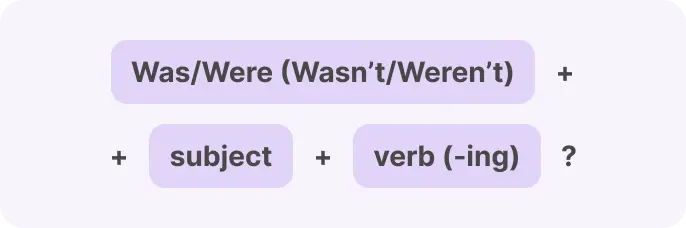
The Past Continuous formula for question sentences is simple. You need to swap the subjects and auxiliary word’ places.
Yes/No questions
Let’s take a look at some examples:

| Question | Answer |
|---|---|
|
|
Yes, I
|
|
|
No, she
|
|
|
Yes, they
|
Wh-questions

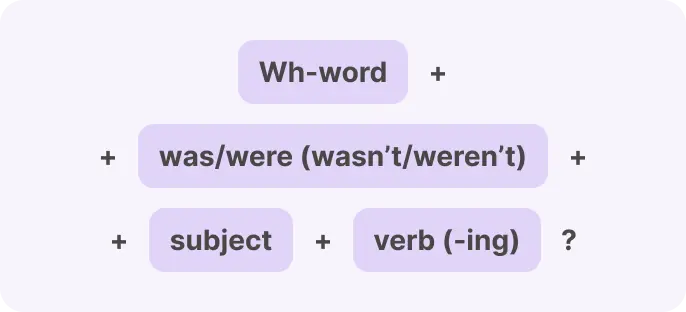
Let’s examine some instances:
| Question | Answer |
|---|---|
|
Why
|
Because they
|
|
What
|
I
|
|
Who
|
I
|
Enjoy personalized learning!
The negative form of the Past Continuous
To create negation in the Past Continuous, you need to put not after was and were, then add the -ing ending to the main verb.
The Past Continuous tense structure for negative sentences:

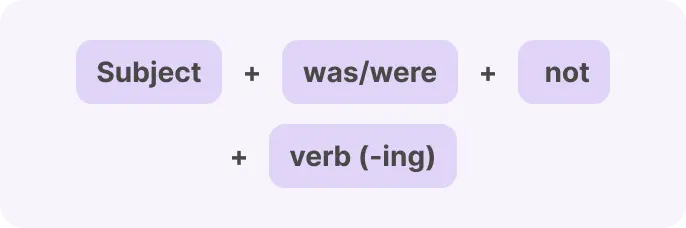
Examples:
Speaking more naturally and less formally requires us to use short forms where we put was not and were not together. As a result, we get wasn’t and weren’t.
Past Continuous examples of negative sentences:
| Subject | Full form | Short form |
|---|---|---|
| I |
I
|
I
|
| You |
You
|
You
|
| He/She/It |
She
|
She
|
| We |
We
|
We
|
| They |
They
|
They
|
| You (plural) |
You
|
You
|
Common mistakes with Past Continuous in English
Because this is a more complex tense, it is easy to misspell or forget about some points. Below, we describe some typical errors that often occur when studying this tense.
Using Past Continuous with stative verbs
The verbs of perception, thinking, and emotions, such as like, love, want, need, and feel, aren’t typically used in progressive tenses.
|
We were agreeing on the arrival time.
|
We agreed on the arrival time.
|
|
They were wanting to buy a house when the crisis happened.
|
They wanted to buy a house when the crisis happened.
|
In some cases, stative verbs can be used in the progressive tense but rather become dynamic actions. For example, I thought (in my opinion), but I was thinking (I was in the process of considering something).
Choosing the wrong form of the verb to be
Speaking was instead of were or even opting for am, is, or are in the Past Continuous tense sentences is another regular mistake.
|
She were fixing the sink while we was dusting the furniture.
|
She was fixing the sink while we were dusting the furniture.
|
|
I were getting to work when the traffic stopped.
|
I was getting to work when the traffic stopped.
|
Misusing time indicators
Selecting wrong tense markers, which are not used with the tense or don’t fit the case.
|
She was doing research while her laptop shut down.
|
She was doing research when her laptop shut down.
|
|
We were visiting our friends in 2024.
|
We were visiting our friends in 2024 when they broke up.
|
The time expressions used in the Past Progressive tense sometimes can suit more than one tense. Remember that this grammar helps to talk about specific, temporary situations, not a long timespan.
Summary
Now that you know the Past Continuous uses, it will be much easier to tell engaging stories with background information, provide more details when explaining something, and understand others. Continue polishing your skills with Koto English!
Past Continuous tense FAQ
We use Past Continuous to talk about temporary situations that were happening at a specific time in the past. This tense helps us discuss actions that were ongoing at the same time or interrupted events.
For example:
Certain time expressions help us understand when to choose the Past Continuous. These words are: when, while, all day/ all night, at that moment, at 8 a.m.
In most cases, the answer is no. If you want to describe senses, mental states, and feelings, selecting the Past Simple tense is safer to create correct sentences to avoid misunderstandings. Look at the example:
|
I was hearing her at that moment.
|
I heard her at that moment.
|
In addition to the errors we mentioned above, several other mistakes happen pretty often, and you need to be mindful of them to sound clear:
- Forgetting about to be when creating negative sentences:
|
My colleague not renting yesterday morning.
|
My colleague was not renting yesterday morning.
|
- Leaving -ing ending out:
|
My mother was feed the cat when I arrived.
|
My mother was feeding the cat when I arrived.
|
- Choosing Past Continuous instead of Past Simple:
|
I was broking my favorite cup yesterday.
|
I broke my favorite cup yesterday.
|