What is a preposition of place?
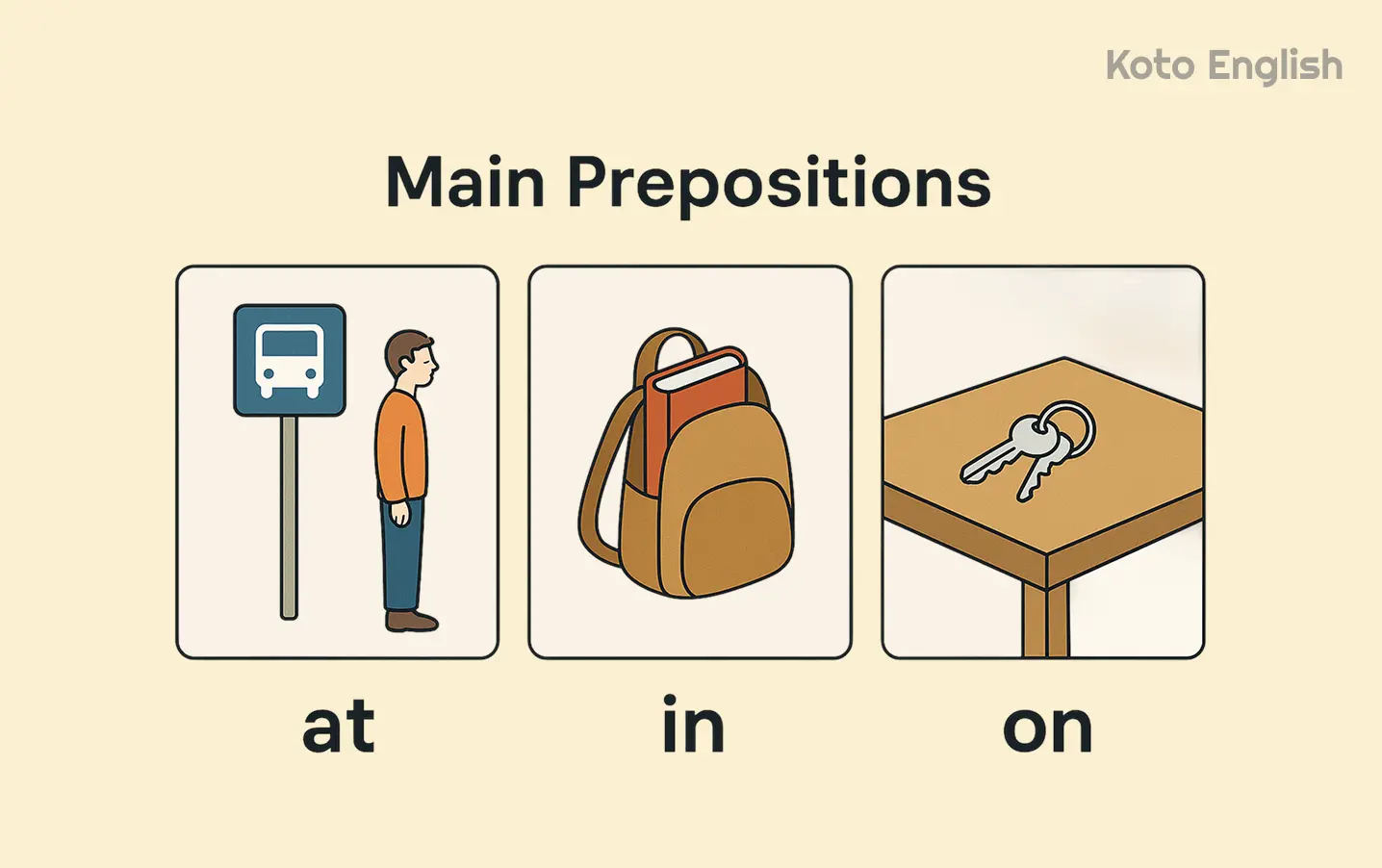
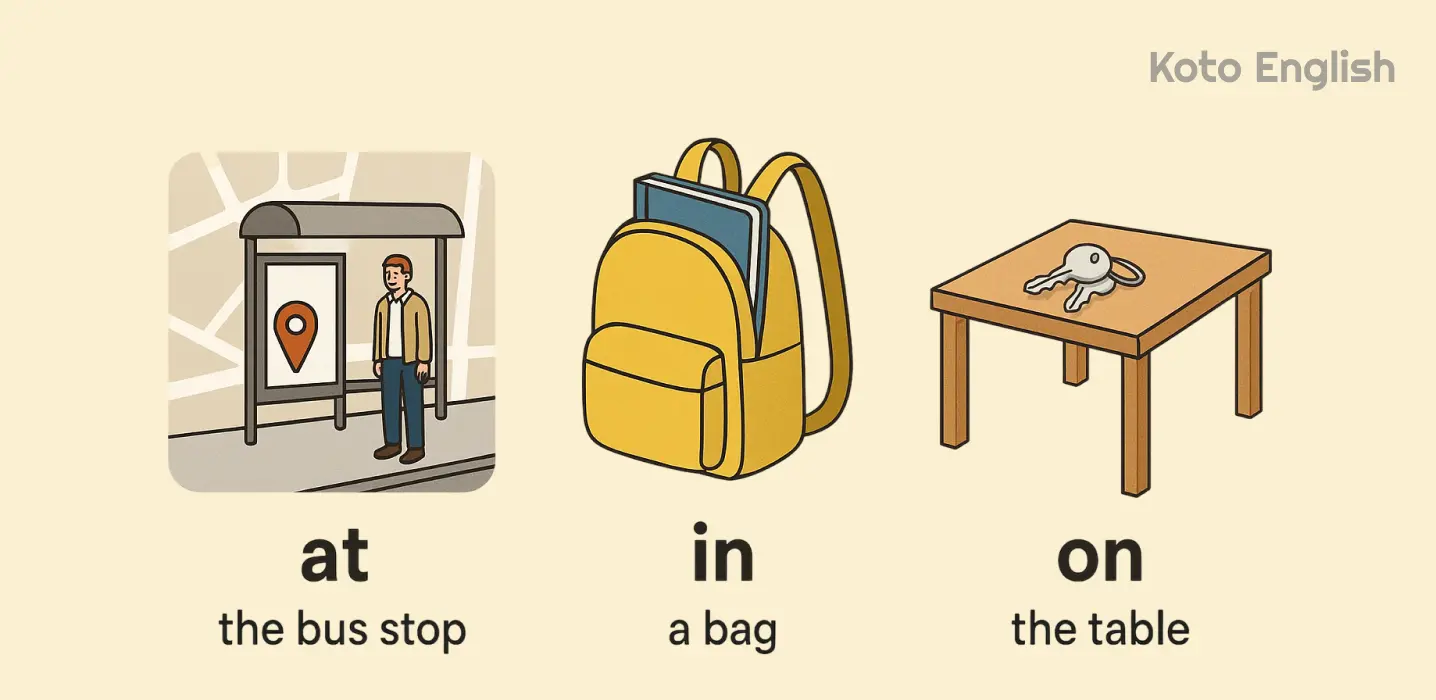
The three most common place prepositions are at, in, and on. Here’s how they differ:
| Preposition | Meaning | Example |
|---|---|---|
| at | point, location |
She is |
| in | space, volume |
The book is |
| on | surface |
The keys are |
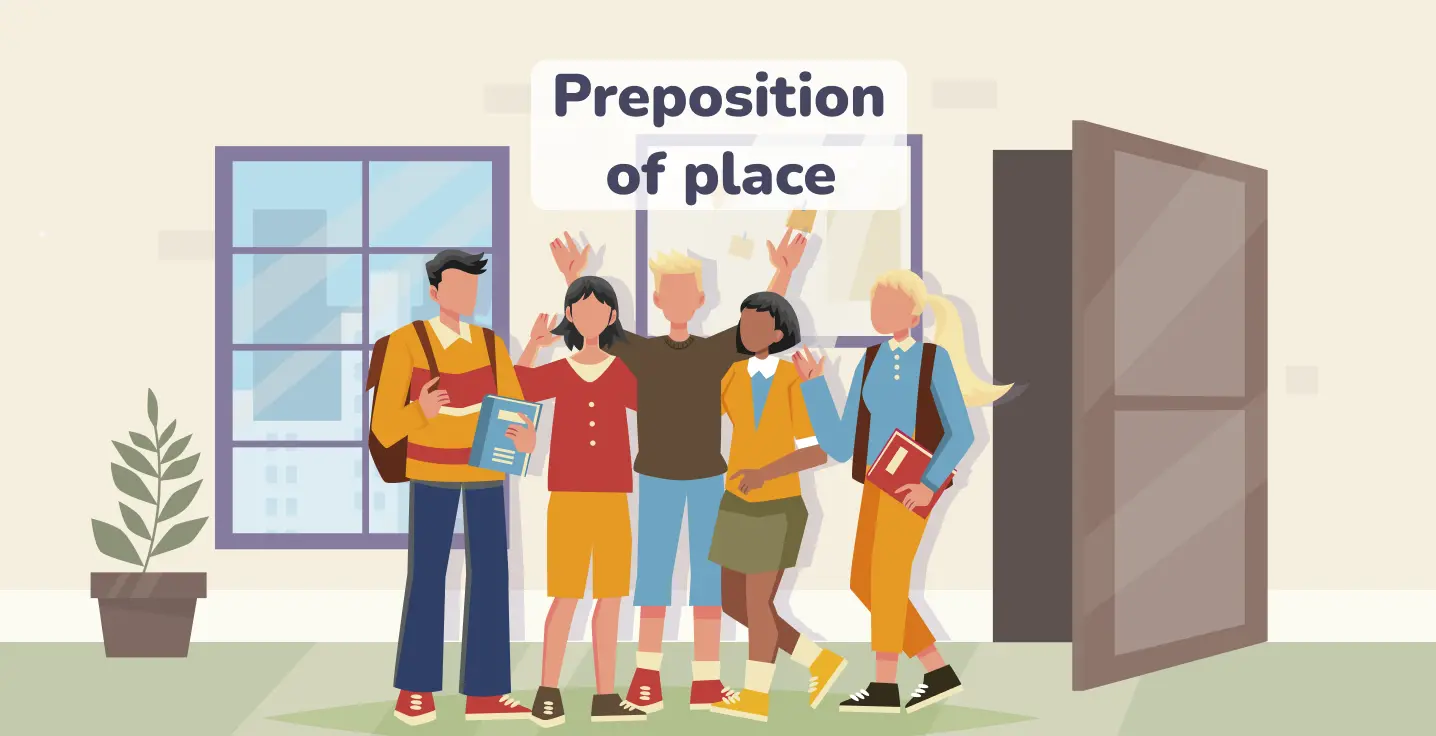
Prepositions of place are short words, such as at, in, on, below, and above. You often see them in various texts, going alongside nouns (on the bench, at the party, in the room) and pronouns (on me, at it, in them). Their role is to map the location of something or someone. These words are very functional, and you will see it in the example below.
| Before | After |
|---|---|
|
Your keys are the room the desk.
|
Your keys are
|
Such a detailed position narrows the perimeter of the item’s placement and provides clarity, so you know for sure, from the instance, that you need to look for the keys on the desk but not inside or at it.
Now, when you know the preposition of place definition, let’s move on to exploring their usage in some sentences:
Level up your English with Koto!
Common place prepositions
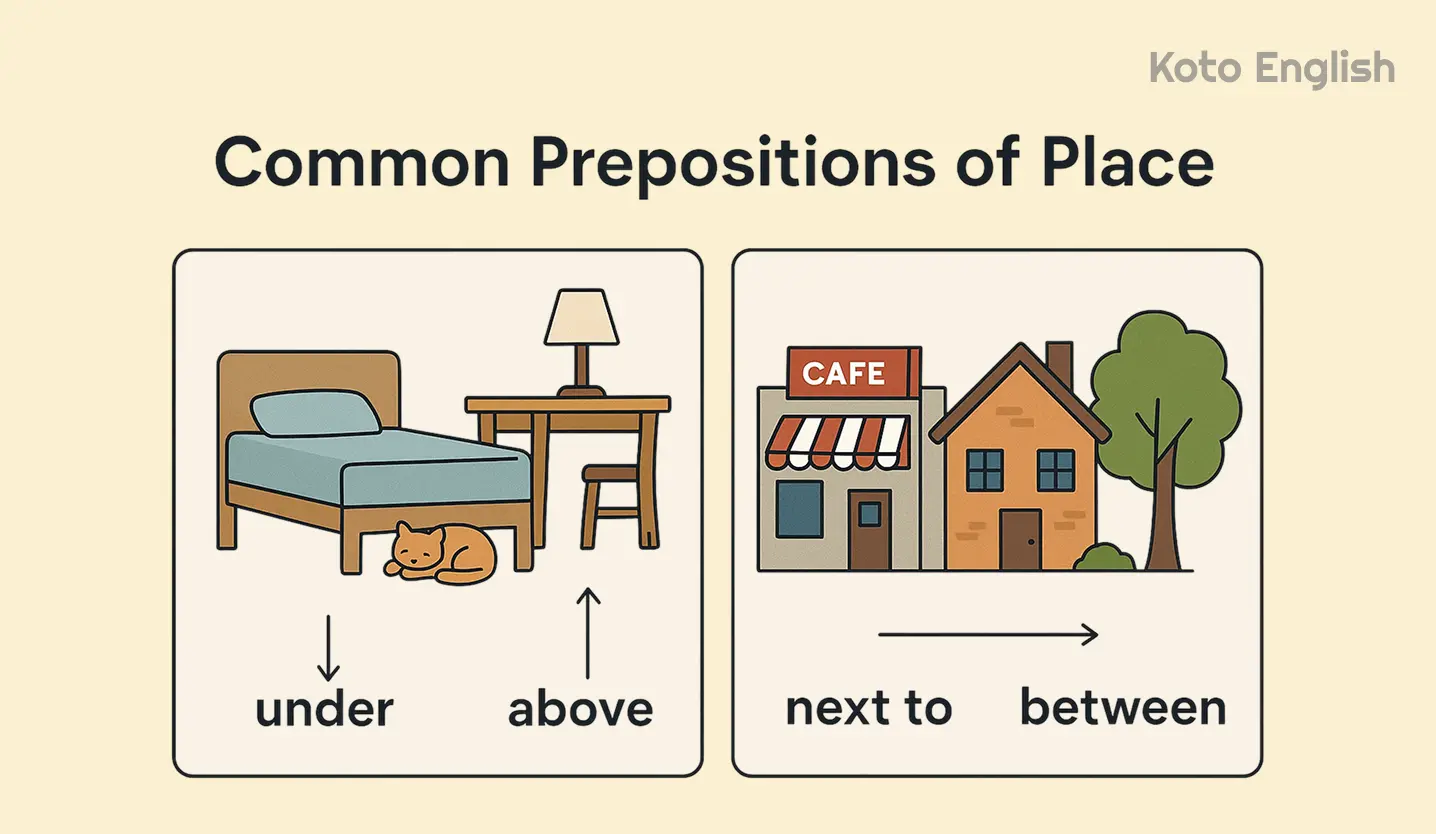
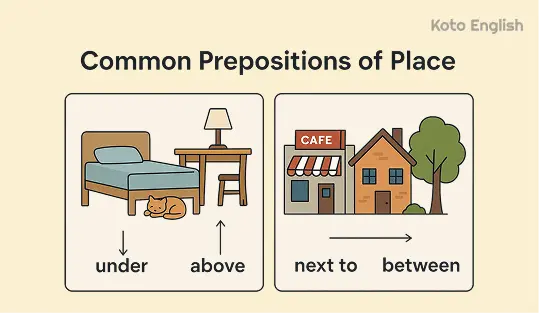
The prepositions of place list is long and includes words that highlight surface, point, direction, and many other factors. In the table below, you will see the most often used ones with their meaning and instances of usage:
| Prepositions | Used when speaking of | Examples in sentences |
|---|---|---|
| at | A specific point |
The pharmacy is |
| in | A location |
The equipment is |
| on | A surface |
The purse is |
| next to | A place close to another object |
There is a pharmacy |
| under | An object that has one or a few items at the top of it, directly below |
Your ID is |
| below | An object is lower than another, not necessarily right under |
The box is |
| above | Something that is higher than another object or person |
The plane is flying |
| in front of | An item facing another one |
The headphones are |
| inside | A thing in an enclosed area, deep within it |
The keys are |
| outside | Opposite to the inside, in the open air |
The bicycle is |
| between | A gap that separates two objects |
There is a big distance |
| over | Something that is higher than another thing and probably touches it |
There is a lamp |
In the following section, we will classify each place’s preposition so you know where to use them.
Usage rules & patterns

It is much easier to understand and memorize the rules when you recognize particular patterns, instead of learning each possible location with its preposition. You will find brief explanations with each category to be able to guess what to select when speaking:
Specific points
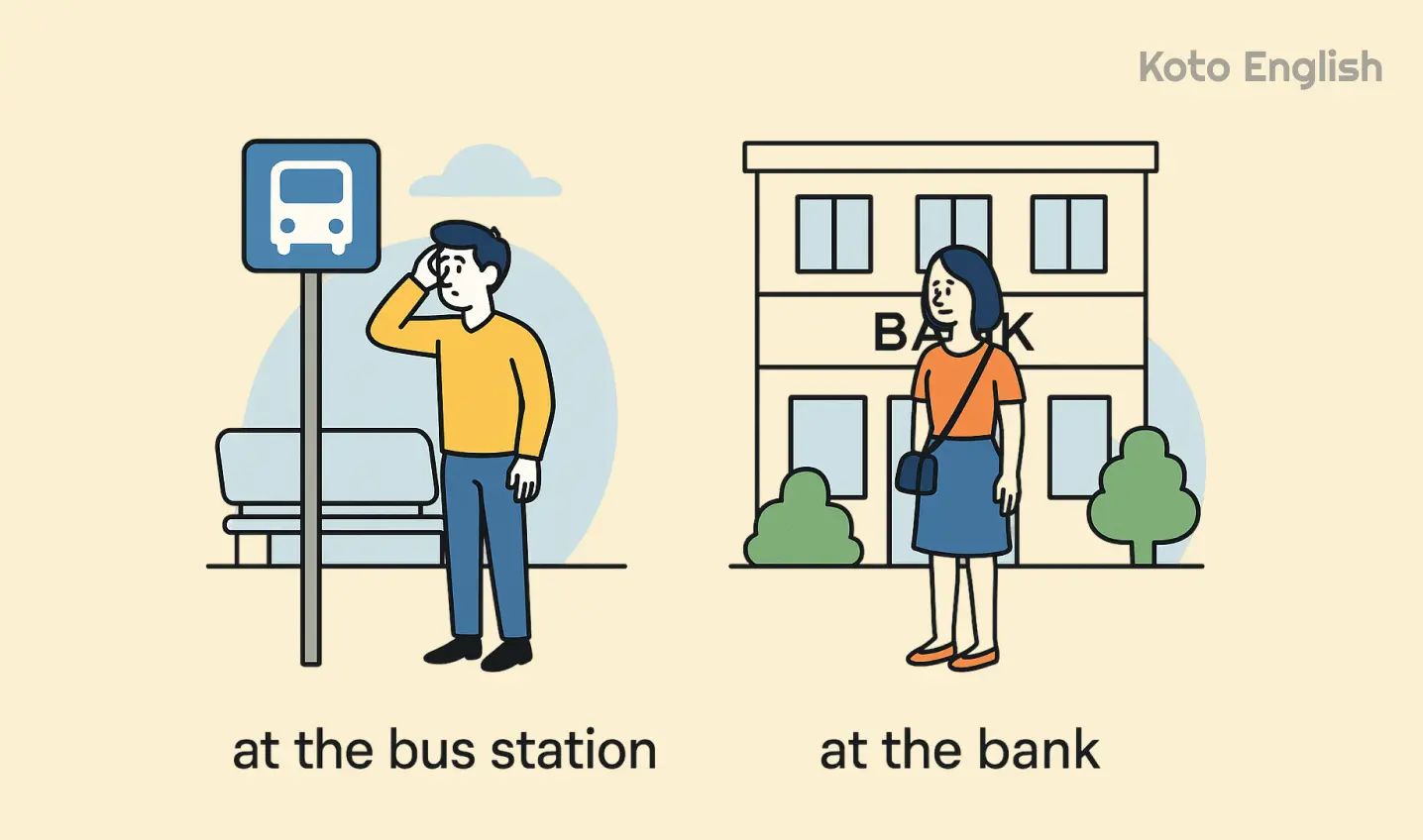
It is used with the spaces you are at, such as dots on a map, rather than a specific location. Especially, take into account small points, such as doors, stops, and public places when you want to indicate that you are close to them, as well as places like home, school, and work.
Variations to use: at
Examples in dialogues:
Locations / enclosed areas
Speaking of locations, such as rooms and countries, you need to choose the instances below. It is also related to parks, banks, and shops when you are in the building, not near it.
Possible prepositions: outside, in, inside
Examples in dialogues:
Surfaces
Specifying that an object lies at the top of another, you opt for this one. It is related to tables, screens, and pages. Also, remember that using on with sides is typical of English (on the right, on the left). Do a prepositions of place worksheet to see more such expressions.
Common options: on
Examples in dialogues:
Up/down position
To describe vertical or relative placement, use these prepositions:
| Preposition | Usage | Example |
|---|---|---|
| above | higher, no contact |
The picture is
|
| over | higher, may cover |
She put a blanket
|
| under | directly below |
The cat is
|
| below | lower, not direct |
The valley is
|
| next to | beside, close |
The shop is
|
| between | in the middle of two |
The house is
|
| in front of | facing, opposite |
The car is
|
There are several words used to describe the vertical position of an item. Above indicates items that don’t move, are higher than other objects, and do not contact them. Over is similar, but it refers to things that move, cover, or are across something.
Under designates objects, which are directly below and can contact other things. And below is applied to show that something is under as well, but not necessarily directly.
Prepositions of place examples: over/under, above/below
Examples in dialogues:
Relative placement
You choose next to when referring to something that is beside an object or a person. In front of helps you describe something that faces an item. Between is the preposition you use to say that a thing or a person is in the middle of two other objects.
Options to choose: between, next to, in front of
Examples in dialogues:
Common mistakes
With some words having similar meanings, multiple idiomatic phrases, and the number of options, errors with preposition of places are unavoidable, especially when you only start learning them. You need to go over both theoretical and practical workouts to refine your knowledge. However, the list of frequent missteps will help you save time:
Confusing “In” and “At”
Usage of in and at is similar to an extent, as they can sometimes be used in identical phrases. But the meaning of their use isn’t interchangeable. For example, when saying in the hospital, it means you are a patient. But telling at the hospital means you are visiting someone. However, there are specific patterns above that should be followed.
|
She is at her room, doing her homework.
|
She is in her room, doing her homework.
|
|
I am at Rome for a work meeting.
|
I am in Rome for a work meeting.
|
Choosing “On” instead of “In”
The difference between these two words is that on is used to describe items that stand on the surface of something (a cup is on the table, a computer is on the desk, etc.), while in is needed to point to something that is inside of an enclosed space, like a box, a cupboard, and a pot.
|
Your phone is in the laptop.
|
Your phone is on the laptop.
|
|
The water on that bottle is hot.
|
The water in that bottle is hot.
|
Following the logic of other languages
The rules in English don’t necessarily repeat the patterns you can meet in other languages. What works in Spanish can be incorrect in English. That’s why it is important to get acquainted with the typical phrases, such as in the picture (when you want to describe what is depicted) and on the picture (on the surface of it), and others.
|
The library is in the corner.
|
The library is on the corner.
|
|
That shop is at the left.
|
That shop is on the left.
|
Misunderstanding the order
English is strict when it comes to the placement of words, and they can’t be scattered freely in a sentence. Put the locational prepositions after the object, but before the place it is in, according to this structure:
Subject + Verb + Object + Preposition of Place + Place.
Also, when you want to specify the location of an item that lies somewhere in the room, use the formula: The phone is in the kitchen at my sister’s house.
|
I left on my table the documents.
|
I left the documents on my table.
|
|
She when was at school lost her keys.
|
She lost her keys when she was at school.
|
Tips for remembering plural forms
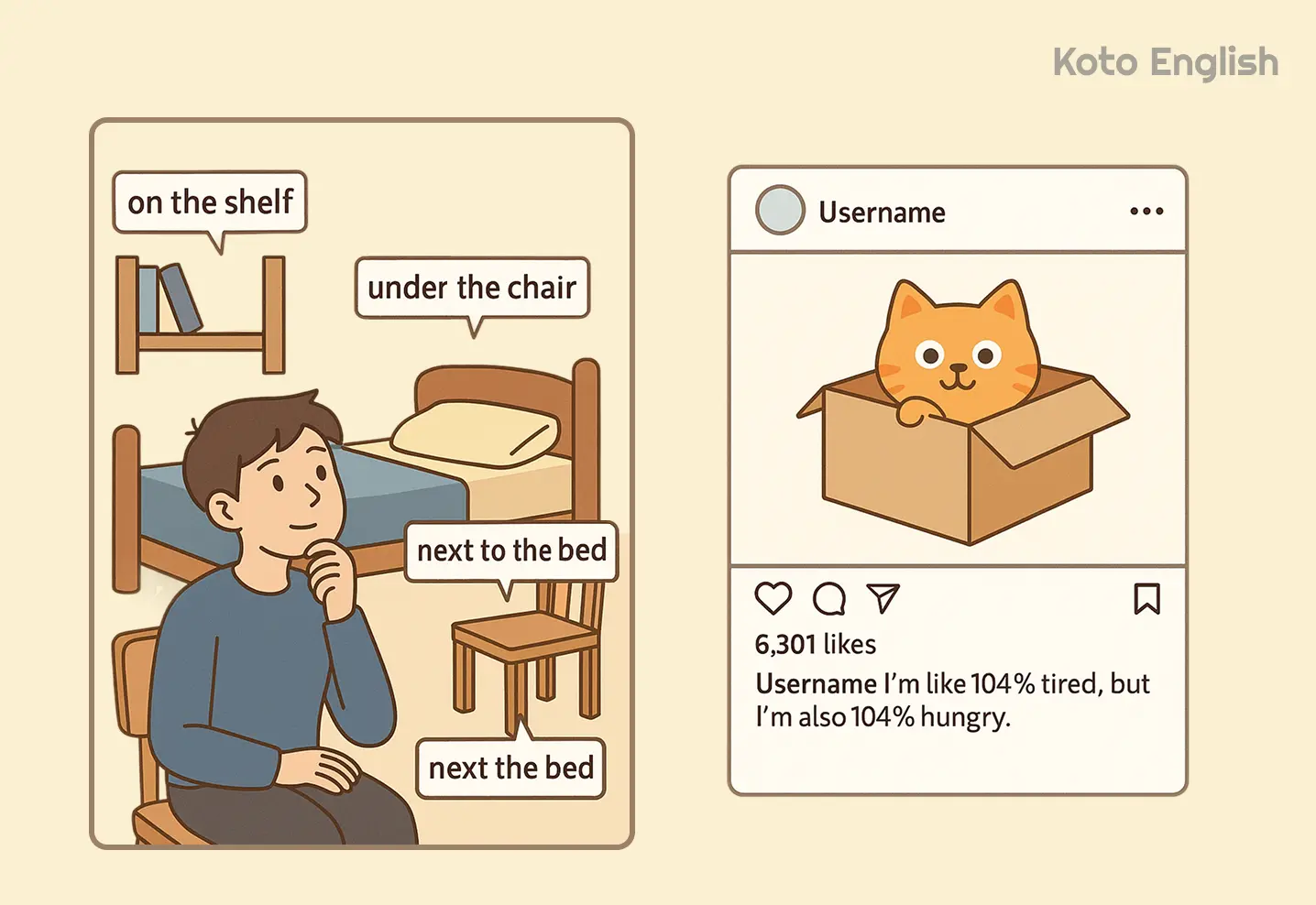
Nowadays, the variety of available language learning activities allows everyone, with different deadlines and needs, to find an approach that maximizes the effort and simplifies the experience. Keep reading to discover tactics that make memorizing enjoyable and effective:
Tip 1. Write your examples
Look at what surrounds you in your room or office. The items on the shelf, under chairs, next to tables, and above the drawer are your sources of good practice of grasping preposition of location examples. That way, you will repeat vocabulary about appliances and household items, strengthen your understanding of the rules, and be able to describe a place you live or work in.
Such contextual learning helps understand the rules better because it visualizes and also touches your personal space.
Tip 2. Read and listen a lot
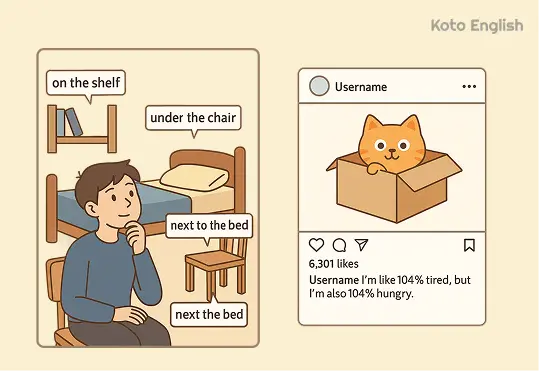
Texts and videos appropriate for your level, as well as memes on X and Instagram, are not only fun ways to spend an hour or two after a long day, but they can also be a great source of phrases that include prepositions of place in a natural and common manner, as native speakers use them in daily life.
Grammar rules and sentences are good, but the more additional material you consume, the better your understanding.
Tip 3. Do exercises with answers
Interactive workouts are essential steps in the study process. First, you learn how to differentiate between at, in, on, then you discover common patterns, and after that, you explore exceptions. A preposition of place worksheet enables you to achieve fluency more quickly.
Conclusion
First, mastering the usage of each preposition, you need to focus not only on the place words themselves, but also pay attention to the spaces in which they are used. Sometimes it is even more helpful, because not all cases follow the logic we stated above. Second, good navigation within the topic requires sufficient time.
You can find a variety of practice-focused drills on the Koto English app that will allow you to understand the difference between prepositions, get to the point of all rules with the life-common examples that will enable you to use the grammar confidently.
Enjoy personalized learning!
Prepositions of location FAQ
Yes, at is indeed a common preposition you can use to designate someone’s location. The rules of its usage are simple — when needing to highlight that someone is at a certain place, like a dot on the map, you use at.
Choose at with the following cases:
-
Locations: banks, airports, stations, shopping centers, cinemas, bus stops, stadiums.
Examples:
My family isat the shopping centre.They are waiting for the trainat the station.
-
Points: door, entrance, gate, corner, window, end of the street.
Examples:
I am waiting in the queueat the entrance hall.We areat your door.
-
Events: wedding, party, concert, conference.
Examples:
He is busy now because he isat the conference.When we wereat the party, we couldn’t find you.
Both inside and in mean point to an object’s location in an enclosed space; however, they don’t always mean exactly the same thing. In is a more common preposition of location that can also be used as an adverb, and in most cases, it is applied whether you need to specify literal or abstract ideas.
Example:
The role of inside is similar, but with the emphasis on the depth of an object’s placement. Namely, speaking of something being inside means that an item is located somewhere deep within a box or a bag.
To illustrate a situation where you would need to choose this word, pretend that you have something inside your pocket and it is not easy to take it out. In this case, it is appropriate to use this preposition.
Example:
If you want to indicate that something is in your pocket, just to note that it is there, in is a better pick.
Yes, some prepositions of place in English are spelled and pronounced the same, whether they are related to time or place.
Examples with place prepositions
Examples with time prepositions
Definitely, there are particular preposition of place examples which don’t suit any categories explained above or that have additional meanings you need to explore and stick to your memory. Let’s go over each of them:
City and street
You use in to refer to countries, towns, and cities, however, when speaking about streets, in most cases, it is right to use on:
Above or over and above = over
There are two words to highlight that something is at a higher level in comparison to another item. While above is used to indicate a static position of a thing or comparisons, over is applied to describe an object that moves or covers something.
In some situations, both prepositions can be used when mentioning the position of something without highlighting its contact with another thing.