

Is it really possible to learn English fast?
Most people wish to learn English quickly and feel they do not achieve this because they expect a dramatic change within a matter of weeks. The problem exists because people learn languages through different stages which begin with understanding and end with speaking ability.
What fast actually means
In a realistic setting, “fast” means making substantial and quantifiable progress in 3-6 months. In regards to learning and spending 30-60 minutes per day studying, basic conversational proficiency can be achieved in 3-4 months, and self-sufficient communication in 6-12 months.
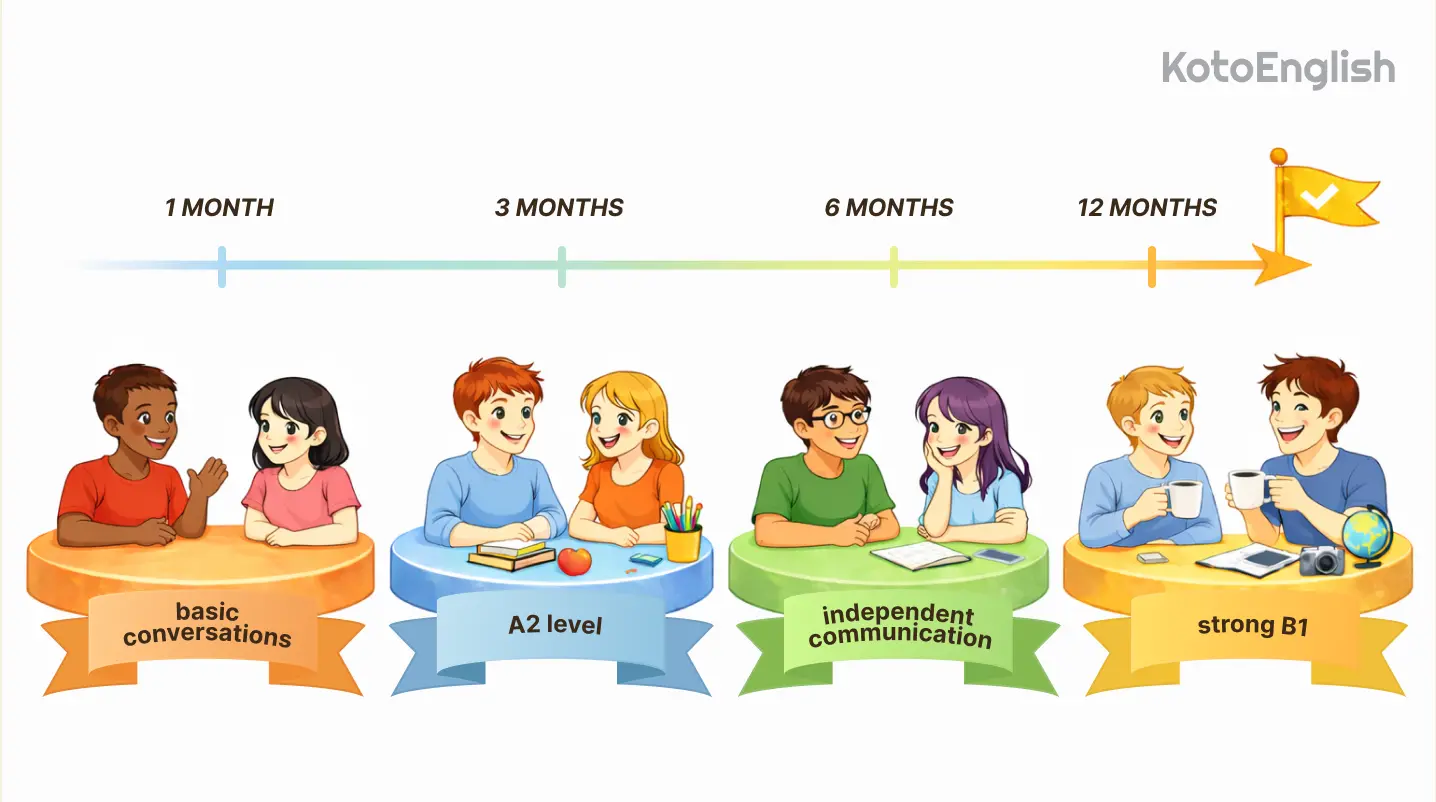
If the study time is doubled to two hours per day, progress can be made 30% to 40% faster. Nevertheless, it is essential to maintain a balanced routine since studying more than three hours per day for an extended period of time may cause exhaustion and decreased retention.
What affects your learning speed
The first thing that determines how soon you can start using English depends on how much new information you attempt to learn at once. When you try to memorize too many new words and topics in one sitting, you will not retain most of them.
The second thing involves the quality of feedback received. Students who check sentences for clarity and correctness tend to learn faster compared to those who do not adjust what they practice.
How to learn English fast: step-by-step plan
Now, it’s time to take a look at what quick learning in reality means. Using this plan, you will not only be able to establish a routine, master the essential English skills, but you will also make tremendous progress in everything, from grammar tenses to effortless conversations, in order to land your dream job or go abroad without the fear of being misunderstood.
Step 1. Set a clear goal
Having a target in mind speeds up the learning process. “I want to improve my English” is too vague. “I want to achieve B1 level in six months to pass a job interview” is more specific. This narrowing helps you pick the right material and practice method from the start.
Before you begin, consider:
- Your target level (A2, B1, B2)
- How many minutes per day can you study?
- Why do you need this skill (learn English fast for work, travel, exams, relocation)?
When your goal is specific, you stop wasting time on unnecessary topics. For example, if you want to discuss business matters, you don’t need to learn the names of trees and rocks, as it will extend the timeline and won’t add any value to your mission.
Step 2. Focus on speaking from day one
Many learners wait too long to improve their English speaking skills, however it is one of the most useful parts. There is no right moment to start a conversation because even at an A1 level, you can talk about your day so that another person can understand you.
For fast progress, aim for:
- 10–15 minutes of speaking every day
- 2–3 live conversations per week
- At least one session with correction weekly
The more you speak, the easier it becomes to work with the other aspects, as it forces your brain to use what you’ve learnt actively. And it is really one of the most effective approaches that helps you learn English faster.
Step 3. Learn high-frequency words
Around 500–1,000 common words and understanding of the Present Simple tense will help you when calling a taxi, explaining your problem to a teller at a bank, and buying something online.
Also, you’ll save a lot of time if you learn common English phrases rather than focus on words alone. Look at this table to see how to structure your word lists better:
| Word | Phrases |
|---|---|
|
decision |
make a decision |
|
apply |
apply for a job |
|
responsibility |
take responsibility |
|
opinion |
In my opinion |
At this pace, within three months you can build a 300–400 phrase base that covers most everyday interactions.
Step 4. Practice listening actively
Watching movies in English is helpful, but only if you listen actively. Passive watching does not train your brain effectively. Active listening means replaying short parts, repeating sentences aloud (shadowing technique), and summarizing what you heard.
A simple 20-minute session can look like this:
- 5 minutes listening without subtitles
- 5 minutes with subtitles
- 5 minutes repeating key sentences
- 5 minutes recalling the context
This short plan will help you significantly improve comprehension and pronunciation. To get the most out of this training, you can also write short notes after every video you watch.
Step 5. Study every day
The difference between a successful learner and a student who quits is consistency. Even the most professionally designed course is useless if you don’t use it.
Here is a simple 30-minute daily study routine:
- Review vocabulary
- Active listening
- Conversation practice
- Short writing exercise
If you have 60 minutes, extend listening and speaking time.
Step 6. Think in English
Translating in your head is not the best way to learn English. To speak faster, you must train yourself to think in English. Start small by describing what you see around you or planning your day in simple sentences.
Try these habits:
- Describe your actions while cooking
- Think about tomorrow’s plans in English
- Label objects around you
- Replace translation with simple sentences
This step is essential if your goal is to become fluent in English fast.
Step 7. Get professional feedback
Self-study helps, but feedback gives you clarity. A teacher, partner, or AI tool can spot the mistakes you don’t notice — especially pronunciation and unnatural phrasing.
With AI tools, you can do it whenever you want, so it is much easier to find some spare time to discuss your day with a bot and ask it to analyze your responses and point out the areas that require enhancement. The same applies to writing, vocabulary usage, and grammar.
Step 8. Track your progress weekly
Improvement requires measurement, as without clear tracking, it is easy to feel busy but see little progress. Weekly review creates accountability and helps you adjust your English learning strategy before small problems become long delays.
Weekly self-assessment checklist:
Did I complete at least 5 of 7 daily sessions this week?
Can I use 10 words from this week’s vocabulary in a new sentence without aids?
Did I understand more of the target audio than last Monday?
Did I record a speech sample this week for the 4-week comparison set?
If you answer “no” to two or more questions, adjust your daily vocabulary practice. You can simplify materials, reduce vocabulary load, or add more exercises to check whether you do better the following week.
Now that you understand the daily system, let’s look at the tools that can accelerate this progress.
The best methods to learn English fast
Various learning methods help develop different skills. What works best for you depends on your deadline, budget, level, and need for structure. The real question is not which tool is better but which one helps you move faster right now.
Self-study vs. learning with a teacher
If you make the same mistake for three months, it becomes a habit. If someone corrects it in the first week, you fix it immediately. That difference alone can save you months.
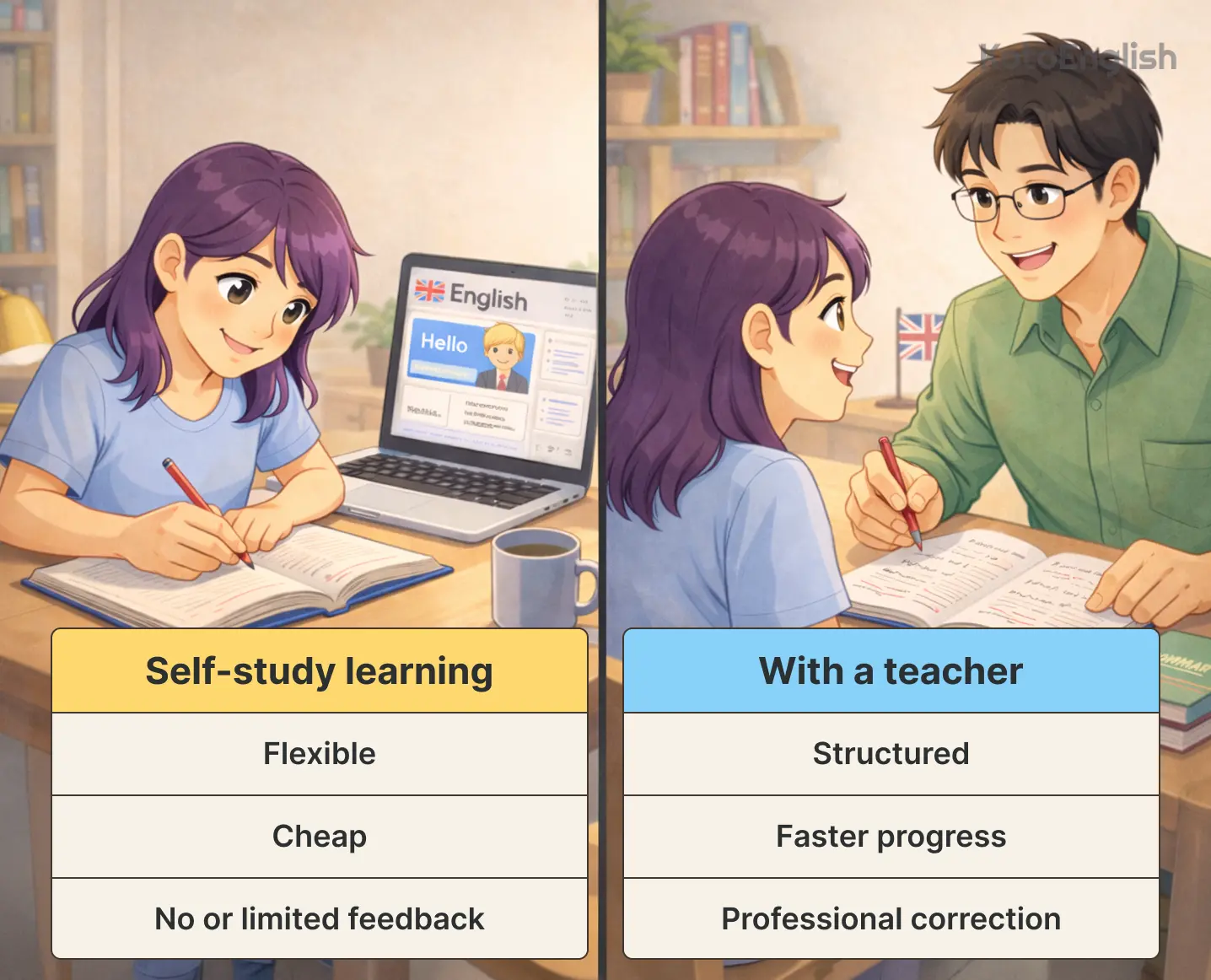
There is also another consideration. When the deadline is more than half a year away and the budget is tight, studying on your own can be effective when using proper resources. In case you need to make a rapid change, guidance can help you improve your English quickly.
Online courses vs. apps
The design of learning applications centers on providing users with repetitive learning activities that they can access at any time. Through brief interactive activities the program enables users to learn new words while they develop their ability to use sentence structures.
The content of online courses delivers more extensive information about various subjects than students can learn through their time limit. The value of the material increases at advanced levels because students have the opportunity to read extended texts, listen to podcasts, study organized lessons, and complete detailed writing assignments.
The following section displays a direct comparison between the educational effectiveness of applications and courses across essential learning domains.
| Aspect | Apps | Courses |
|---|---|---|
|
Vocabulary |
High-frequency repetition and spaced review |
Vocabulary integrated into lessons |
|
Grammar |
Interactive drills and pattern recognition |
Structured explanations and progression |
|
Speaking |
AI practice or guided prompts |
Live or instructor-led practice |
|
Listening |
Short, focused clips |
Longer contextual audio |
|
Reading |
Bite-sized texts |
Full-length structured materials |
|
Writing |
Guided micro-writing |
Paragraph and essay tasks |
If you only study once a week, progress feels slow. Short daily sessions through apps keep English active in your mind between lessons and help you learn English at home fast. Many advanced learners use a combination of both approaches: daily reinforcement through modular apps, weekly expansion through courses.
Immersion method explained
Immersion also helps you sound more natural. When you hear English every day, sentences start to feel familiar faster. You stop translating word by word.
Effective at-home immersion includes:
- Switching device language to English
- Reading news and articles daily
- Watching popular movies in English
- Writing notes and reminders


Over time, immersion helps you pick up tone and timing — when to pause, when to react, and how conversations naturally flow. This works best with dialogue-heavy content: interviews, sitcoms or audiobooks where you can hear how people actually respond in everyday situations.
Common mistakes that slow down your progress
Some of the learning habits might look good on the surface but actually slow down your progress without you even noticing. You might be busy, organized and serious about English, but somehow you don’t improve your speaking skills.
Mistakes follow predictable patterns. If you can catch them early on, you can change direction quickly instead of wasting months on ineffective study.
Here are the most common pitfalls that all students, whatever their level, might fall into:
Overfocusing on grammar
Grammar is important, but when it becomes the center of your study, communication slows down. Language is a skill, not a theoretical subject. Understanding rules does not automatically create English fluency.
| Spend most study time reading grammar explanations | Limit grammar study to short, focused sessions |
| Memorize rules without practice | Use new structures in pronunciation practice the same week |
| Focus on accuracy only | Balance accuracy with fluency |
Set a clear boundary. Spend no more than 10–15% of your weekly study time on pure grammar explanation. The rest should involve listening, speaking and active use.
Inconsistent practice
If you skip a week, the first two sessions back are usually just reviews. That’s time you could have spent moving forward.
| Study intensively once or twice a week | Study 30–60 minutes daily |
| Learn new material without review | Include structured weekly revision |
| Rely on motivation | Follow a fixed schedule |
Create a minimum standard for yourself. Even on busy days, complete a short 20–30 minute session. Intensity can change, but rhythm should not.
Fear of speaking
Fear slows progress because it reduces production. You may understand long texts but an inner block doesn’t allow you to speak English confidently. When this part is avoided, fluency cannot develop naturally.
| Avoid speaking to prevent mistakes | Accept mistakes as part of learning |
| Practice silently only | Include regular live speaking sessions |
| Compare yourself to advanced speakers | Track your own improvement weekly |
Even two short conversations per week create noticeable improvement within one month. Speaking builds confidence through repetition, not preparation alone.
When these patterns change, improvement becomes easier to notice from week to week.
How long does it take to learn English?
Knowing realistic time scales can save you frustration. The question you need to ask is: “How many hours to learn English are required to move between different levels of fluency?” Learning a language happens in stages. Each phase develops a set of abilities, and there are clear measures for tracking them.
30-day expectations
Thirty days will not make you fluent, but it is enough to build a functional conversational base. However, with one hour of study per day, you’ll be able to complete 25 to 30 hours of learning per month.
You’ll be able to learn around 200 to 300 words during this time. These are not words you simply recognize, but phrases you can recall and use in short sentences with some control.
Within this period, learners typically:
- Understand slow, clear speech on familiar topics
- Introduce themselves and describe routines
- Ask and answer basic everyday questions
- Write short 5–8 sentence paragraphs


Listening skills improve first with controlled materials. You begin catching more complete sentences instead of isolated words. Even if you don’t understand everything, the overall meaning becomes clearer.
3-month progress
Many learners think about whether they can learn English in 3 months. With one hour of focused daily practice, it is possible to achieve a good level in A2. You will be able to link ideas into sentences, and use words like because, but, so more fluently.
Your active vocabulary may increase to as many as 500 to 1,000 words that are useful for everyday situations.
Within three months, learners often:
- Maintain 5–10 minute conversations on familiar topics
- Express opinions with simple reasoning
- Write 150–250 word texts with manageable errors
- Follow moderately paced speech on known subjects
- Self-correct basic grammar mistakes
By this stage, everyday interactions require less mental effort. Ordering food, describing your weekend, or answering simple questions feels more natural than it did at the beginning. However, advanced discussion, abstract ideas, and professional nuances remain unstable.
Realistic timeline by level
One of the most common questions you may ask is how long it takes to learn English to a particular level. Below, you will find a breakdown of each CEFR level with cumulative time needed to reach it.
On average, learners need between 90 and 1,200 cumulative study hours to move from A1 to C2 level.
| Level | Cumulative hours | Months at 1h/day | What you can do |
|---|---|---|---|
|
A1 |
90–100 |
3–4 |
Use basic phrases and ask simple questions. |
|
A2 |
180–200 |
6–7 |
Handle everyday situations, talk about routine tasks. |
|
B1 |
350–400 |
12–14 |
Hold conversations, describe experiences, express opinions simply. |
|
B2 |
500–600 |
17–20 |
Communicate confidently, understand complex texts. |
|
C1 |
700–800 |
24–27 |
Speak fluently, use advanced vocabulary. |
|
C2 |
1,000–1,200 |
34–40 |
Communicate like a near-native, understand nuance and subtle meaning. |
The timeline above reflects average cumulative study hours under consistent practice.
Every level of English opens up new possibilities. With A2, you can travel abroad with confidence and deal with everyday problems by yourself. With B1 and B2, you can make international friends and get better job opportunities. With advanced levels, you can get access to global education, leadership, and development.
Conclusion
Learning English fast — especially for beginners — is not about intensity. It’s about eliminating inefficiency. When your daily routine combines structured speaking, repeated vocabulary practice, active listening, and correction, progress compounds. Within 90 days, you may not be perfect — but you will be noticeably faster, clearer, and more confident in real-life communication.
As soon as you build the English learning plan with a realistic timeline you can follow without pressuring yourself, you won’t be asking such questions because you’ll see it’s already working.
Frequently asked questions
Yes — you can build basic conversational English in 3 months with daily practice. However, if your goal is a job interview or fluent communication, you’ll need more time and structured speaking feedback.
The fastest way to learn English is to reuse what you learn multiple times. Instead of constantly adding new words, practice building new sentences from the same vocabulary in different situations. Depth creates faster progress than constant expansion.
30–60 minutes a day is enough for steady progress. Studying three hours daily often leads to fatigue and lower retention.